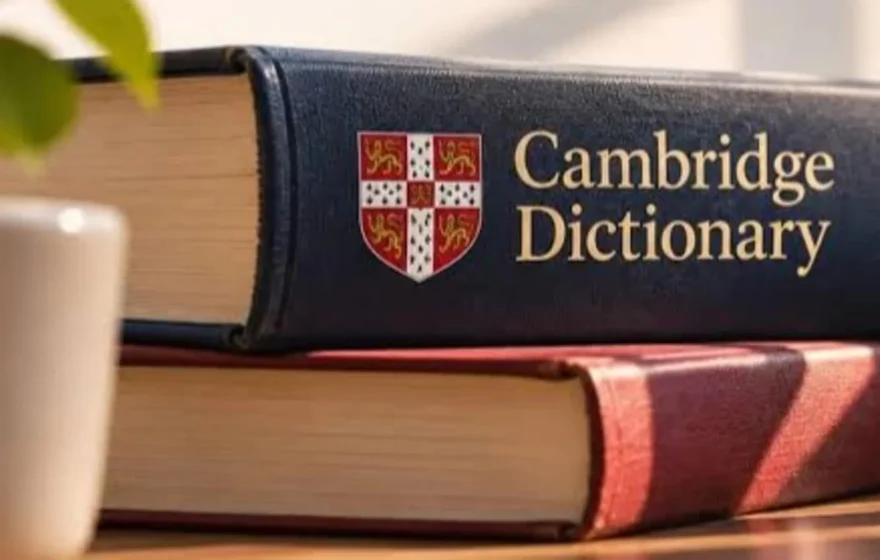
In a year when machines have learned to write, paint, compose and converse with unsettling fluency, the word that best captures the mood of the moment turns out to be the simplest one of all. Cambridge Dictionary has named “human” its Word of the Year for 2026, a choice that says less about language than about the questions people are asking themselves as artificial intelligence moves deeper into everyday life. The dictionary defines “human” as having the qualities, faults and feelings associated with people, rather than gods, animals or machines.
Francesca Woodward, a board member of Cambridge University Press, said the word captured the spirit of 2026 as people increasingly question what it means to be human amid rapid advances in artificial intelligence and growing concern about machines replacing workers. Her observation reflects a conversation that has moved far beyond technology circles, into offices where staff wonder whether their jobs will survive the next wave of automation, and classrooms where teachers try to tell whether an essay was written by a student or a chatbot.
The dictionary’s researchers noticed something telling in the way people have been using language this year. Terms such as “human-made” and “human author” have become noticeably more common, as writers, artists and creators look for ways to mark their work as the product of a person rather than a machine. The label that once would have seemed unnecessary has become a guarantee of authenticity in a world flooded with content that no human hand has touched.
Tom McClelland, a philosopher of science at the University of Cambridge, said the choice reflected changing ideas about humanity as people try to understand the differences between human and artificial intelligence, particularly in areas such as consciousness, creativity and compassion. A chatbot can produce a poem that rhymes and scans, but whether it understands what the poem means, or feels anything in writing it, is a question philosophers have debated for centuries and technology has now made urgent.
The word “human” was selected from a shortlist that also included “agent”, referring to artificial intelligence systems capable of operating with limited human control, and “wholesome”, describing something that benefits a person’s physical, moral or emotional well-being. Another contender was “dusking”, the practice of watching daylight fade as a form of relaxation, a gentle, unhurried pastime that feels like a quiet rebellion against the pace of modern life. Each of the shortlisted words tells its own story about the year, but “human” was the one that gathered them all together.
The dictionary also highlighted new additions to its pages this year, including “aura farming”, the term for actions intended to build an admirable public image, and “looksmaxing”, the practice of improving one’s physical appearance. Both words belong to the slang of a generation that lives much of its life online, and both show how quickly language adapts to new habits and new pressures.
Cambridge Dictionary selects its Word of the Year based partly on search activity on its website, alongside the judgement of its editors about which word best captures the mood of the year. The tradition began in 2015, when the first winner was “austerity”, and the list since then reads like a diary of the past decade. In 2020 the word was “quarantine”, chosen as the pandemic reshaped daily life. In 2021 it was “perseverance”. In 2023 the choice was “hallucinate”, used to describe the confident falsehoods that chatbots produce when they invent facts. Last year it was “parasocial”, describing the one-sided connection people feel with a celebrity, a fictional character or an artificial intelligence companion they have never met.
The pattern across those recent years is hard to miss. For three years running, the dictionary’s choice has been shaped by artificial intelligence, first by what the technology gets wrong, then by the relationships people form with it, and now by the question of what it leaves for us. In 2024 the winner was “manifest”, a word that belonged to the world of self-help and social media rather than technology, but the return to artificial intelligence in the years around it shows how completely the subject has come to dominate the way we talk about the future.
Cambridge is not the only dictionary making this kind of choice. Collins Dictionary has named “mogging”, a slang term popular among younger generations, its Word of the Year for 2026, while Merriam-Webster chose “slop” in 2025 to describe the low-quality digital content, often generated by artificial intelligence, that now fills so much of the internet.
There is something quietly hopeful in the choice of “human”. It suggests that after years of marvelling at what machines can do, people are turning their attention back to what only people can do, and finding value in it. The word does not reject technology or pretend it can be wished away. It simply insists that the qualities, faults and feelings that make us human are worth naming and celebrating, even in a year when machines have never seemed more capable.
