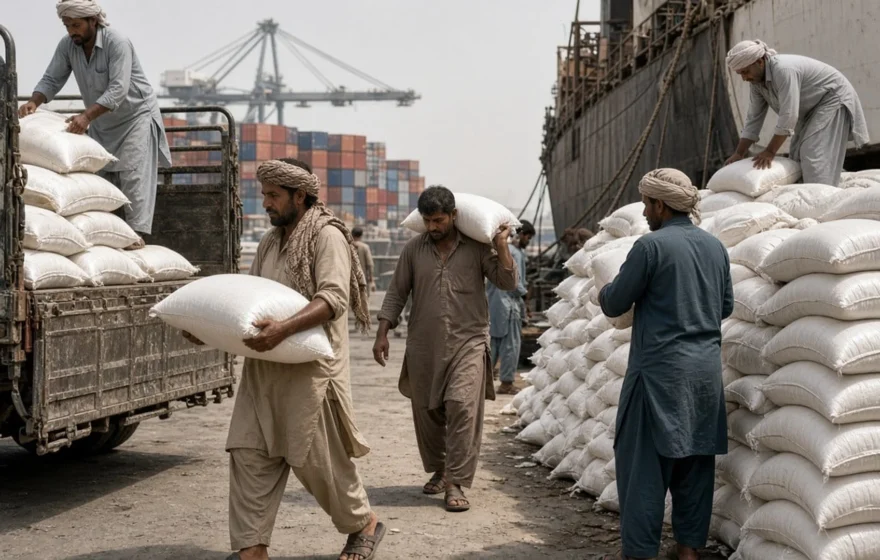
The federal government has quietly cleared another 400,000 tonnes of sugar for export, taking the total approved for shipment abroad this season to 600,000 tonnes. The decision was taken at a meeting of the Economic Coordination Committee of the Cabinet on Friday, chaired by Finance Minister Muhammad Aurangzeb.
What has drawn attention is the silence around it. The Finance Ministry’s statement said only that the committee had considered recommendations from the Cabinet Committee on the Export of Sugar, headed by the deputy prime minister, about protecting farmers through adequate price support. It did not say how much sugar had been cleared. Food Security Minister Rana Tanveer Hussain later confirmed the figure.
The Cabinet Committee had recommended 400,000 tonnes, and the committee added a 16,000-tonne quota for Sindh, bringing the total to 416,000 tonnes. The government had already permitted 200,000 tonnes earlier in the season. It is the third such approval in four months, and with 108,000 tonnes of imported sugar cleared in August, the season’s total reaches 724,000 tonnes.
Third Approval in Four Months
For the industry, the approval removes the biggest obstacle to the new crushing season. The Pakistan Sugar Mills Association says its members hold around 1.1 million tonnes of surplus sugar even after the earlier quota, with some estimates closer to 1.3 million tonnes. With warehouses full and bank loans to service, mill owners say they cannot afford to crush fresh cane and add more sugar to an oversupplied market.
That argument has hardened into a standoff. The government had set November 15 for crushing to begin. When the deadline arrived, only one of Punjab’s 47 sugar mills, Ramzan Sugar Mills, had started. The rest stayed shut despite a Punjab food department order to begin crushing within 24 hours.
The mill owners had already stated their position. At a general body meeting in Lahore, Karachi and Islamabad, the association agreed unanimously not to begin the 2026-27 crushing season before December. It wants the export permission first, and a long-promised policy to deregulate the sugar trade, so mills can set prices and trade without government quotas.
Why the Mills Are Waiting
For farmers, the delay is the most painful part. Sugarcane stands in the fields with no buyer, and every week of delay eats into their income. Punjab has 2.45 million acres under sugarcane this year, about 16 per cent more than last year. In Sindh, crushing has not started either.
The law gives the government a stick to use. Under the Punjab Sugar Factories Control Act of 1950, a mill that fails to start crushing on the notified date can be fined up to five million rupees a day. So far, though, the government has chosen persuasion over penalties.
In July, mills were selling sugar at an ex-mill price below 135 rupees a kilogram, which the association says was below the cost of production. A new season would add fresh sugar to an oversupplied market and push prices lower still.
A Familiar Pattern
None of this is new. Pakistan has been caught in the same cycle for years: under pressure from millers, the government allows exports to clear unsold stocks, and then, as domestic supplies tighten and prices climb, it scrambles to import sugar to stabilise the market.
The last round followed that script exactly. In 2024-25, Pakistan exported around 765,734 tonnes of sugar against a permitted 700,000 tonnes, earning about 411 million dollars. In December 2024, the ex-mill price was around 125 to 130 rupees a kilogram. By June 2025, retail prices had jumped to 200 rupees a kilogram in most parts of the country, and in July the cabinet approved an import plan for 500,000 tonnes.
The Trading Corporation of Pakistan brought in 300,000 tonnes between September and November 2025, and 108,000 tonnes of it sits at its Pipri godown in Karachi. The government is considering selling it at around 110 rupees a kilogram, against a reserve price of 184.8 rupees set in September, a loss of about 75 rupees a kilogram, or roughly 8.1 billion rupees. No final decision has been announced.
What Happens Next
The immediate question is whether the mills will now start crushing. The export approval was the condition they had set, and the government has met it in part. The association had pressed for one million tonnes, so the 416,000 tonnes approved is less than half of what it asked for.
The longer question is about reform. The committee reiterated the importance of deregulating the sugar sector, which the International Monetary Fund has also made a condition of its programme. Until that happens, the same confrontation is likely to return next November.
For now, the food security minister insists there is no shortage of sugar and that the crushing season is about to begin. Consumers, who paid 200 rupees a kilogram for sugar only last year, will be watching the retail price closely. If the mills start crushing on time, the government will be able to say the gamble paid off. If prices rise again, the quiet approval given on Friday will look a great deal louder.
