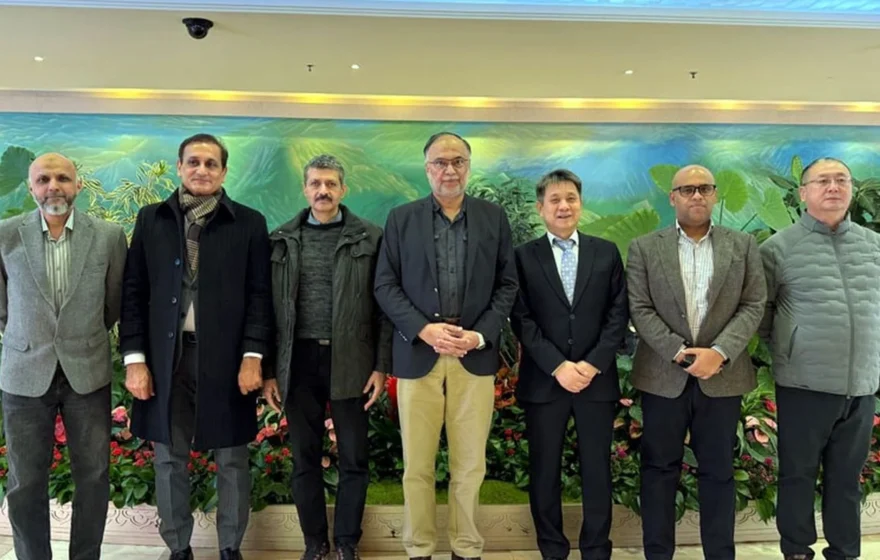
Federal Minister for Planning, Development and Special Initiatives Ahsan Iqbal has arrived in Beijing for the departure ceremony of Pakistan’s first astronaut, a moment the government is presenting as the start of a new chapter in the country’s space story. The astronaut is set to become the first foreign guest aboard China’s Tiangong space station, a milestone that puts Pakistan among the nations whose citizens have lived and worked in orbit.
Iqbal was received at Beijing Airport by Yang Yunli, the vice president of the China Great Wall Industry Corporation, along with officials from the Embassy of Pakistan, according to the Ministry of Planning. The minister is due to travel to the space mission centre on Monday, where he will meet the two Pakistani astronauts who have completed their training. One of the two will be finally selected for the flight. The other will remain as backup, ready to step in if circumstances change before launch.
A Historic Moment for Pakistan
Speaking about the mission, Iqbal said the flight of Pakistan’s first astronaut would be a historic moment for the entire nation and a new symbol of the ironclad brotherhood between Pakistan and China. He framed the journey as the point where Pakistan’s ambitions in space become a reality the whole country can watch unfold.
“This flight represents Pakistan’s journey towards space, carrying the dreams of our youth beyond the Earth,” he said. The words were aimed as much at young people back home as at the officials in Beijing, because the government wants the mission to inspire students who have grown up hearing about space travel as something that happens in other countries.
“Pakistan-China friendship, higher than the Himalayas, will soar even higher than the skies with this historic flight,” the minister added, giving the familiar language of the relationship between the two countries a new and literal meaning.
Background
The China Manned Space Agency announced on November 7 that a Pakistani astronaut would join China’s Shenzhou-24 crewed mission as a payload specialist, making them the first foreign national to visit the Tiangong space station. The astronaut will make a short stay in orbit before returning to Earth aboard the Shenzhou-23 spacecraft. It will also be the first joint spaceflight involving Chinese and foreign astronauts in the history of China’s crewed space programme.
The two Pakistani candidates, Muhammad Zeeshan Ali and Khurram Daud, have spent months training at China’s astronaut training centre in Beijing. They were picked through a three-stage assessment under a cooperation agreement that Pakistan and China signed in Islamabad in February 2025. Both men have now completed the full course of preparation. One will fly on the mission, while the other will serve as backup.
Iqbal had earlier announced that Pakistan’s first astronaut would fly to space on November 25. He has also said Pakistan has set a target of landing on the moon by 2035. Even the mission emblem for Shenzhou-24 carries a Pakistani touch, with the country’s national flower, jasmine, included in its design.
The station the astronaut will visit is itself a recent achievement. Tiangong, which means Heavenly Palace, is China’s first permanently crewed space station and has been in low Earth orbit since 2021. Its core module, Tianhe, was launched in April 2021, and the Wentian and Mengtian laboratory modules followed in 2022, forming a T-shaped complex of three modules. Crews of three normally live aboard for about six months at a time, and the station has been continuously occupied since June 2022.
For Pakistan, the flight is the latest step in a space journey that began more than six decades ago. The country’s space agency, SUPARCO, was set up in 1961, and Pakistan’s first satellite, Badr-1, was launched in 1990 aboard a Chinese rocket. Progress since then has been slow, but the pace has quickened lately. In May 2024, Pakistan’s first lunar mission, the small satellite iCube Qamar, rode into space aboard China’s Chang’e-6 probe and sent back its first images of the Moon from a distance of 200 kilometres, a moment the prime minister at the time called Pakistan’s first step in space.
That history explains why the government is treating this mission as more than a symbolic gesture. A Pakistani astronaut working aboard Tiangong will gain hands-on experience of living and conducting experiments in orbit. The payload specialist role means the astronaut will carry out scientific work during the short stay, and the lessons learned are expected to feed directly into Pakistan’s own plans for satellites, research and, eventually, its own crewed ambitions.
What happens next will unfold quickly. Once the final selection is made at the mission centre, the chosen astronaut will go through the last preparations before the flight. The departure ceremony that Iqbal has travelled to attend will mark the formal start of that final phase, and the whole country will be watching when the rocket lifts off. If the mission goes as planned, Pakistan will join the small group of nations that have sent a citizen into space, and the flight will stand as the most visible result yet of a partnership that has now reached the edge of the atmosphere.
