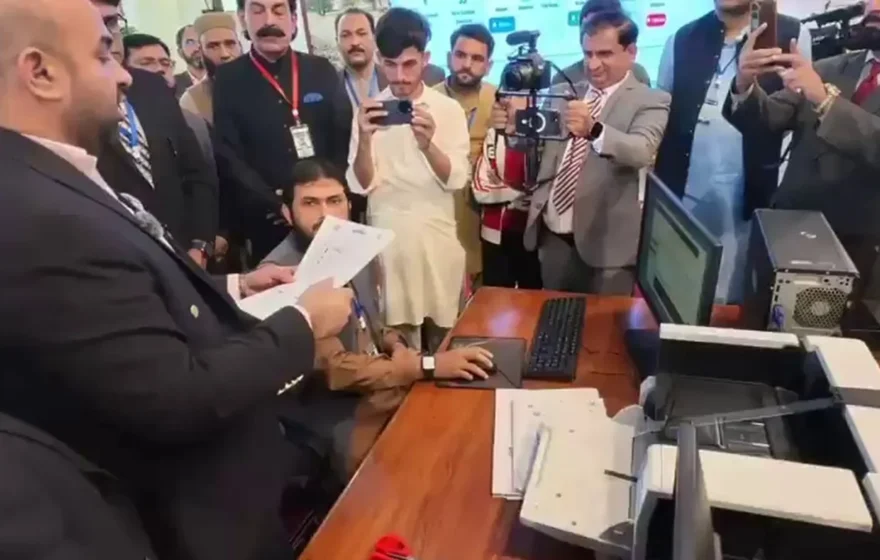
Punjab is about to change the way millions of board examination papers are checked. The province will scan students’ answer sheets and mark them on computer screens, with examiners required to prove their identity through facial recognition before they can open a single paper. Provincial Education Minister Rana Sikandar Hayat announced the move, sharing a video of the new system in action.
Under the new On-Screen Marking system, known as OSM, a student’s handwritten answers will no longer travel in bundles of paper from one marking centre to another. Each answer sheet will be fed through a high-speed scanner, turned into a digital copy, and sent to an authorised examiner through a secure online platform. The examiner will read the scanned pages on a screen and enter marks directly into the system.
The change matters because board examinations in Punjab are enormous. Nine separate boards conduct matric and intermediate examinations across the province, handling answer sheets in the millions every year. For decades those sheets have been checked by hand at marking centres, a process students and parents have often called slow and uneven. The provincial government now believes that putting the process on screen will cut errors, make marking more consistent, and give students greater confidence in their results.
How the System Works
The demonstration shared by the minister showed the system of the Board of Intermediate and Secondary Education in Bahawalpur. Answer sheets were fed into a high-speed scanner, and the scanned pages appeared on a real-time dashboard, from where an examiner could begin marking them on screen.
Before any marking can begin, the examiner must pass a facial recognition check. The system compares the face in front of the camera with the record of the examiner assigned to those papers, and it allows access only when a single matching face is found. If two faces appear in front of the camera at the same time, the system locks itself. The safeguard makes sure the person given a set of papers is the one who marks them, and stops anyone passing on a login for someone else to do the work.
The dashboard also follows marking progress as it happens, showing how many papers have been checked and how many are still waiting. An AI-assisted checking feature adds a second layer of review alongside the examiner’s own marking. Students will notice very little change in the examination hall: they will still write their answers on paper, just as they do today. The difference comes after the papers leave the hall, when the sheets are scanned and the rest of the process takes place on screen.
Part of Wider Exam Reforms
The on-screen marking system is the latest step in a wider overhaul of examinations that Punjab’s boards have been preparing for months. Earlier this month, the chairpersons of all nine boards met in Lahore and decided that examinations for four science subjects would be conducted on e-sheets next year. At the same meeting, they finalised the subjects in which on-screen marking would be introduced for matric and intermediate examinations.
The groundwork had already begun before that meeting. In early October, the Lahore board issued a notification announcing its move towards on-screen marking, naming four intermediate subjects for the first phase: Chemistry, Biology, Computer Science and Statistics. Training workshops for examiners, principals and students ran through the second half of October, and the Rawalpindi board confirmed its own rollout later that month.
Other reforms have been moving in the same direction. The Lahore board has made biometric thumb impressions mandatory for Class IX and XI candidates during registration. It has also introduced central marking for ninth-class practical examinations, after complaints about mismanagement in practical assessments. Under the new arrangements, marking is to be broken into smaller batches of questions rather than handing hundreds of complete answer books to a single examiner, with set time limits so that delays can be spotted quickly.
For students and their families, the promise of the new system is straightforward: results that are fairer, more accurate, and delivered faster. An electronic record of every paper will show when it was received, who marked it, and how long the marking took, making it far harder for papers to go missing or marks to be entered wrongly.
Yet the real test will come when the system is used at full scale. Scanning millions of answer sheets without error, keeping the platform running through the busiest weeks of the marking season, and making sure examiners in every district are trained and equipped will demand careful preparation. The Lahore board has said the system will be introduced gradually, starting with a small number of subjects and expanding to more over the next two to three years. The handwritten answer sheet will remain, but almost everything that happens to it afterwards will be digital: scanned, tracked, checked on screen, and recorded in a system that knows exactly who marked it and when. For a province where board results shape university admissions and careers, that is a change worth watching closely.
