Every November, the same grey blanket settles over Punjab’s cities. Visibility drops and people ask the same question: is this just winter fog, or something far more dangerous? Fog and smog may look alike from a window, but they are not the same thing. Punjab’s government says it has spent the past two years treating smog as a year-round problem, and the early numbers suggest the approach may be starting to work.
Fog Is Not Smog
Fog forms when water vapour cools and condenses into tiny droplets close to the ground. Smog is different: air loaded with harmful gases and fine particles, above all PM2.5, the microscopic soot that can pass deep into the lungs. In winter, cold air near the ground gets trapped beneath a warmer layer above, and with weak winds the pollution cannot rise and disperse. When ordinary fog forms in air that is already dirty, the two mix into the dense grey haze Punjab knows as smog. Visibility alone is therefore a poor guide to safety: a thick fog can be mostly water vapour, while a clear-looking day can still carry pollution far above safe levels. The proper measure is the Air Quality Index, which tracks pollutant levels and the health risk they carry.
A Reminder of How Bad It Can Get
Punjab does not have to imagine the worst case. In November 2024, Lahore’s air quality index passed 1,000, several times the level of 300 that counts as hazardous, and one monitoring point in Multan recorded an index of 2,553, with PM2.5 nearly 190 times the World Health Organization’s guideline. Schools and colleges were shut across the province, a health emergency was declared in Lahore and Multan, and around 1.8 million people were estimated to have suffered breathing problems or eye irritation.
Why Winter Action Alone Is Not Enough
Winter makes the problem visible, but it does not create it. Vehicle exhaust, factory smoke, brick kiln emissions, dust from building sites, crop-residue burning and the open burning of household waste all pollute the air through the year; cold weather only traps what is already there. Punjab’s response has therefore been built around tackling those sources in every season.
Cleaner Buses and Tighter Checks
Transport is where the change is most visible. The province says it has put 1,100 electric buses on the road across 28 districts, with plans to add 1,900 more. About 1.2 million vehicle emission tests have also been carried out to find the vehicles pumping out far more smoke than they should.
Factories, Kilns and the Fields
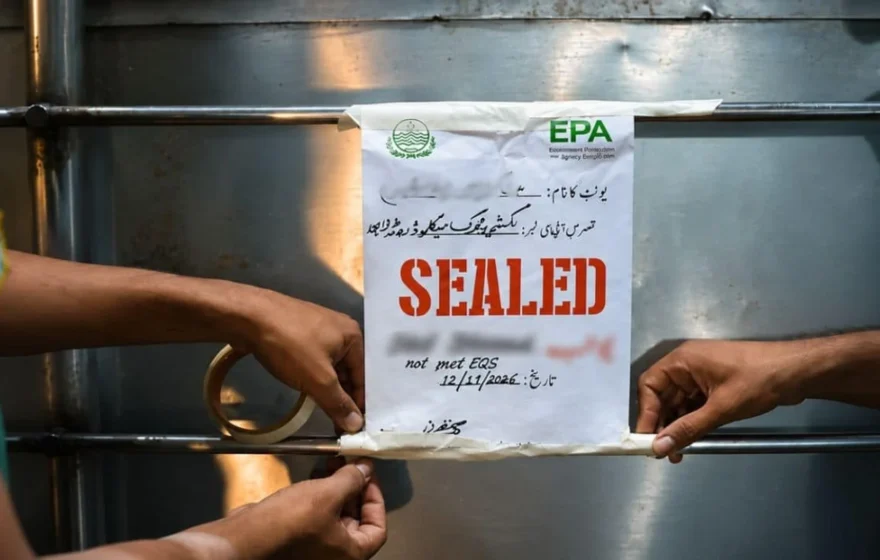
Industry has been pushed the same way. More than 14,000 emission-control systems have been fitted, covering over 96 per cent of the industrial units targeted, and all 8,000 brick kilns in the provincial initiative have been converted to zigzag technology, which burns fuel more completely and cuts the thick black smoke of older kilns. In the fields, Punjab has handed out more than 10,045 super seeders, machines that let farmers sow directly into leftover straw instead of setting fire to it, with a 60 per cent subsidy. The province reports a 65 per cent fall in crop-fire incidents in 2025, and 67 Quick Response Units with 750 officers now aim to reach reported field fires within 10 to 15 minutes.
Watching the Air
None of this works without knowing what is in the air. Punjab has built 80 monitoring stations and aims to reach 103 by the end of 2026, with artificial intelligence tools to help officials spot violations faster. Monitoring does not clean the air by itself, but without it every other measure is guesswork.
What the Latest Figures Suggest
The early signs point in the right direction. October 2026 was Lahore’s cleanest October in five years. Patients across five smog-related disease categories fell by 43 per cent in January to October 2026 compared with the same months of 2025, and respiratory illness outpatients dropped from about 22.87 million in the same months of 2023 to 7 million in 2026. The province cautions that no single measure can claim the credit. One good season does not make a trend.
What Other Countries Learned
Punjab is not the first place to face this test. China declared a war on pollution in 2013, and Beijing’s PM2.5 levels have since fallen by roughly two-thirds, with good-air days in the capital rising from just 13 in 2013 to more than 300 a decade later. Britain learned the same lesson earlier and at a terrible price: the Great Smog that choked London for five days in December 1952 is thought to have killed around 12,000 people, and it led directly to the Clean Air Act of 1956.
A Ten-Year Plan, and a Part for Everyone
Punjab’s ten-year Smog Mitigation Plan follows that pattern, combining stronger regulation, cleaner transport, tighter industrial controls, better farming and wider monitoring into a single long-term effort. Two years in, the province says several indicators are moving the right way, but the test now is keeping the measures in place. The government also stresses that officials cannot do it alone: not burning household waste in the open, keeping vehicles maintained and farming more cleanly all help, and violations can be reported through the Green Punjab App or the helpline on 1373. In the end, the aim is not a clearer view in winter. It is air that is safe to breathe all year round.
