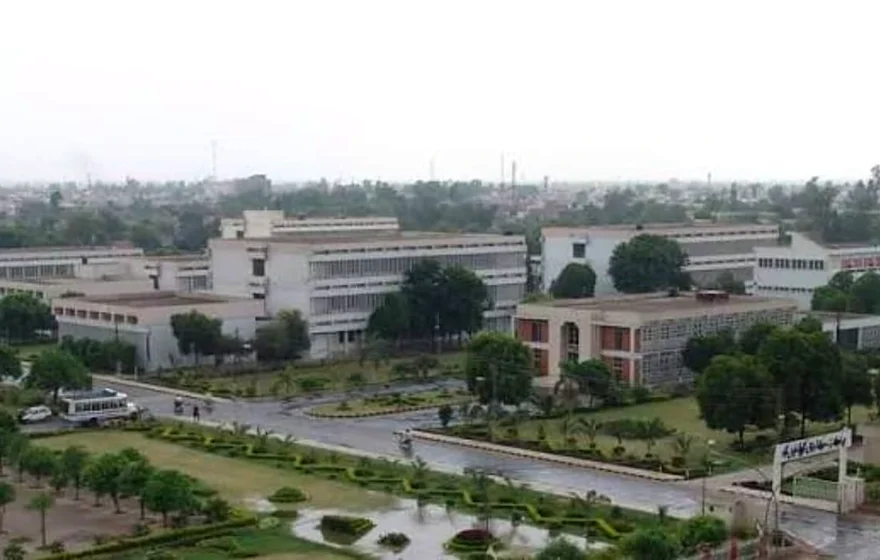
Professionals and alumni associations have opposed the government’s decision to rename Punjab Medical College as Faisalabad Medical College, urging authorities to retain the institution’s historic identity as a constituent college of Faisalabad Medical University. In a joint letter addressed to the Punjab governor, the university’s vice chancellor and the principal of Faisalabad Medical College, the Punjab Medical College Alumni Association in North America and Punjab Medical College Alumni UK called for the reinstatement of the original name, arguing that a name built over decades should not be set aside lightly.
The letter, signed by the North American association’s president Dr Saadia Alvi and the UK association’s president Dr Shahnaz Akhtar, refers to the Public Sector Medical Universities (Second Amendment) Ordinance 2026. It states that Section 5(a) inserts a new sub-section into Section 3 of the Faisalabad Medical University Act 2017, reviving the college as a constituent institution but naming it Faisalabad Medical College. The alumni associations accept the revival of the college within the university structure, but they object to the new name, and they have asked the authorities to restore the name under which the institution has been known for most of its life.
The alumni argued that the institution, established in 1973, had built a strong reputation in Pakistan and abroad under the name Punjab Medical College, and they said the name represented its history, professional identity and legacy. That argument goes beyond sentiment. For an educational institution, a name carries the weight of its graduates’ achievements, its standing among peer institutions, and the recognition it has earned from employers and regulators over time.
Dr Amir Sarfraz, a member of the UK alumni association, said thousands of graduates were practising in the UK, the United States, the Middle East and other countries, which gives the dispute an international dimension. Their qualifications were registered with professional and academic bodies, including the General Medical Council and the Educational Commission for Foreign Medical Graduates, under the name Punjab Medical College. Those registrations underpin a doctor’s right to practise and seek employment, and any mismatch between a qualification document and a current institutional name can invite questions.
He warned that changing the name could create confusion and complications in the verification of qualifications, professional registration and credentialing. Even if the authorities intend the change to be straightforward, verification systems often rely on exact matches between names on documents and names in registers, and discrepancies can trigger additional checks, delays or requests for explanatory letters. For a doctor applying for a post, a licence or a training position abroad, a delay caused by a name mismatch is not a minor inconvenience; it can affect a career decision, a start date or a visa process. The alumni associations are therefore asking, in effect, for the administrative burden to be avoided rather than managed after the event.
He added that retaining the college’s original name would not affect the vice chancellor’s administrative authority or the university’s governance, a point that seeks to remove the most obvious objection to the alumni request. If the college can function as a constituent institution of Faisalabad Medical University while keeping its historic name, then the dispute is not about who runs the institution or how it is governed, but about identity alone. That framing is deliberate, because it presents the alumni demand as compatible with the government’s restructuring, rather than as opposition to the university itself.
The episode also raises a wider question about how institutions handle renaming. Names are sometimes changed to reflect a new location, a new structure or a benefactor, and there can be good reasons for doing so. But when an institution has graduates spread across the world, a renaming decision has consequences far beyond a signboard or a letterhead, reaching into databases, registers and personal records that are difficult to update retrospectively. Consultation with alumni and professional bodies before a change, and clear transitional arrangements when a change is made, can prevent much of the difficulty that follows. In this case, the alumni associations say they want the original name restored, which suggests they feel that consultation and clarity were lacking.
What happens next will depend on how the Punjab government, the governor’s office and the university leadership respond to the joint letter. The authorities could reinstate the name Punjab Medical College while keeping the college within the university, which would satisfy the alumni associations and remove the verification concerns they have raised. They could also keep the new name and issue formal clarification for credentialing bodies, though that would leave graduates to manage the transition themselves. Or the matter could remain unresolved, with the two names existing in parallel in different records, which would be the worst outcome for everyone. For the thousands of graduates whose careers are tied to the institution’s name, and for the students who will follow them, a clear decision that protects the continuity of their qualifications matters far more than the name on any single document, and it is that continuity the alumni associations are asking the authorities to preserve.
