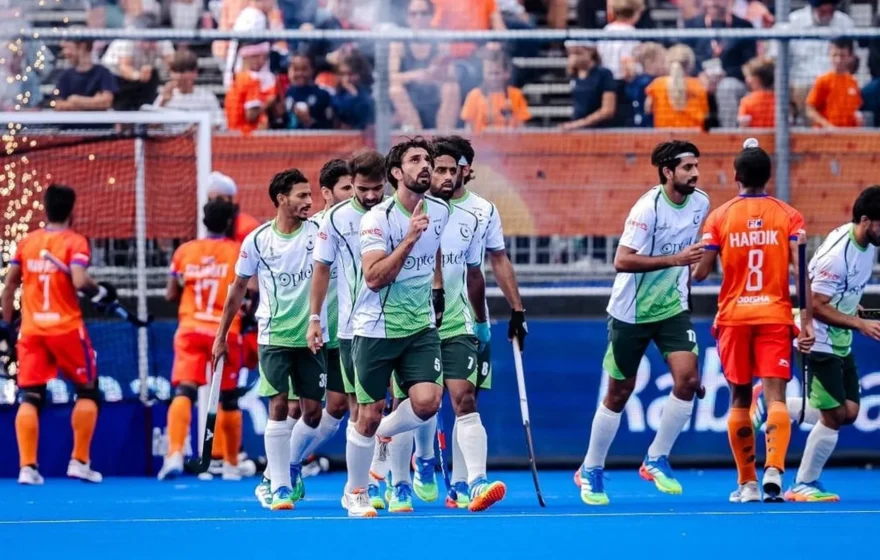
International Hockey Federation president Tayyab Ikram has said that no fixture in world hockey draws more viewers than a match between Pakistan and India, and that the famous rivalry remains central to the sport’s future around the globe. Speaking to reporters in Lahore, Ikram said the contest between the two neighbours mattered far beyond the result on the day, because it brought new eyes to a game that is fighting hard to grow its audience in an increasingly crowded sporting world.
“Pakistan-India matches are extremely important for global hockey. Their viewership surpasses that of all other hockey matches,” he said. For the world governing body, the fixture is not simply a nostalgic throwback to an older era. It is one of the few hockey occasions capable of cutting through to a mainstream audience, and its absence from the calendar is felt well beyond South Asia.
Ikram was careful, however, to draw a line between what hockey’s administrators can do and what sits in the hands of governments. Decisions about bilateral series between Pakistan and India, he said, rest with the governments of the two countries rather than with their hockey federations, and the FIH has no power to force the issue. His hope was that relations would improve to a point where hockey could once again serve as a bridge, bringing people together in the way sport so often does when politics allows it room to breathe.
That hope is set against a long history. Pakistan and India were once the undisputed giants of world hockey, sharing Olympic gold medals and World Cup titles between them. Pakistan won the World Cup a record four times and claimed three Olympic gold medals, while India collected eight Olympic titles of their own. In recent decades the balance of power has shifted towards European and Australian teams, and Pakistan’s struggles have run deeper than most. The Green Shirts have not qualified for the Olympic Games since London 2012.
Ikram also addressed Pakistan’s absence from the Asian Hockey Champions Trophy in India, a tournament the team were expected to contest but ultimately skipped. He revealed that the FIH had been in discussion with Pakistan about the event seven months before it began, and that the world body had hoped the team would take part. When the Pakistan Hockey Federation decided to withdraw, he said, the FIH respected that choice, describing it as a matter of national dignity rather than a sporting decision to be second-guessed from outside.
The other news Ikram brought pointed in a much brighter direction. He confirmed once again that Pakistan have been awarded the hosting rights for the FIH Hockey Men’s Nations Cup, which will bring ten international teams to Lahore from February 19 to 28 next year. “I once again confirm that the FIH Nations Cup has been awarded to Pakistan. Hosting this event will mark the beginning of a new era for hockey in the country,” he said, repeating an announcement the FIH had formally made only days earlier.
The tournament, the fifth edition of the Nations Cup, will be the largest yet. For the first time it will feature ten teams rather than eight, with hosts Pakistan joined by Egypt, Ireland, Japan, Malaysia, New Zealand, Scotland, South Africa, South Korea and the United States. The winning team will earn promotion to the 2027-28 season of the FIH Hockey Pro League, the sport’s top-tier annual competition. Pakistan know that route well. They finished as runners-up in the 2024-25 edition and then spent the 2025-26 season in the Pro League, gaining regular exposure to elite opposition.
For Pakistan, hosting the tournament is about far more than one competition. It is the return of a major international hockey event to a country that once staged the sport’s biggest occasions as a matter of routine, and a vote of confidence from the world body in Pakistan’s ability to host elite sport. The FIH has also approved the Naseer Bunda Hockey Stadium in Islamabad as an official High Performance Centre, while the federal government has pledged its full support to the Pakistan Hockey Federation and asked it to prepare a comprehensive plan for the revival of the game.
Ikram used his visit to make a broader point about how Pakistan should measure that revival. For the past thirty to forty years, he noted, almost every conversation about hockey in the country has revolved around the national team, with victories treated as proof the sport is healthy and defeats as evidence it is dying. That is too narrow a way to judge progress, he suggested. Bringing international tournaments to Pakistan and developing facilities matters just as much as any single result.
Whether the Nations Cup delivers the new era Ikram spoke of will only become clear when the tournament arrives in Lahore next February. But for a sport that has waited years for a turning point, a home tournament, a new high performance centre and the backing of the world governing body is the most encouraging combination Pakistan hockey has enjoyed in a long time.
