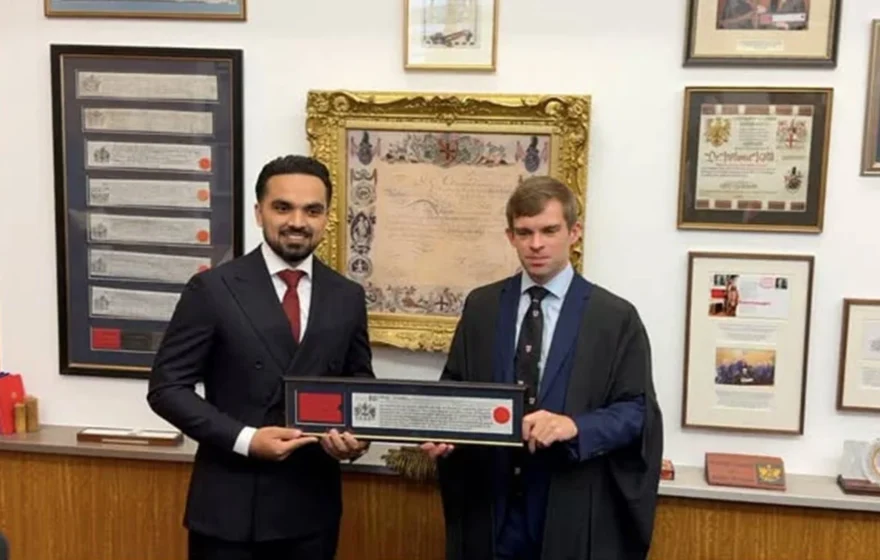
British-Pakistani businessman Nasir Younas has received the Freedom of the City of London, one of the British capital’s oldest civic honours, in a ceremony at the Chamberlain’s Court at Guildhall. The award recognises his services to business, the hospitality industry and philanthropy in the United Kingdom, and it marks the latest chapter in a journey that began when he arrived in London from Lahore as a teenager with £200 in his pocket, very little English and nobody to show him the way.
Watched by family, friends and leaders from business and public life, Younas read the Declaration of a Freeman, signed the Register of Freemen and was formally greeted as a Citizen of London. He dedicated the honour to his wife, children, parents and team.
Speaking at Guildhall, Younas reflected on the distance he had travelled. He said he had landed in London with £200 his father had borrowed, very little English and nobody to show him the way, and that to stand in Guildhall and be greeted as a Citizen of London was the proudest moment of his working life. London, he said, deserved much of the credit. The city had educated him and built him. It taught him English at a McDonald’s counter, management in a pizza kitchen and business on its streets.
Younas grew up in Ghoray Shah, near Lahore, as the eldest son of a shopkeeper. From the age of 14 he helped with his father’s grocery business, opening the shop at six in the morning every Sunday while his friends played cricket. It was an early education in hard work that carried him through his first difficult years in Britain. The money for his journey had been borrowed by his father, a sacrifice he has never forgotten.
His first job in London was in the basement of a restaurant on Oxford Street, where he spent eleven hours a day boiling rice, from eleven in the morning until ten at night, for £40 a day. He went on delivering pizzas by motorbike across south-west London, facing regular robberies and assaults, yet he stayed with the trade and learned it from the inside. For fifteen years he worked in the pizza industry, until he knew the business well enough to run his own.
The turning point came in 2018, when he decided to work for himself. Having promised himself that he was finished with kitchens, he bought a Turkish restaurant in Ilford and transformed it into a Pakistani restaurant, laying the foundations for the Haweli brand. Haweli, founded in 2021, has since grown into one of London’s fastest-growing Pakistani restaurant chains, with branches in Ilford, Norbury and Southall. Today Younas chairs NY Group, which brings together the Haweli Restaurant Group, NY Properties and the NY Foundation.
The Freedom of the City of London is not his first recognition. In 2024 he received the Avicenna Medal at the House of Lords, presented by Prince Philipp of Liechtenstein, and recently addressed a symposium at the University of Cambridge. Yet the Freedom carries a particular weight, connecting its recipients to nearly eight centuries of London’s history.
The Freedom is believed to have begun in 1237, when it marked the status of a free man, protected by the City’s charter and not under the jurisdiction of a feudal lord. In the Middle Ages it became a right to trade, closely linked to the medieval guilds known as the livery companies, and in 1835 eligibility was extended to anyone who lived in, worked in or had a strong connection to the City. Today it is largely a symbolic honour, awarded for outstanding contribution to London or public life.
The ceremony follows a fixed and ancient pattern. Freemen are admitted by the Clerk of the Chamberlain’s Court at Guildhall, where they read the Declaration of a Freeman, swearing allegiance to the King and obedience to the Lord Mayor, and sign the Freeman’s Declaration Book, a sheepskin register. They are then presented with the Copy of the Freedom, a parchment document, along with the Rules for the Conduct of Life, which date from the middle of the eighteenth century, before the clerk extends the right hand of fellowship and greets them as a Citizen of London.
Younas now joins a list of recipients that includes Queen Elizabeth II and Diana, Princess of Wales, the prime ministers Winston Churchill and Margaret Thatcher, world leaders including Jawaharlal Nehru and Nelson Mandela, and figures from science, business and the arts such as Professor Stephen Hawking, Jimmy Choo, Morgan Freeman and J. K. Rowling. Recent recipients include England captain Harry Kane and the UK’s Chief Medical Officer, Professor Sir Chris Whitty.
For the British-Pakistani community, the honour means more than the ceremony itself. Younas’s story, from a borrowed £200 and a basement kitchen to the Guildhall, is a reminder of how much of modern Britain has been built by people who arrived with almost nothing and worked their way up through long hours and small businesses. His philanthropy through the NY Foundation, and the jobs created by the Haweli chain, are part of the same story.
