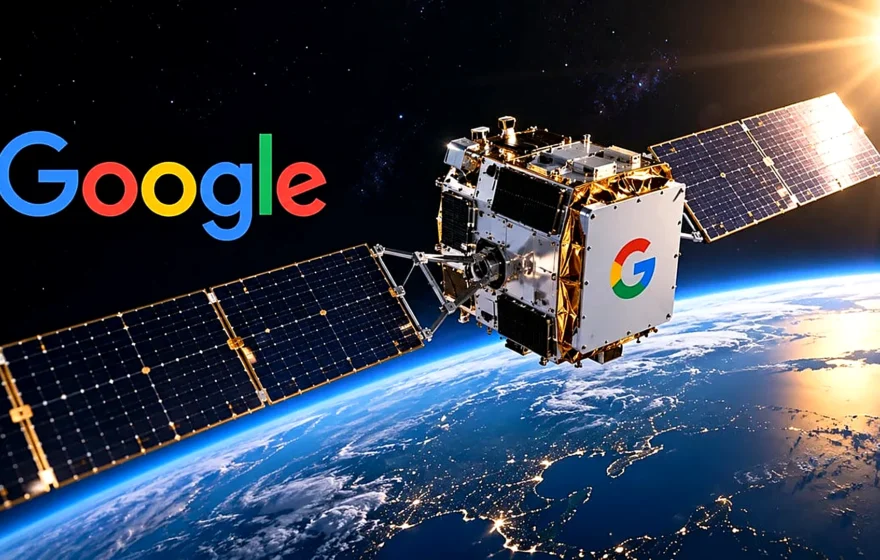
Google has reached a striking first in its effort to take artificial intelligence beyond Earth. An AI model running aboard a satellite in orbit has answered a question sent from the ground and returned its reply to Earth, in an important early step towards computing systems that could one day work in space.
The test belongs to Project Suncatcher, Google’s research programme into whether machine learning could be carried out by satellites. The company confirmed the result on 30 October, after weeks of checks following the launch of its experimental spacecraft. That satellite left Earth on 1 October aboard a SpaceX Falcon 9 rocket, as part of a rideshare mission carrying around 100 spacecraft from Vandenberg Space Force Base. Google built the prototype with Earth-imaging company Planet.
A First Message From Orbit
For the first live trial, engineers sent a prompt to the satellite during a pass over a ground station, asking the onboard Gemma 4 model to compose a short poem about life in space. Gemma is Google’s open family of AI models, and the version on the satellite ran on one of the company’s Tensor Processing Units, the specialist chips it already uses in its data centres on Earth.
As the spacecraft travelled over Svalbard in Norway, it sent its answer back down: a brief three-line verse picturing Earth far below and starlight as a source of power. Its safe arrival confirmed that the whole chain had worked. Google has described the moment as its “Hello World” milestone, borrowing the phrase programmers use for the first programme that runs successfully on a new system, and says it was the first complete AI response produced by a data-centre-class processing chip working in orbit.
The team did not stop at a single poem. Further trials asked the model for more short verses and for reports on the satellite’s own operating state. Those follow-up tests, the company says, confirmed that the onboard system could process prompts in space and communicate its results back to Earth.
Why Google Is Looking to Space for AI Computing
The experiment matters because of a problem much closer to home. AI services are growing fast, and the data centres that run them need enormous amounts of electricity, both to drive their processors and to keep them cool. Finding enough power cleanly has become one of the biggest questions facing the industry.
Project Suncatcher asks whether some of that work could move to where sunlight is plentiful. The prototype flies in a sun-synchronous orbit, a path that keeps its solar panels in almost constant daylight. In principle, a fleet of such spacecraft could ease the pressure on power grids on Earth while still meeting the appetite for AI computing.
The idea, however, comes with serious practical hurdles, and Google is open about them. Space is harsh for delicate electronics: a satellite must cope with wild temperature swings, radiation that can damage circuits, and the violent shaking of launch itself. The prototype carries four of Google’s processing chips, but power and heat limits mean it can only run one chip for roughly 15 to 20 minutes at a time. The point of this first spacecraft is modest: to learn whether the chips can survive launch, switch on, and keep working in orbit.
That is also why the company is careful about what this test does not prove. It has announced no plan to sell AI computing from space, and the prototype is not a working data centre. It cannot yet show whether space computing would be affordable or scale to many users. What it does show is narrower but still real: a data-centre-class chip can run a modern AI model in orbit and return an answer.
Two Linked Satellites Planned for 2027
Google’s next phase will push the hardware harder. Engineers plan to study how the chips hold up over longer stretches in orbit, watching for the effects of heat stress and radiation exposure across months of operation. The mission is expected to run for about a year.
The larger milestone is set for 2027, when Google intends to launch two connected satellites and test them working together. That step matters because a single satellite, however capable, cannot carry the workload of a data centre. Only a linked group of spacecraft, sharing tasks and passing information between them, could begin to handle larger jobs. Google first sketched that vision in late 2025, describing compact satellite constellations joined by laser-based links.
For now, Project Suncatcher remains what it has always been billed as: an early research effort, not a product. Yet the first answer from orbit changes the conversation around it. A year ago, the notion of AI data centres in space was a research paper and a launch plan. Today a spacecraft overhead has switched on its AI chip, answered a question, and sent the reply home. The road to a working orbital computing system is long, and most questions about cost, scale and reliability are still unanswered. But the first link in the chain has now been tested where it has to work.
