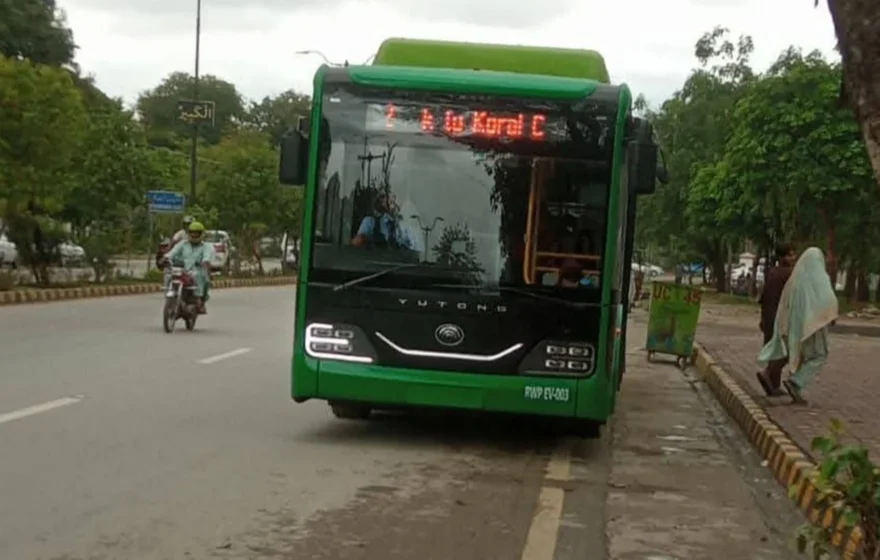
The Green Electric Bus Service on the Rawalpindi-Kahuta route will run only to Fauji Foundation Hospital, a decision that has drawn strong opposition from residents of Kahuta. They say the shortened route leaves them paying extra to reach the city centre, and they have announced plans to protest until the service is extended to Rawalpindi.
The problem is the fare. The private coaster service between Gordon College in Rawalpindi and Kahuta charges Rs. 230 for a one-way journey, and under the new arrangement it stays in place. Electric bus passengers from Kahuta will have to pay another fare to get from Fauji Foundation Hospital to Raja Bazaar or Saddar, so a daily commuter faces two tickets instead of one, and a journey far costlier than the cheap ride the buses were meant to provide.
Residents argue the answer is simple: extend the service to Gordon College on Liaquat Road. They say that would give passengers better transport at a fare of just Rs. 50, a fraction of what the coasters charge. In their view, the current route protects the private coaster operators at the expense of passengers, and they want the decision reviewed before the service begins.
Punjab Chief Minister Maryam Nawaz has approved 13 electric buses for the Rawalpindi-Kahuta route under the Green Electric Bus Service project, and the service is expected to begin soon. The approval is welcome news in Kahuta, where residents have waited for a reliable and affordable public bus. It is the route, not the buses, that has caused the anger.
The dispute comes as the programme expands rapidly across Rawalpindi. The Chief Minister inaugurated the city’s Green Bus service in November 2025 with 45 buses on four routes, at Rs. 20 a person and free travel for women, students, senior citizens and special persons. The fleet has since grown to 80 buses, and the network now covers eight routes, including Saddar, Koral Chowk, Fawara Chowk, Mandi Mor, Faizabad and Tramri Chowk. Other passengers now pay Rs. 25, while the free categories remain unchanged.
The buses are a step up from anything Kahuta commuters have had before: air-conditioned, with Wi-Fi, charging ports, CCTV monitoring, wheelchair space and separate compartments for women. They also connect with the Metro Bus network serving Rawalpindi and Islamabad, which matters for passengers travelling further into the twin cities. The Chief Minister has said the government plans 1,100 green buses across Punjab by December, one of the largest public transport investments in the province’s history.
For Kahuta, the stakes are higher than for most city routes. The town sits outside Rawalpindi, and its residents depend on the city for work, education, markets and hospitals. A cheap, reliable bus is not a convenience; it is the difference between an affordable working day and one eaten up by fares. A fare of Rs. 230 each way already takes a heavy toll on household budgets, and a second fare on top of the electric bus would make the new service little better than what it replaces.
The argument is therefore about more than a single bus stop; it is about who public transport is meant to serve. A government service launched with public money, at fares far below the private market, should put passengers first. When its route is drawn in a way that keeps a private operator’s business intact, people are entitled to ask whether the public interest or a private interest shaped the decision. The Punjab Mass Transit Authority, which operates the service, has not explained publicly why the route stops at Fauji Foundation Hospital.
There is also a practical question about daily use. Passengers arriving at Fauji Foundation Hospital will need to find onward transport to Raja Bazaar or Saddar, the busiest commercial areas of the city, and pay for it separately. That change of bus adds time as well as money, and for women, students and elderly passengers an inconvenience the electric bus service was designed to remove. A direct run to Gordon College on Liaquat Road would put them in the heart of the city in one journey.
What happens next rests with the provincial government and the transport authority. Residents have announced a protest, and the pressure is on the authorities to reconsider the route before the buses start running. If the service is extended, Kahuta commuters would get the affordable ride they were promised, and the programme would show it can reach beyond the city centre. If it is not, the first electric buses to Kahuta will arrive carrying a dispute about whose interests they serve.
The row is a test of the Green Bus programme’s promise. Cheap, clean and comfortable buses are only half of the offer; the other half is a network that takes people where they need to go. A route that stops short and forces a second fare weakens that promise, however good the buses themselves may be. The people of Kahuta are not asking for a favour. They are asking for the service to do what it was built to do, and to do it for them as fully as for the city.
