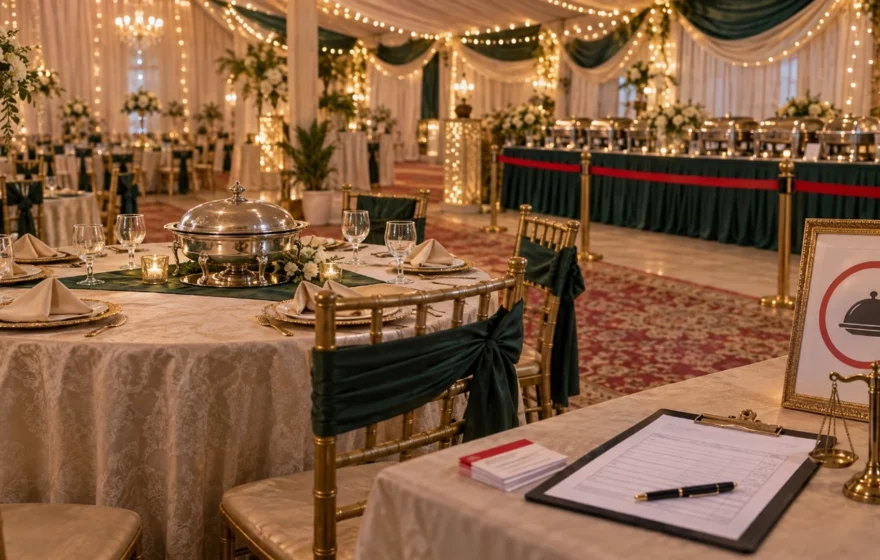
Three wedding marquees in Lahore have been fined for serving more food than the law allows, as the district administration steps up inspections of marriage halls during the busy wedding season. The fines were imposed on venues in the Cantonment and Shalimar tehsils after officers found extra dishes being served in breach of Punjab’s one-dish rule.
The action came on the orders of Deputy Commissioner Ali Ejaz, who has directed a fresh crackdown on marriage halls and marquees across the district. Three online fines were issued through the Payment Slip ID system at the venues where the violations were found, a method the administration says leaves a clear digital trail and makes it harder for anyone to quietly settle a penalty off the books.
For families planning a wedding in Lahore, the message is that the rules which have been on the statute book for a decade are being enforced in earnest again. The one-dish law is not a new idea, and it is not a ban on celebrating well. What it does is put a legal limit on the wedding feast, and the district administration has shown repeatedly that it is willing to fine, and even seal, venues that ignore it.
Tehsil-Level Surveillance
On the Deputy Commissioner’s directions, Assistant Commissioners and Additional Assistant Commissioners carried out inspections across the district to check whether marriage halls and marquees were following the one-dish policy. The inspections covered venues in different tehsils, with officers visiting halls during functions to see what was actually being served to guests.
Ejaz directed the officers to keep up surveillance at the tehsil level, to make sure the law is strictly implemented at marriage halls and marquees, and to ensure that online fines are recovered and verified on time. The emphasis on verification matters, because a fine that is issued but never collected sends no signal at all. By routing penalties through the Payment Slip ID system, the administration can track each fine from the moment it is imposed until the money is paid.
The crackdown is part of a wider pattern of enforcement in Punjab. In an earlier province-wide drive, five marriage halls were sealed, twelve cases were filed and thirty people were arrested, with fines totalling Rs4.3 million imposed on the owners. In Lahore Division alone, officers inspected 316 marriage halls, found violations at 25 of them, imposed fines of Rs700,000 and registered eight first information reports, while three hall proprietors were arrested. In October 2025, nine halls in Lahore were sealed in a single day for breaching the one-dish and timing rules. The latest fines in Cantonment and Shalimar are a continuation of that approach, applied venue by venue rather than in a single sweeping raid.
‘Violations Will Not Be Tolerated’
Marriage hall and marquee owners have been instructed to serve only what the law permits at wedding functions, and not to add extra dishes to please hosts or guests. “Violation of the one-dish law at wedding halls will not be tolerated, and indiscriminate action against establishments violating the law will continue,” Ejaz said.
He added that the Payment Slip ID system ensures transparency in the penalty process, and he urged marriage hall owners to cooperate with the district administration rather than test the limits of the law. The warning was aimed as much at the halls as at the families who book them, since both sides share responsibility when a menu goes beyond what is allowed.
The law behind the fines is the Punjab Marriage Functions Act of 2016, which limits the wedding meal to one main dish, one rice dish and one sweet dish, with roti, naan, salad, raita and hot and cold drinks allowed alongside. It also requires ceremonies at public places to end by ten at night, and it makes the owner, manager and caterer of a venue responsible for following the rules, not just the family hosting the function. Food served in excess of the limit can be forfeited, and the penalties for breaking the law run from a fine of Rs50,000 up to Rs2 million, along with imprisonment of up to one month.
The Act was written with a clear purpose. Weddings in Punjab had become a contest of extravagance, with families spending far beyond their means on lavish multi-course feasts, and the burden fell hardest on those who could least afford it. By capping the menu, the law was meant to take the pressure off families, cut food waste and draw a line that every household, rich or poor, would have to respect. That purpose is still cited by the administration whenever enforcement picks up, and it is why the crackdown tends to return each wedding season.
Whether the latest fines change behaviour will depend on what happens next. A fine that is paid and forgotten changes little, but a steady programme of inspections, backed by the threat of sealing a venue, has a way of concentrating the minds of hall owners. For now, the district administration has made its position clear: the one-dish rule is the law, the fines are real, and the inspections will continue.
