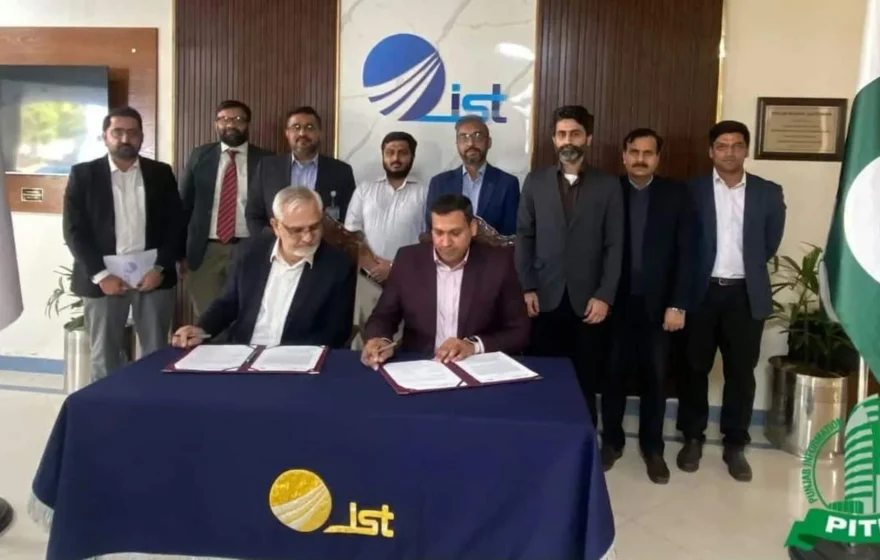
The Punjab Information Technology Board has signed a memorandum of understanding with the Institute of Space Technology to promote innovation, research collaboration and technology-driven product development under the Chief Minister’s Initiative Makerspace Punjab. The agreement was signed by PITB Director Skill Development Ahmad Islam Syan and IST Registrar Dr Syed Adnan Qasim, with representatives of both organisations present. It is the latest in a series of academic partnerships PITB has struck this autumn, and it brings one of Pakistan’s most specialised science universities into a programme that is trying to turn the province into a place where hardware products are designed and built, not just assembled.
The partnership will give the two institutions a platform to explore joint work, exchange technical expertise, and connect academic research with practical innovation and emerging technology. That sounds like the usual language of a memorandum, but the context gives it weight. Makerspace Punjab is not a single laboratory or a one-off grant. It is a dedicated facility being built to give students, researchers, start-ups and small manufacturers access to the equipment and guidance they need to take an idea from a sketch to a working prototype, and the agreements PITB keeps signing are the way it is pulling universities into that orbit.
PITB Chairman Faisal Yousaf said Makerspace Punjab, an initiative of the Government of Punjab implemented by PITB, aims to strengthen Pakistan’s hardware innovation ecosystem by providing advanced facilities for product design, prototyping, testing and local product development. The emphasis on hardware is deliberate. Pakistan’s software industry has grown quickly, with freelancers and export firms winning work around the world, but hardware has lagged behind. Designing a circuit board, machining a precision part or testing a sensor still means finding a workshop with the right machines, and for most students and small firms that workshop does not exist. A makerspace is meant to close that gap by putting the machines in one place and staffing them with engineers who can help people use them.
The facility itself is Punjab’s first makerspace, housed at Arfa Karim Tower in Lahore, and it is laid out across three floors. The ground floor holds the heavy equipment, including computer-controlled machining, 3D printing and circuit board and Internet of Things laboratories. The basement provides workshop and training space along with open areas for hackathons and design sessions. The first floor holds the lighter laboratories for robotics, augmented and virtual reality and usability testing, as well as a seminar room and team offices. The range matters, because a hardware product is rarely one thing: a smart device may need a printed casing, a custom circuit board, a sensor and a test with real users, and the makerspace is designed to cover that whole path under one roof.
The Institute of Space Technology is a natural partner for that kind of work. Founded in September 2002 under the national space agency SUPARCO, it is Pakistan’s only dedicated space science and technology university, teaching aerospace engineering, avionics, space science, remote sensing and related disciplines. Its students work on satellites, navigation systems and materials science, which are fields where a design is worthless until it has been built, tested and rebuilt. That habit of turning theory into hardware is exactly what a makerspace is for, and the partnership should give IST students and researchers access to prototyping facilities and technical mentorship that a university workshop alone cannot provide.
The agreement follows a pattern PITB has been building since October. In that month it signed memorandums with COMSATS University Islamabad’s Lahore campus, the University of Education Lahore and the University of Punjab, and more recently it has added Superior University, the University of Lahore and the University of Sargodha. Each agreement carries the same offer: access to specialised laboratories, technical guidance, training and prototyping facilities, along with joint research, entrepreneurship and knowledge exchange. The IST agreement extends that network beyond Lahore’s general universities to a federal science institution in Islamabad, which suggests the programme is being treated as a national academic network rather than a purely provincial one.
Whether any of this produces real products is the question that will decide the programme’s value. Memorandums are easy to sign and hard to convert into working devices, and Pakistan has seen plenty of innovation schemes that ended as press releases. The test will be whether students and researchers actually walk into the Arfa Karim Tower facility, use the machines, and come out with prototypes that become products. If they do, the IST partnership makes sense: space technology demands precision engineering, and precision engineering is precisely the skill that Pakistan’s hardware sector lacks. If they do not, the agreement will join a long list of well-meaning partnerships that changed very little. For now, the two institutions have put their names to a shared ambition, and the next step is to show what it can build.
