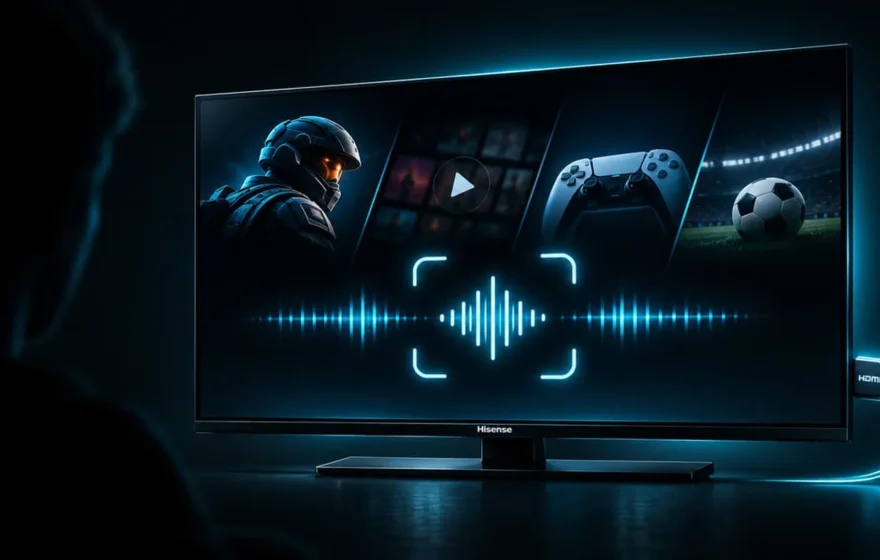
A television owner in Britain has found that his Hisense set was quietly sending details of what he watched to an advertising company in Israel, roughly once every 2.7 seconds, even with personalised advertising switched off. It comes only months after Texas took five of the world’s biggest television makers to court over the same kind of technology.
Gabriel Werneck traced the traffic leaving his Hisense 55U65QEVS television to Nexxen, an Israeli advertising technology company. What troubled him most was their reach as well as their frequency. The system did not limit itself to the television’s own streaming apps. It could also identify programmes and films played through devices connected by HDMI, including games consoles and streaming sticks, so almost everything on the screen was potentially logged.
Nexxen’s own public material describes software that can recognise content played through media players, games consoles and other equipment attached to compatible televisions. The company says it shares or licenses viewing data, along with audience groups built from that information, to partners for advertising, audience measurement and market research. In other words, the record of what a household watches can be sold on as a commercial product.
Texas Took Legal Action in 2025
Similar concerns had already prompted legal action in the United States. On December 15, 2025, Texas Attorney General Ken Paxton announced lawsuits against Hisense, Samsung, LG, Sony and TCL, alleging that they collected viewing information without proper consumer knowledge or consent. Two days later, a court issued a temporary order barring Hisense from collecting, using, selling or sharing Texans’ viewing data gathered through automatic content recognition.
The Texas complaints alleged the software could capture screenshots as often as every 500 milliseconds, monitor viewing in real time and send the information back to the manufacturer without the viewer’s knowledge, so advertisers could build targeted campaigns from private viewing habits. The lawsuits were brought under the Texas Deceptive Trade Practices Act, with penalties of up to 10,000 dollars sought for each violation. A similar temporary order was issued against Samsung on January 6, 2026, and a class action making comparable claims was filed in New York on January 9, 2026. The Texas office also argued that Hisense and TCL, as Chinese companies, could be compelled by Chinese law to hand consumer data to Beijing.
How the TV Tracks What You Watch
Werneck’s investigation shows how the tracking works in practice. His television runs the VIDAA U09.60 operating system, and he found software in the background that listened to the sound the set was playing and converted it into small digital patterns known as audio fingerprints. The system created a 72-bit fingerprint from about one second of sound, produced a new one roughly every quarter of a second, and sent them onward in batches of ten. Those fingerprints can be matched against a library of known recordings to identify a show, film or advertisement. The messages also carried a device identifier, timestamps, the selected input and the app in use, and the identifier never changed, so the viewing record could be tied to one specific set.
Earlier Tests Found Similar Tracking
Werneck’s findings are not an isolated case. A 2024 study presented at the ACM Internet Measurement Conference examined Samsung and LG televisions in Britain and the United States and observed viewing-recognition activity during HDMI playback, and switching the feature off stopped the traffic to the tracking servers. The 2026 Watching the Watchers project reported the same kind of HDMI tracking on a Supersonic television running VIDAA, and again found that disabling the feature stopped the traffic. The pattern is consistent across brands: the technology watches external devices as well as built-in apps, and it can be turned off, but only if the owner knows where to look.
The Tracking Has a Separate Setting
That last point is central to Werneck’s account. He found that a permission labelled Agree to Enhanced Viewing Service had remained selected since the television was first set up, and removing it closed the connection to Nexxen during his test. On his British model, the option sat several menus deep, under Settings, then Support, then Disclaimer and Privacy, then Data Sharing, Privacy and EULA. A follow-up check recorded no outgoing packets for sixty seconds, and further checks during playback, after restarting the set and after installing updates, produced the same result. A single agreement given during setup can keep a television reporting viewing habits for years.
There are limits to what has been established so far. Werneck’s investigation concerns a television sold in Britain, while the court action concerned consumers in Texas, and whether Hisense televisions sold in Pakistan use the same tracking setup remains unverified. VIDAA says the service’s availability and its controls vary by model and market. For owners in Pakistan, the lesson is the same: smart televisions are computers, and the viewing history they collect has real commercial value. Anyone who owns a Hisense set, or indeed any smart television, would do well to open the privacy settings, look for anything described as enhanced viewing, viewing information services or automatic content recognition, and switch it off.
