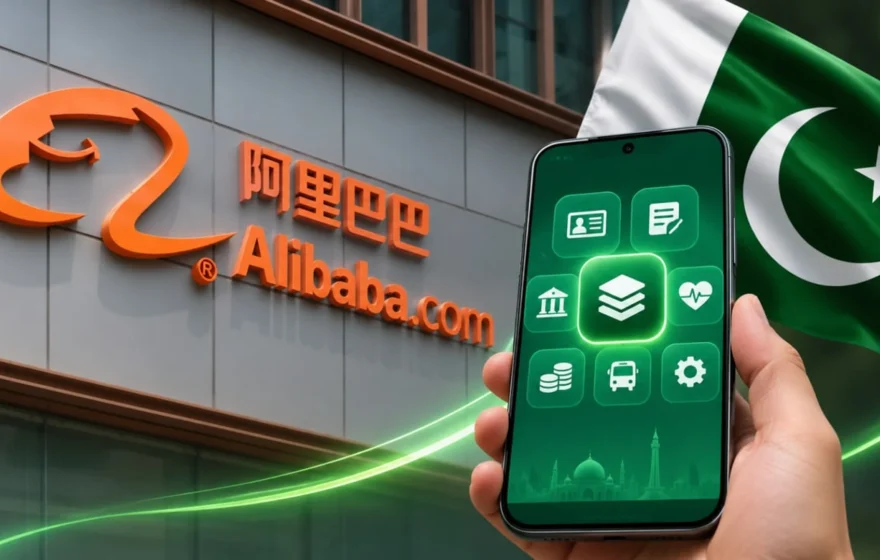
Pakistan is moving towards a government Super App that will bring public services onto a single digital platform, with Chinese technology giant Alibaba developing the application under its collaboration with the government. The development was discussed during a review meeting of the Ministry of IT and Telecommunication chaired by Prime Minister Shehbaz Sharif in Islamabad, where officials said the app would let citizens access a wide range of government services from one place instead of dealing with separate departments, websites and queues.
The meeting was informed that Alibaba is developing a comprehensive Super App for the Government of Pakistan through which citizens will be able to use various government services on one platform. The initiative is part of the Strategic Transformative Framework being implemented with Alibaba. Officials did not disclose a launch date, the specific services that will be included in the application, or the timeline for its rollout, leaving the most practical questions about the project unanswered for now.
The idea behind a super app is simple, and it has already been proven at enormous scale in China, where apps such as WeChat and Alipay began as a messaging service and a payment tool and grew into platforms through which hundreds of millions of people pay bills, book travel, access government services and run small businesses without ever leaving the app. Pakistan’s version would apply the same logic to the state itself: one login, one interface, and services ranging from certificates and licences to bill payments and complaints, all in the same place.
The Super App is only one piece of a much larger partnership. In May, during his visit to China, Prime Minister Shehbaz Sharif met Alibaba chairman Joe Tsai at the company’s headquarters in Hangzhou, where the two sides signed a strategic framework agreement covering artificial intelligence, cloud computing, digital commerce, financial technology and health. The package includes work on local AI models for Urdu and regional languages, a skills programme for 500,000 people, and places for at least 2,000 small and medium enterprises in a dedicated Pakistan pavilion on Alibaba’s platform.
At a follow-up meeting in Islamabad on 28 October, the prime minister set a November deadline for ministries to complete their work on the Alibaba projects and submit progress reports, telling officials the partnership must deliver tangible results on clear targets and timelines. The meeting reviewed AI models for agriculture, a tobacco traceability system, digital export platforms for citrus and olives, and an AI-assisted system for early cancer diagnosis. The petroleum regulator OGRA is to receive AI tools for an analytics system to monitor the fuel supply chain, the Export Promotion Board is working with Alibaba to lift exports, and the IT ministry’s Ignite programme is to launch a 15-day AI training course in collaboration with the company. The government has also set a target of one billion dollars in AI investment by 2030, and in July Pakistan became a founding member of the China-established World AI Cooperation Organization.
The prime minister used the latest meeting to stress that Pakistan was working to fully utilise the potential of its IT sector and make it a major contributor to economic growth and employment opportunities for young people. He also underlined the need to improve digital infrastructure, internet speeds and reliable connectivity across the country, while accelerating technical training for Pakistani youth. That emphasis matters because an app is only as useful as the connectivity behind it.
There are encouraging numbers behind the push. The meeting was told that IT exports reached 4.6 billion dollars by June this year, while exports during July to September 2026 stood at 1.24 billion dollars. Under the DigiSkills programme, more than 931,000 people had completed training by June 2026, with further progress in training activities recorded during July to October as the programme works towards its targets.
Pakistan has tried to digitise its state before, with mixed results. The Pakistan Citizen Portal gave people a way to lodge complaints with government departments, NADRA’s Pak-ID app lets citizens apply for identity documents from their phones, and several provinces run their own service apps. The problem has been fragmentation: each service lives in its own place, with its own login and rules. A single Super App would only be worth the name if it genuinely gathers those services together rather than adding one more door.
Whether it does that will depend on decisions the government has not yet announced. Nobody has said which services will be included first, when citizens will actually be able to download the app, or where the platform will host the personal data of millions of users, a question that matters when a foreign company builds the system holding citizens’ records. Until those details appear, the Super App remains a promise rather than a product, and its success will be judged by whether it survives contact with Pakistan’s bureaucracy and patchy connectivity. If it does, it could become the most visible result of the Alibaba partnership, and the clearest sign yet that the government’s digital ambitions are turning into services people can actually use.
