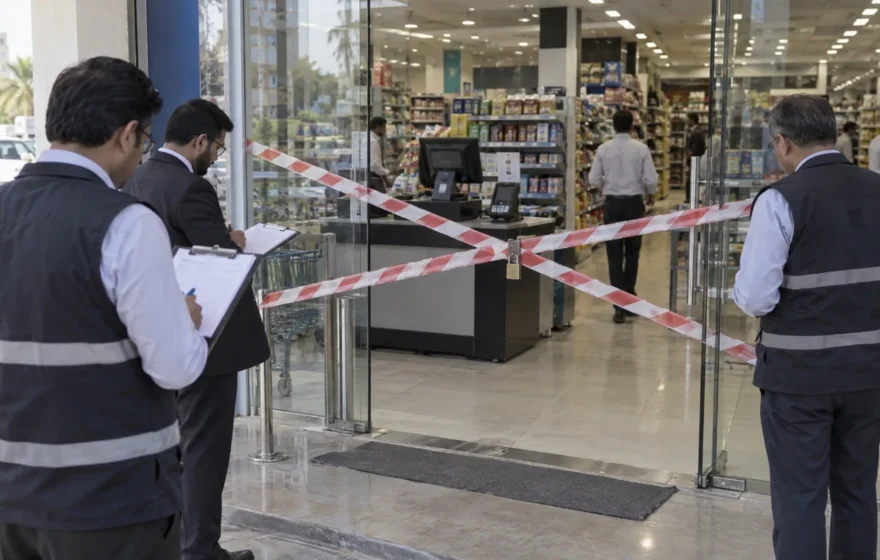
The Federal Board of Revenue has sealed a retail outlet of a well-known superstore in Karachi after uncovering financial irregularities running into billions of rupees. The action was taken by the board’s Regional Tax Office-II over violations of the Point of Sale integration system, through which large retailers are supposed to report their sales to the tax authorities in real time. The operation was led by Deputy Commissioner Corporate Office-II Hina Malik, and it is the latest in a series of enforcement actions against retailers accused of keeping their sales off the official books.
POS System Cut Off for 122 Days
Investigations revealed that the superstore’s Point of Sale system had been disconnected from its main computer network for the past 122 days. The Point of Sale system is the till system that records each sale and sends the details to the Federal Board of Revenue, so that the sales tax collected from customers can be checked against what the business declares. When the system is disconnected, sales can be made without any record reaching the tax authorities. The tax office found that the disconnection was not a brief technical fault. It had lasted for four months, during which the store continued to serve customers every day while its tills were cut off from the network that was supposed to monitor them.
Billions in Off-System Sales
During the audit, tax authorities found that more than Rs3.27 billion in sales had been conducted outside the Point of Sale system, with off-system invoices issued between July 2024 and September 2026. Sales to unregistered buyers alone totalled Rs3.27 billion, leaving an unpaid sales tax liability that the board put at Rs240,570 million. The figures show how much money can pass through one retail outlet unreported when the monitoring system is switched off. A superstore of this size takes in large sums every day, and over two years the unrecorded sales added up to billions. The case is also about the principle that a business of this size cannot operate outside the system every other large retailer must follow.
The sealing of the outlet sends a message that goes beyond one store. Under the Sales Tax Act of 1990, large retailers are required to issue digital invoices through the integrated Point of Sale system, so that every sale is recorded and the tax due on it can be traced. When a retailer issues paper invoices outside that system, or disconnects its tills from the network, the authorities lose sight of the transaction entirely. The rules that govern the system, including Rule 150ZEO of the Sales Tax Rules, give tax officers the power to seal premises where those requirements are not being met, and that is the power the Karachi tax office used in this case.
A Wider Crackdown on Missing Receipts
The Karachi sealing did not happen in isolation. Only a day earlier, the board sealed outlets of United Bakery, one of the oldest and best-known bakery chains in the country, in Islamabad and Karachi for allegedly failing to issue digital invoices through the integrated Point of Sale system. A notice at the bakery’s Islamabad premises on November 24 stated that the outlet had been sealed because it had not issued Point of Sale digital invoices, and on the same day the chain’s outlet in Saddar, Karachi, was also sealed. The two actions together show a tax office moving against retailers of every kind, from neighbourhood bakeries to large superstores, and applying the same rules to all of them. Nor is this the first time a Karachi superstore has been sealed for this reason. In March last year, the Regional Tax Office-I sealed a superstore in the DHA area of Karachi after finding that its invoices were not integrated with the board’s Point of Sale invoicing system.
The crackdown matters because sales tax evasion by large retailers is one of the largest leaks in Pakistan’s tax system. The gap between the tax that should be collected and the tax that actually reaches the treasury runs into hundreds of billions of rupees every year, and much of it comes from the retail sector, where cash sales and unrecorded transactions are common. By forcing large retailers onto the integrated system, the tax board is trying to close that gap at the point where the sale happens, rather than chasing the money afterwards through audits and investigations.
For the superstore in Karachi, the immediate consequence is a sealed outlet and a tax demand that will now have to be settled with the authorities. For the wider retail trade, the message is that the tax office is watching the tills, and that a disconnected system will be treated as evidence of wrongdoing rather than as a technical problem. Whether the crackdown changes behaviour across the sector will depend on whether the enforcement is sustained, and whether the penalties are large enough to make other retailers think twice. The board has chosen a public and forceful way of making its point, and the sealing of a famous Karachi superstore will be noticed by every large retailer in the country.
