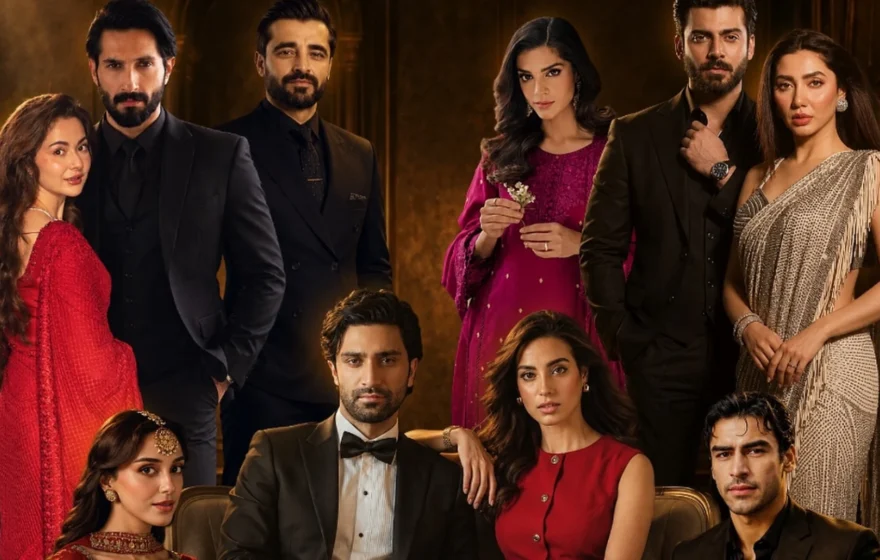
On December 4, Netflix will premiere Jo Bachay Hain Sang Samait Lo, released around the world as All the Love Our Hearts Carry, making it Pakistan’s first-ever commissioned Netflix original. This is not a local drama the platform picked up after it aired somewhere else. Netflix ordered the series itself and had it built for the platform from the ground up.
Pakistani dramas have long travelled beyond the country’s borders, carried by satellite channels, streaming platforms and word of mouth among the diaspora. Yet until now, no Pakistani series has been commissioned as an original by Netflix itself. That distinction matters, because a commissioned original is developed with a global audience in mind from the start. The premiere is therefore a test of whether Pakistani storytelling, made at a scale the industry has not attempted before, can hold its own on the world’s biggest streaming stage.
The Story
Adapted from Farhat Ishtiaq’s bestselling Urdu novel, the series weaves six love stories across three generations and three countries, moving between Pakistan, Italy and the United Kingdom. At its centre is Sikandar Sheheryar, a Harvard-trained lawyer living in Rome, haunted by insomnia and nightmares after a traumatic event. He keeps the world at arm’s length until he meets Liza, a gifted artist carrying her own complicated past, and their meeting sets off a story about love, loss, healing and the wounds one generation passes to the next.
The novel first appeared as a serial in Khawateen Digest in 2009, before being published as a book in 2013. Its title is drawn from a ghazal by Faiz Ahmed Faiz, and the story has lived in readers’ minds for well over a decade, which is part of why its arrival on screen carries such weight.
The Writer
Farhat Ishtiaq drives the whole thing. She wrote the original novel and adapted it into the screenplay herself, a writer bringing her own words to the screen. She is the name behind some of Pakistan’s most-watched dramas, including Humsafar, Bin Roye and Yaqeen Ka Safar. Her own years living in Rome shaped the novel’s Italian setting, giving the scenes in Italy a lived-in texture.
The Director and Producer
Momina Duraid wears three hats on this production, serving as showrunner, director and producer under her banner, Momina Duraid Films. She is a producer whose track record reads like a list of the most-loved Pakistani dramas of the past fifteen years, with Humsafar, Zindagi Gulzar Hai, Dastaan and Suno Chanda among her credits. The project was commissioned by Netflix’s Middle East and North Africa team in collaboration with HUM Network, and Saife Hassan serves as head of post-production.
The Cast
The ensemble is the largest ever assembled for a Pakistani production. Fawad Khan plays Mehmood Akhtar, Mahira Khan the young Rahat, with Samiya Mumtaz as the older Rahat, Ahad Raza Mir plays Sikandar Sheheryar and Iqra Aziz plays Liza. Sanam Saeed appears as Vittoria Akhtar, Hamza Ali Abbasi as Shehryar Khan, Hania Aamir as Kulsoom and Khushhal Khan as Zain Sheheryar. Maya Ali plays Amna, Bilal Ashraf plays Waqar Khan, Ahmed Ali Akbar plays Jahanzeb and Aamina Sheikh plays Sadia. Nadia Jamil appears as Asha, Omair Rana as Amit, Nadia Khan as Amna and Saife Hassan as Vikram, with Usman Javed as Khan Bahadur Ali, Samina Ahmed, Maha Hasan as Zuleikha and Shahzayn Duraid as Faizan completing the cast.
It is a full-circle moment for several of them. Fawad Khan and Mahira Khan reunite after Humsafar and The Legend of Maula Jatt, while Fawad Khan and Sanam Saeed share the screen again after Zindagi Gulzar Hai and Barzakh.
The Music
The soundtrack is the hidden headline of the production. Rohail Hyatt, the man who built Vital Signs and defined the sound of Coke Studio, produced the entire six-track EP, which was released by Netflix Music on November 24 alongside the trailer. The title track, Jo Bachay Hain Sang Samait Lo, is performed by Abdul Hannan, Zenab Fatimah Sultan and Rohail Hyatt. Kashish is performed by Asim Azhar, Zeb Bangash and Rohail Hyatt, while Deewana brings together Fawad Khan, Shae Gill and Rohail Hyatt. A thumri version of Kashish is performed by Akbar Ali and Rohail Hyatt, So Ja Re Munne by Samiya Gohar and Azaan Sami Khan, and Hum Tum Mile by Shamoon Fida, Sarwat Naz and Hassan Badshah.
Release Details
Part 1 premieres globally on December 4, 2026. Netflix has confirmed Part 2 without giving a release date, listing it as coming soon. The platform has not yet announced the total episode count or the runtime. The trailer and the soundtrack both dropped on November 24, at a grand launch held at Karachi’s Mohatta Palace, where HUM Network’s chief executive revealed that Netflix had upgraded the series from a regional release in 80 countries to a full global rollout across 191 countries.
The series now carries the hopes of an industry that has spent years proving it can tell stories the world wants to watch. If it finds its audience, it will open a door for more Pakistani productions to be commissioned rather than merely licensed.
