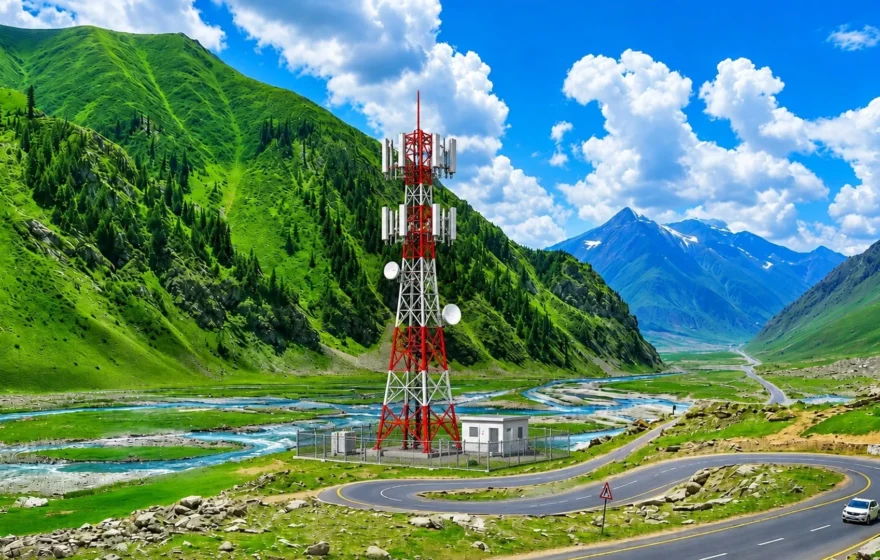
For years, a holiday in Pakistan’s northern valleys has meant leaving the connected world behind. Phones lose signal on the climb out of Naran, messages refuse to send beside a mountain lake, and a simple call home becomes a hunt for the one spot on a ridge where a single bar appears. That frustration could soon become a thing of the past. Tourists visiting some of the country’s most loved destinations are set to get high-speed mobile internet and far better call services under an initiative by the Universal Service Fund, the state body charged with taking telecom services to the parts of Pakistan the market has left behind.
The programme aims to improve mobile network coverage at the tourist destinations themselves and along the roads that lead to them, places where telecom services are currently unavailable or too weak to be useful. Local communities, who have long coped with patchy signals of their own, stand to gain just as much, and tourism-related businesses should find it easier to grow.
The plan is part of a wider effort to push telecom infrastructure beyond Pakistan’s big cities and into underserved areas, and it arrives as the north’s popularity has never been higher. Every summer, tens of thousands of families drive up from Lahore, Islamabad and Rawalpindi into Kaghan, Swat and Dir, and reliable connectivity there is no longer a luxury for posting holiday photographs. It is how people navigate, pay, book rooms and, when something goes wrong, call for help.
Tourist Destinations Covered
According to a document from the Ministry of Information Technology and Telecom, the programme covers six of the most visited spots in the north. Three of them sit in the Kaghan Valley in Mansehra district, the classic summer route for tourists from Punjab and the capital. Babusar Top, the high pass at 4,173 metres linking the valley to Chilas and the Karakoram Highway, is the first. Lake Saif-ul-Malook, the alpine lake at 3,224 metres about nine kilometres above Naran beneath Malika Parbat, is the second, and Sharan Forest, the quiet pine forest above the valley favoured by campers and trekkers, is the third.
The other three destinations spread the programme further west. Kumrat Valley, the forested valley in Upper Dir that has drawn growing crowds in recent years, is included, along with Mahodand Lake, the high lake in Swat that has become one of the valley’s signature sights. Galiyat, the hill tract in Abbottabad district that includes the resort towns of the Murree hills, completes the list, bringing the programme closer to the capital and its weekend visitors. Together, the six spots cover the full arc of the northern tourist season, from the summer crowds in Kaghan and Swat to the weekend traffic in Galiyat.
There is also a safety argument running through the initiative. The programme aims to improve emergency response in remote tourist areas, and reliable mobile connectivity will help tourists and local residents contact the relevant authorities during an emergency, allowing the agencies concerned to respond more quickly. In the valleys, a working phone can be the difference between a long wait and a rescue.
Project Status
According to the ministry’s document, two projects under the Universal Service Fund’s Next Generation Broadband for Sustainable Development Programme for Tourist Destinations were already under implementation during the financial year 2024-25. That suggests the work is not starting from scratch, and that the announcement reflects projects already moving through the system rather than a promise made for the first time.
The fund has been doing this work for nearly two decades. It was established by the government in 2006 and began operating in May 2007 under the Ministry of Information Technology and Telecom, with the aim of spreading the benefits of the telecom revolution to every corner of the country. It is financed by the telecom operators themselves, who contribute 1.5 per cent of their adjusted gross revenue, and it uses that money to subsidise operators willing to build networks in places that are commercially unviable.
The timing is worth noting. It comes as winter closes in on the valleys, and the road over Babusar Top has already shut until next summer, which means the work can be planned and built while the tourist season is paused. What will decide whether the initiative succeeds is what happens next: which operators will provide the service, what speeds tourists can expect on a crowded summer weekend, and whether coverage will hold up on the roads between the destinations as well as at the destinations themselves. The real test will come when the first summer crowds return and reach for their phones. If it works, the change will be felt in small ways: a family checking the road ahead before setting off from Naran, a hotel owner in Kumrat taking an online booking, a trekker above Sharan calling for help. None of that is dramatic, but together it is the difference between a tourist industry that runs on luck and one that runs on infrastructure.
