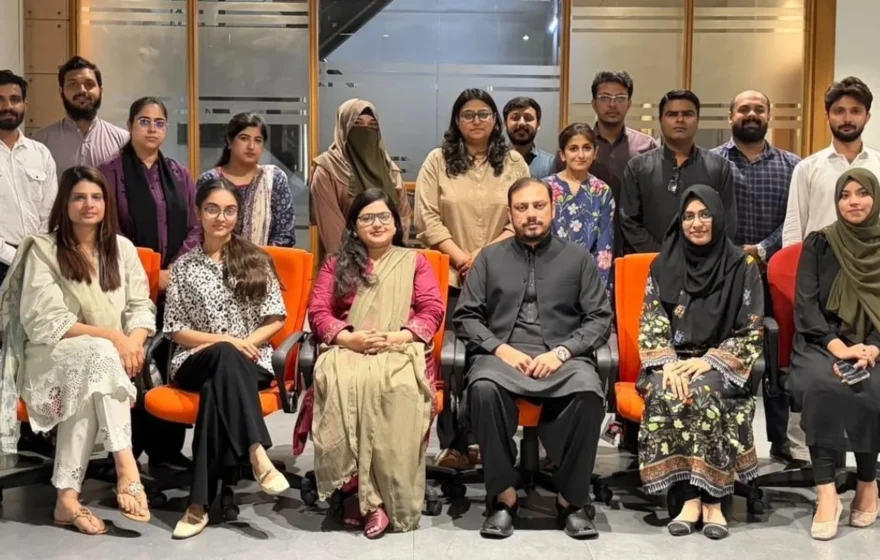
Nobody tells you how heavy the first few years of a career can feel. There is the excitement of a new role, and right beside it, a quiet worry: is everyone else figuring this out faster, and do I belong here? Most early professionals carry these questions silently. Left alone, that worry shapes how people speak up. How an organisation responds in these early years says a great deal about what it truly values, and Wateen, the Lahore-based telecom company, has answered with a programme built for exactly that moment.
The company calls it the Foundation Program, designed for the part of working life that no degree prepares you for. Over eight Fridays, colleagues from across the organisation come together for a module-based learning programme, with each session planned to build on the one before it. Sessions on communication, presentation skills, stakeholder management and design thinking introduce these skills early, in a space where learning is the whole point.
Growth Mindset Is More Than a Value
At Wateen, growth mindset is a core value: embracing continuous learning and investing in personal and professional development. It rests on the belief that learning does not end with formal education. The idea is easy to print on a poster and much harder to practise, because corporate life asks for different skills from the ones a university teaches, and most people pick them up slowly.
Understanding stakeholders, giving a good presentation and mastering corporate communication are rarely taught in a classroom, yet they decide how far a young professional goes in the first years of a job. Along the way, many feel they should already know these things, as though everyone else arrived with the manual. Wateen’s position is that nobody should have to learn all of this alone.
Where Foundation Comes In
The programme was designed to change the early-career experience for people still finding their footing. Instead of leaving new colleagues to absorb corporate skills by accident, it gathers them in a room, on purpose, and works through the skills one module at a time. Each session builds on the last, so communication leads into presentation skills, and stakeholder management makes more sense once participants have practised speaking to a room.
Why a Dedicated Programme Matters
Many of these lessons would arrive eventually, over the course of a corporate life. But there is a real difference between experiencing them alone, one mistake at a time, and learning them together. A dedicated programme speaks openly about the quiet anxieties early professionals walk in with: finding their voice, handling pressure and making space for themselves in a large organisation. It tells them these concerns are normal and shared, and that asking for help is part of growing.
The presentation skills session showed this well. It began with an honest conversation, as everyone shared what they feared most about presenting. Towards the end, each person delivered a one-minute presentation on a randomly assigned prompt. Nerves were high, but what stayed with them was realising that everyone else had felt the same. That shared admission is the point: the skill is not only how to stand and speak, but how to be nervous in front of colleagues and carry on anyway.
There is a quieter benefit too. When colleagues from different functions learn side by side, hierarchies soften and strangers become peers. Confidence stops being something people build in isolation and becomes something they build together. A room that begins with hesitation can end with laughter and the comfort of not being the only one still figuring it out. For a company, that is not a soft outcome: people who feel they belong stay longer, ask better questions and take on harder work.
Building a Culture of Continuous Growth
A culture of learning does not build itself. It exists when a company takes its responsibility to invest in its talent seriously, not only in what people do today but in the careers they are building. That means creating spaces for early professionals to learn, ask questions and seek feedback, while building a stronger talent pipeline.
Wateen has had to reinvent itself more than once. Founded in Lahore in 2005 and owned by the Abu Dhabi Group, it began operations in 2007 with a large fibre-optic network, and it became the first company in the world to launch WiMAX broadband services nationwide, beginning with 24 major cities in Pakistan. The WiMAX network has since been shut down, and the company now offers fibre broadband in Karachi, Lahore and Multan. A company with that history knows its people must keep learning or fall behind.
A few Fridays cannot erase every doubt. What they can do is show people they are not walking this road alone, and that is the workplace Wateen says it is committed to building, where every employee has the support to find their footing. For Pakistan’s telecom sector, where skilled young engineers and graduates are courted by every operator, that investment is also practical: the companies that keep their best young people will not only pay the most, but teach them something worth staying for.
