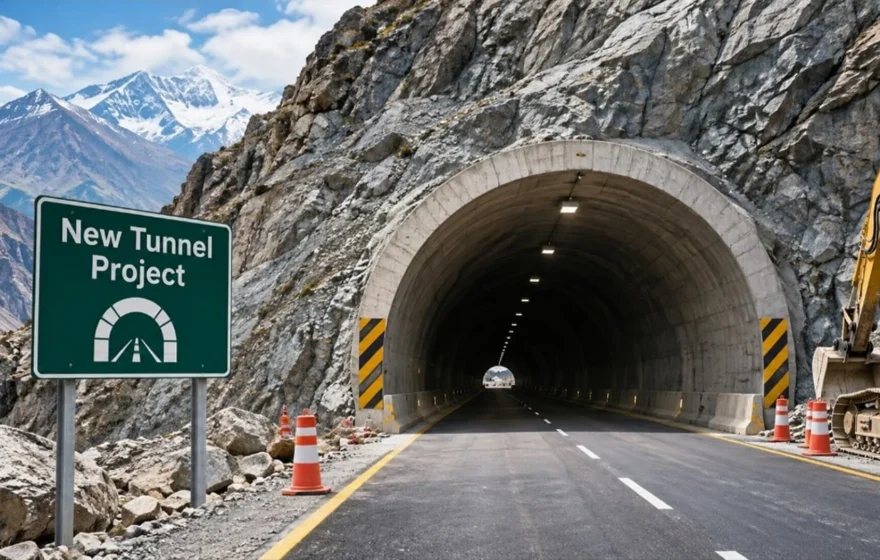
Travellers on the road to Skardu have long planned their journeys around the mountain, not the clock. A single fall of rock can close the only route into Baltistan for days, and last month it did exactly that. Now the National Highway Authority is preparing to bore through the problem instead of working around it, with a 1.56-kilometre tunnel at Malupa on the Jaglot–Skardu Road, announced on Tuesday by Federal Minister for Communications Abdul Aleem Khan during a visit to Gilgit-Baltistan.
The Malupa Tunnel will be 10.8 metres wide, carrying traffic in both directions with a shoulder on each side. It will be built as a single tube using the New Austrian Tunnelling Method, a technique designed for unstable mountain rock, with cut-and-cover protection at both ends and modern lighting, ventilation, drainage and emergency systems inside. The point of all that engineering is simple: take traffic off the exposed slope altogether at one of the worst landslide points on the route, so that falling rock lands on a concrete roof instead of on the road.
The need for it was demonstrated only last month. On the morning of 22 October, a huge section of mountainside gave way near Shangus in the Roundu Valley, burying the Baltistan Road under boulders and debris. Thousands of passengers, including tourists, were stranded on both sides. The Gilgit-Baltistan Disaster Management Authority said debris was still sliding, machinery could not shift the largest boulders, and the Frontier Works Organisation had to send in a blasting team. The road stayed closed for days, and the authority warned people not to try crossing the slide zone and to check the police helpline, 15, before setting out. It was the latest reminder of a weakness that has shadowed this road since it was built.
The Jaglot–Skardu Road, also called the S-1 or Baltistan Road, runs 167 kilometres from Juglot, near Gilgit on the Karakoram Highway, east along the Indus River to Skardu. Army engineers built the original track between 1970 and 1982. For decades it was a narrow, crumbling strip that drivers knew as the well of death, a journey that could take ten hours or more. Between 2017 and 2021 the Frontier Works Organisation rebuilt and widened it from 3.6 metres to 7.3 metres at a cost of Rs31 billion, and the upgraded road was opened in December 2021, cutting the drive to around four hours. But the upgrade was finished without the tunnels and realignments that had been part of the original plan, and that omission is why a single landslide can still shut the whole route.
The National Highway Authority has identified 11 critical points along the route that need extra protection, including tunnels and overhead shelters. Work has already started on protective sheds at Malupa and Barundonala, and the minister inaugurated the Maloopa Shelter during the same visit. The sheds are concrete roofs over the carriageway, designed so that falling rock and debris slide over the traffic instead of onto it. The minister said the shelter would reduce the risk of casualties during landslides, and the tunnel extends the same idea further: where a shed is not enough, go under the mountain entirely.
The tunnel is one part of a broader set of instructions the minister left with the National Highway Authority. Streetlights are to go up along the road, rescue services are to be established, and the patrolling system along the Baltistan Road is to be improved. He told officials to find lasting answers to the damage caused by landslides and heavy rain rather than clearing the same stretches after every storm, and he pressed them on construction quality and on finishing work within the promised time. The authority is carrying out the work from its own resources, and the minister asked the Gilgit-Baltistan government to cooperate fully with it.
For the people of Skardu, Kharmang, Shigar and Ghanche, this is not a scenic detour but the only all-weather road link to Gilgit and the rest of the country. Supplies from Punjab and Khyber Pakhtunkhwa, and from the markets of Gilgit, reach Baltistan along it, and so do the tourists who keep Skardu’s hotels, jeeps and trekking businesses alive. When the road closes, shelves empty, bookings collapse and patients bound for hospitals in Gilgit wait. A tunnel at Malupa will not fix every danger point on a 167-kilometre mountain road, but it removes one of the worst of them, and the shelters planned for the other danger points show the same thinking at work.
No start date or completion timeline for the tunnel was announced during the visit, and the real test will be whether the work begins on schedule and holds to the quality standards the minister demanded. For now, the announcement marks a change in approach: after years of clearing landslides after they happen, the plan is to build through and over them before they happen. The travellers who were stranded near Shangus last month will be watching to see whether that promise reaches the ground.
