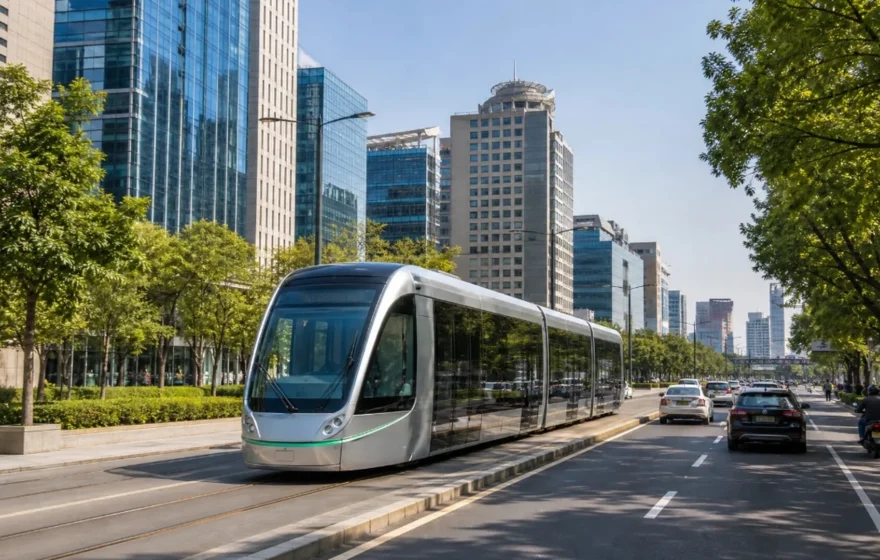
Lahore is finally about to see its long-awaited trackless electric tram in regular service, with Punjab Chief Minister Maryam Nawaz announcing on Tuesday that the vehicle will hit the city’s streets next week. The announcement, made on her account on X, brings a firm date to a project that has been talked about, tested and delayed for more than a year.
Maryam Nawaz described the tram’s arrival as another milestone in Punjab’s journey towards a modern and future-ready province, saying the province had stepped into a new era of futuristic development. The project sits at the heart of the provincial government’s push for cleaner and more modern public transport. For commuters who have watched the sleek, three-carriage vehicle appear in test runs and publicity footage over the past year, the announcement finally answers the question of when they will actually be able to board it.
The tram itself is unlike anything else running on Lahore’s roads. It is a battery-powered Autonomous Rapid Transit vehicle, also referred to as SART, which stands for Super Autonomous Rapid Transit. Instead of steel wheels running on fixed rails, it moves on rubber tyres along ordinary roads, guided by sensors and cameras that follow a virtual track. That is the point of the technology: a city gets something that looks and feels like a tram without digging up streets to lay tracks or building the expensive infrastructure a metro line demands. The vehicle was imported from China and assembled locally, and preparations have included road testing and the fitting of specialist tyres.
In practical terms, the tram can carry roughly 250 to 300 passengers across its three connected compartments, making it far roomier than a standard bus and well suited to a busy urban corridor. Reports put its range at about 25 to 27 kilometres after a fast charge of around ten minutes, so it can be topped up quickly between runs rather than sitting out of service for hours. Passengers are expected to ride free during the initial trials, while early fare estimates have ranged from Rs 20 to Rs 30 once service begins.
The road to this launch has been a long one. The tram first arrived in Lahore in the middle of last year, imported from China and assembled at the Ali Town Depot, and in August 2025 the chief minister herself took an inaugural test ride, travelling from Raiwind Road to Muslim Town in live traffic with the provincial transport minister. Yet the months that followed brought revisions rather than a launch, and the tram remained a familiar sight in announcements rather than on the streets.
The original plan had called for a roughly 27-kilometre route along Canal Road, running from Thokar Niaz Baig to Harbanspura, one of the busiest transport corridors in the city. That route has now been dropped from the plan amid environmental concerns, including the potential cutting of trees along the canal, and technical issues and funding constraints also contributed to the delays and revisions. The chief minister did not name a replacement route in her announcement, which leaves one of the most important questions about the service unanswered for now: exactly where will it run? Canal Road had been chosen because it carries heavy traffic, so its replacement will need to serve a similar purpose.
The tram is only one part of a much larger plan. It falls under Punjab’s five-year transport modernisation programme, under which officials have discussed rolling out the trackless transit system in ten cities over three phases, starting with Lahore, Faisalabad and Gujranwala. The technology is already in use in cities such as Abu Dhabi and in Chinese cities. For Lahore itself, the tram would join an existing network that already includes the Orange Line Metro Train and the Metrobus, adding a middle layer of transport that is cheaper to build than a train line and carries far more people than a bus.
Whether the tram lives up to that promise will depend on what happens after next week’s launch. Running a long, sensor-guided vehicle through Lahore’s mixed traffic will be a genuine test of the technology and of the drivers who will operate it manually in Pakistan for safety reasons. The route question matters too, since a tram needs a corridor with enough demand to justify its capacity, and the fare will have to be low enough to attract daily commuters while still covering the cost of running and charging the vehicles.
For now, the announcement gives Lahore something concrete to look forward to. After more than a year of test rides and revised plans, the trackless tram is finally about to carry passengers, and its first week on the roads will show whether this unusual piece of technology can become an ordinary part of getting around. If it works, Lahore will have a cleaner, quieter and higher-capacity way to move through its busiest areas, and Punjab will have a model it can take to Faisalabad, Gujranwala and beyond. Either way, next week will be the moment the project stops being a promise and starts being judged as a service.
