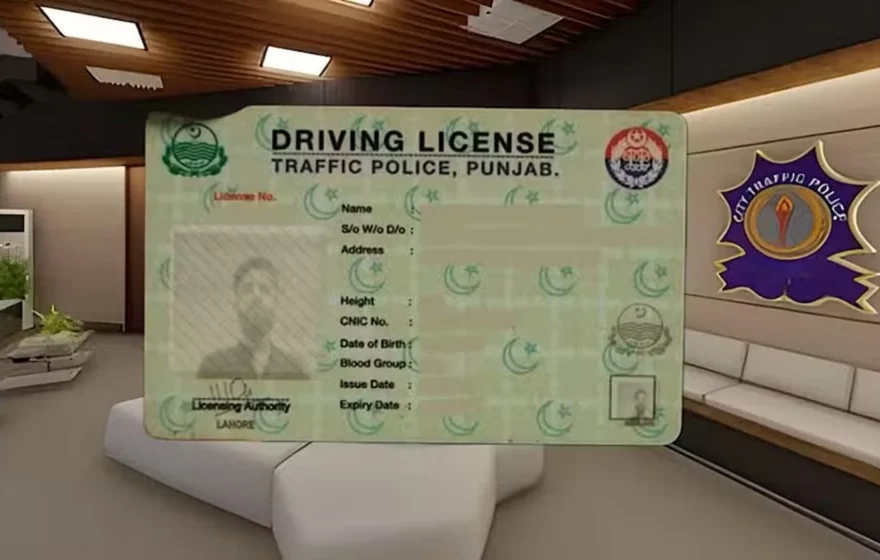
Punjab has processed more than 438,000 driving licence applications in just three weeks, in a surge that shows how quickly the province’s licensing system is now working. Lahore alone accounted for over 75,000 of the licences issued during the period, and the figures cover every stage of the process, from first-time learner permits to renewals of existing licences. The province-wide drive followed instructions from the Deputy Inspector General of Traffic to speed up licensing services and make them more accessible to citizens across Punjab.
Figures shared by a traffic police spokesperson show that authorities issued more than 141,000 learner permits and over 130,000 regular driving licences during the three weeks. Another 163,000-plus licences were renewed in the same period, covering learner, regular and international categories. Taken together, the numbers mean that close to half a million people either obtained a licence for the first time or kept an existing one valid in less than a month.
The rush has a simple explanation. Getting a licence in Punjab has become far easier than it used to be, and more people are taking advantage of it. The process now starts online, through Dastak, the Punjab government’s one-window platform, where an applicant can apply for a learner permit for Rs. 500 per category. The applicant creates an account, fills in the form, uploads a live photograph and scans of the front and back of the national identity card, generates a payment slip and pays through an ATM, online banking or mobile banking. The permit is issued quickly once the payment goes through, and it is valid for six months.
After the learner permit comes a wait of 42 days, during which the new driver is expected to practise with a licensed driver beside them. The wait, which was dropped for about three months in 2024 and then restored in December that year, is meant to make sure nobody takes the driving test without any practice at all. Once the 42 days have passed, the applicant visits a licensing centre in person to take two tests: a sign test covering road signs, traffic rules and safe driving, and a practical driving test on a set course that includes parking, reversing and following the examiner’s instructions. A medical certificate from an authorised practitioner is also required.
The fees for the full licence are modest by the standards of most household expenses. As of October 2026, a one-year car licence costs Rs. 1,830, including Rs. 480 for courier delivery of the card, plus a Rs. 150 test fee, while a motorcycle licence costs Rs. 930 plus a Rs. 50 test fee. Renewal is fully online through Dastak, with no test if the licence is renewed on time, and the annual renewal fee is Rs. 450 for a motorcycle and Rs. 1,350 for a car. The licence card is delivered by courier, and an electronic licence can be downloaded in the meantime. Licensing centres in major cities such as Lahore open around the clock, while those in smaller cities operate from 8 am.
Lahore’s share of the total is striking but not surprising. With more than 75,000 licences issued in the city alone, the provincial capital accounted for roughly one in six of all the applications processed in Punjab. Lahore has the largest number of vehicles, the most licensing centres and the longest opening hours, so it naturally handles the biggest volume. But the fact that more than 360,000 licences were processed outside Lahore shows that the surge is not confined to the capital. District licensing centres across the province are handling large numbers too, which suggests that the online application system has spread the load beyond the big cities.
There is a road safety angle to all of this that matters as much as the convenience. Every licence issued through the proper process is a driver who has passed a sign test and a practical test, and who holds a document that can be checked and, if necessary, suspended. Unlicensed driving remains a serious problem on Punjab’s roads, and one of the reasons people drive without a licence has always been that getting one was slow and difficult. A system that can process 438,000 applications in three weeks removes much of that excuse. The challenge now is to keep the testing honest at that volume, because a licence that is handed out without a real test is worse than useless: it gives an untested driver the confidence of a legal document.
The three-week figures also say something about the direction of public services in Punjab. The driving licence system, built by the Punjab Information Technology Board for the traffic police, now runs through the same Dastak platform that handles other government services, and the licence itself can be verified online. For citizens, that means less time standing in queues and more of the process done from a phone. For the government, it means a record of every licence issued, which makes enforcement possible in a way paper records never did.
