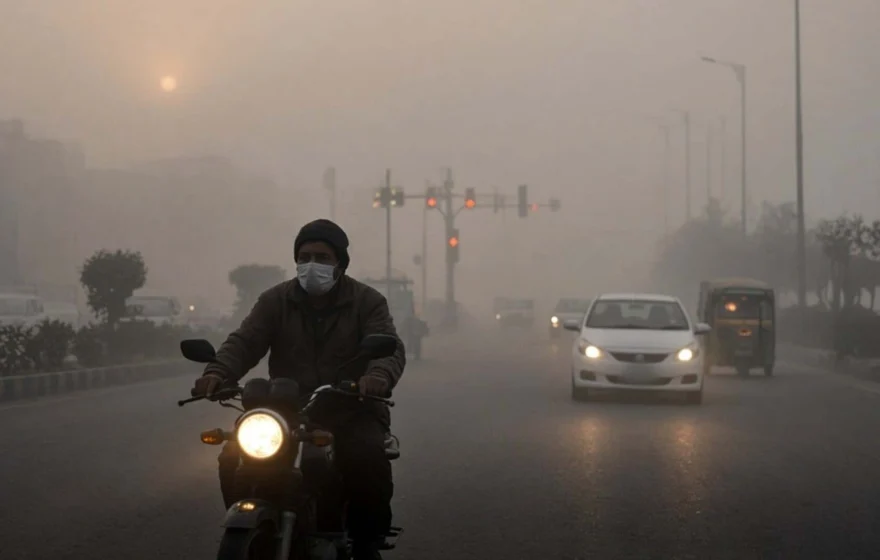
Lahore woke on Sunday to air so thick that the skyline was little more than a suggestion. The Air Quality Index in parts of the city was measured above 530, a level classified as hazardous and far beyond the threshold at which air is considered safe for breathing. For residents, the morning was a familiar but still alarming reminder of how quickly the city’s air can deteriorate as winter sets in.
For residents, the numbers were not abstract. Schools and workplaces opened as usual, but many people reported stinging eyes, sore throats and difficulty breathing. The pollution was visible, too: a dense smog hung over roads and buildings, reducing visibility and lending the entire city a dull, grey cast. For children, older people and those with asthma or other respiratory conditions, the advice was to stay indoors and avoid outdoor exertion, advice that is easy to give and hard to follow for those who must work, travel or earn a living outside.
Five Punjab Cities Among the Worst
Lahore was far from alone in its predicament. Gujranwala topped the list of the most polluted cities in Punjab, recording an AQI above 570, while Lahore, Multan, Rawalpindi and Faisalabad were all in the danger zone. The data underscores that the problem is not confined to one metropolis: across Punjab’s urban centres, air quality had deteriorated sharply, driven by a combination of local emissions, weather conditions and cross-border pollution.
The breadth of the problem makes it harder to dismiss as a local anomaly. When five major cities are simultaneously recording hazardous levels, the causes are systemic, involving traffic, industry, construction dust and the burning of agricultural waste across a wide area. In each city, the pattern was similar: pollution built up overnight, trapped by calm winds and cool air, and remained high through the morning, with little relief until wind patterns changed.
Crop Fires Surge Around Lahore
One of those causes was laid bare by satellite data. Almost 4,000 crop fires were detected in the four weeks leading up to November 2, most of them in the districts around Lahore. Farmers burn stubble after harvest to clear fields quickly for the next planting, a practice that is officially discouraged but remains widespread because it is cheap and fast. The smoke from those fires drifts into Lahore, combining with vehicle exhaust and industrial emissions to produce the thick smog that blanketed the city on Sunday.
The timing sharpened the problem. November is the peak of the stubble-burning season in Punjab, and the fires coincided with weather conditions that trap pollution close to the ground. Cool nights and still air prevent smoke from dispersing, allowing particulate matter to accumulate hour by hour. The result is the seasonal smog that has become a grim annual feature of Lahore’s autumn and winter, despite repeated government campaigns against crop burning and pledges to enforce bans.
October Gains Fade
The grim morning also marked the end of a period of relative improvement. October’s average AQI in Lahore was lower than the same month in 2024, at 177 compared with 185, offering some hope that measures to control pollution were beginning to work. But the improvement was modest, and the average remained well into the unhealthy range, meaning that even on a better month, the air was still far from safe.
The Pakistan Air Quality Initiative analysis found that while the share of days rated as hazardous fell from 28 percent in October 2024 to 21 percent in October 2025, the share of days rated as unhealthy for sensitive groups rose from 13 percent to 25 percent. In other words, fewer days were catastrophically bad, but more days were bad enough to harm vulnerable people. The data suggests a shift in the distribution of pollution rather than a decisive improvement, with hazardous days becoming less frequent but unhealthy days becoming more common.
That distinction matters for public health. A reduction in hazardous days is welcome, but if it is offset by an increase in days that are unhealthy for sensitive groups, the overall burden on hospitals and clinics remains high. Children, older people and those with pre-existing conditions are affected on a larger number of days, even if the worst peaks are slightly less common. The October figures, therefore, should be read as a sign of partial progress, not as evidence that the problem is being solved.
The relief that did come was limited. Average PM2.5 levels in Lahore fell to 112 micrograms per cubic metre in October 2025, down from 132 in October 2024, a 15 percent reduction that still left concentrations well above the World Health Organization’s guideline of 15 micrograms per cubic metre for annual exposure. A 15 percent improvement sounds significant until it is set against a baseline that is more than seven times the safe limit, and even October’s improved average remained firmly in the unhealthy range.
For now, Lahore’s residents face another season of hazardous air, with the familiar cycle of smog, health warnings and official appeals repeating itself. The data from October shows that progress is possible, but also that it is slow, fragile and easily overwhelmed by a single bad morning. Until crop burning is curbed, emissions are reduced and weather conditions improve, days like Sunday will remain a regular feature of life in Punjab’s cities, and the air that millions breathe will continue to pose a serious threat to their health.
