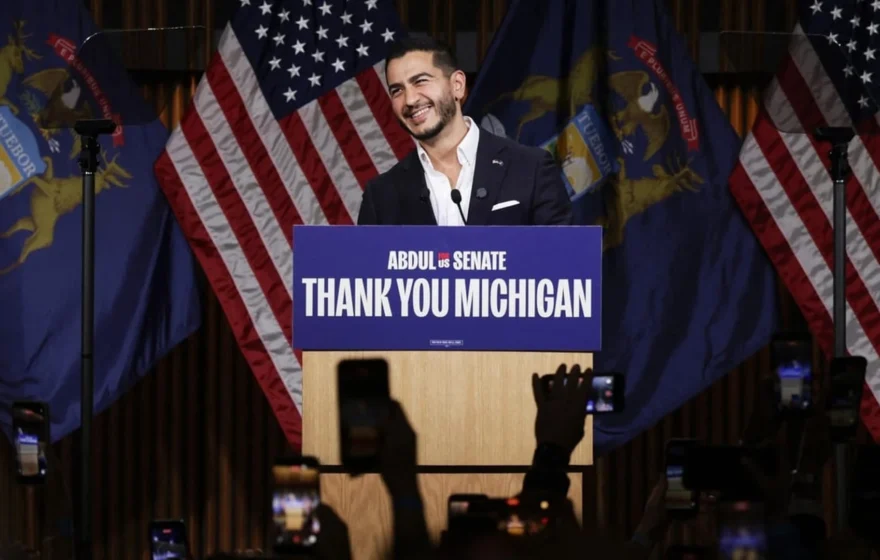
Newly elected United States Senator Abdul El-Sayed has said he wants to ban unconditional American military aid to Pakistan, a position that could strain one of the oldest strands of the relationship between Washington and Islamabad. El-Sayed, a Democrat from Michigan who made history last week by becoming the first Muslim ever elected to the US Senate, said the same rule should apply to every country that receives American weapons and money, and he framed the argument in simple terms: American tax dollars should pay for schools and hospitals at home, not for bombs and tanks abroad.
He made the remarks at a town hall in Ann Arbor on October 26, where he appeared alongside veteran Senator Bernie Sanders at the Michigan Theater. El-Sayed said the United States should stop writing blank cheques for foreign governments. Right now, he told the audience, those countries are getting bombs and tanks and unconditional foreign military aid, and he wants that to end, naming Israel, Egypt, Jordan, Pakistan, Saudi Arabia and Qatar in the same breath. He added that Americans pay their taxes so their children can go to good schools.
The point El-Sayed was keen to stress was that he was not singling out any one country. He has said he would apply the same standard to every recipient, including Egypt, the country his own family emigrated from, rather than picking on Israel alone. That distinction matters, because his campaign was repeatedly attacked over his criticism of American military support for Israel.
El-Sayed is 42 years old, a physician and former public health official who was born and raised in the Detroit area and is the son of Egyptian immigrants. He defeated Republican Mike Rogers, a former congressman backed by President Donald Trump, by about seven points to win the seat being vacated by retiring Democratic Senator Gary Peters, after beating Congresswoman Haley Stevens in the Democratic primary in August. He will be sworn in when the new Congress convenes in January.
His comments matter for Pakistan because the country has a long and troubled history with American military assistance. Pakistan formally became a major non-NATO ally of the United States in 2004, and between the financial years 2002 and 2017 Congress appropriated about 33 billion dollars in American assistance to Pakistan, according to the Congressional Research Service. Around 14.5 billion dollars of that came through the Coalition Support Funds, which repaid allies for supporting counter-insurgency operations, about 11 billion dollars was economic assistance, and about 8.2 billion dollars was security-related. That flow of money and equipment was built around the war in Afghanistan, but lawmakers in Washington regularly questioned whether Islamabad was doing enough against militant groups along the Afghan border.
The relationship reached its lowest point in January 2018, when the first Trump administration suspended all security assistance to Pakistan, including payments through the Coalition Support Funds and the transfer of security-related equipment. The administration said Pakistan had failed to take decisive action against the Afghan Taliban and the Haqqani network, and President Trump accused Pakistan of giving America nothing but lies and deceit in return for more than 33 billion dollars in aid. The suspension froze 255 million dollars in Foreign Military Financing, and later that year the Pentagon cancelled a further 300 million dollars in Coalition Support Funds, while Congress stripped another 500 million dollars from the programme, bringing the total withheld to about 800 million dollars.
Since then Pakistan has repeatedly asked Washington to restore that assistance, arguing that it bore enormous costs in the war on terror. American aid has been switched on and off before, cut back sharply in the 1990s and restored in large volumes after the attacks of September 11, 2001. A new senator arguing that military aid should come with conditions carries weight when he intends to vote on the very bills that decide where the money goes.
It is important to be clear about what El-Sayed can and cannot do on his own. A single senator cannot ban foreign aid by himself, and the power to approve or block assistance rests with Congress as a whole and with the president. What he can do is vote on foreign aid legislation, push to attach conditions to the money, and work with like-minded senators to block blank-cheque assistance. For Islamabad, the practical question is whether the argument gains support in the Senate, where conditions on assistance to Pakistan have been debated for years.
For now, the episode tells Pakistan two things. First, the debate in Washington about military aid is not going away, and a new generation of American lawmakers is openly questioning whether the United States should keep sending weapons abroad. Second, the future of American assistance to Pakistan is more likely to be decided on conditions than on the old pattern of unconditional support, and Islamabad will need to make its case in a Congress where voices like El-Sayed’s are growing louder. His victory alone does not change the law, but the months after he takes his seat in January will show whether that voice turns into votes.
