A confidential United Nations report has laid out how a network of companies and facilities linked to the United Arab Emirates allegedly moved hundreds of Colombian former soldiers into Sudan to fight alongside the paramilitary Rapid Support Forces, the group at the centre of some of the worst atrocities of the country’s war.
The report, submitted to the UN Security Council in early November and first disclosed by The New York Times on November 5, identifies the Abu Dhabi-based Global Security Services Group, known as GSSG, as the principal recruiter of the Colombian fighters. The company arranged their recruitment, training and movement into Sudan, where they served in a unit known as the Desert Wolves. The fighters reportedly operated drones, handled artillery, fought as infantry and trained RSF combatants, playing what investigators describe as a significant role in the paramilitary force’s operations in Darfur.
The routes the fighters are said to have taken run through some of the most fragile corners of the region. UN investigators traced their movement through Libya, Somalia and Chad before they reached Sudan. A base operated by the UAE-linked Puntland Maritime Police Force in Bosaso, on Somalia’s northern coast, was identified as a place used for the transit or training of the Colombians before deployment. Training locations inside the Emirates were also named, including facilities in Abu Dhabi, Ghayathi and al-Wathba. The picture is not of stray volunteers but of an organised pipeline, with recruitment in one continent, preparation in another and combat in a third.
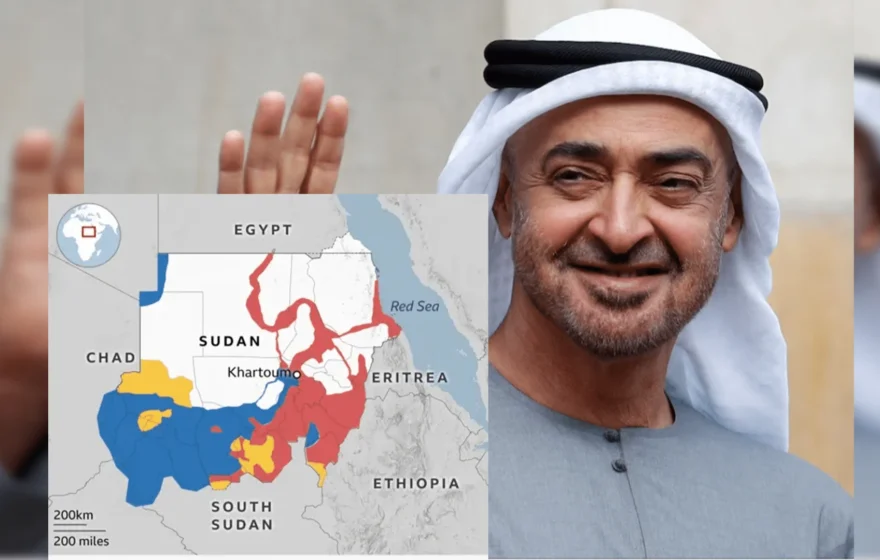
The fighters’ most consequential deployment, according to the report, came during the long siege and capture of el-Fasher, the capital of North Darfur and the last major city in the region still held by the Sudanese army. The RSF surrounded the city for around eighteen months, cutting off food supplies and striking its hospitals and markets, before a final ground assault in late October 2025. The city fell within days. Amnesty International later documented crimes against humanity and ethnic cleansing during the campaign, with communities including the Zaghawa singled out for abuse. A UN fact-finding mission concluded in February that the mass killings carried the hallmarks of genocide. A year on, fewer than 70,000 people remain in a city that was once home to more than a million.
The new report builds on a growing body of findings that have pointed in the same direction for months. In July 2026, the UN panel monitoring the Darfur arms embargo told the Security Council that the UAE had supported the RSF by providing mercenaries, and said the Colombians had trained at two military bases in Abu Dhabi before deployment. Two months later, the UN’s Independent International Fact-Finding Mission for Sudan reported that there were reasonable grounds to believe a transnational network had supplied the RSF with weapons, logistics, training and foreign fighters through the Emirates, Chad, Libya, Puntland and Colombia. That mission was careful to draw a line, however: it did not attribute the network’s conduct to the Emirati state itself.
Human Rights Watch added further detail in an 83-page report published in May 2026, titled From Bogota to El Fasher, which documented how GSSG appeared to have hired hundreds of Colombian former military personnel from 2024 onwards. The organisation traced recruitment to a Colombia-based agency called A4SI, whose contractors signed contracts with GSSG and were transferred through UAE military facilities before deployment to Sudan. Estimates of the total involved have varied, from several hundred to roughly 1,500 to 2,000. The United States Treasury has already acted on parts of the chain, sanctioning A4SI in December 2025 and its renamed successor in April 2026.
The UAE has consistently and firmly rejected the allegations. Abu Dhabi maintains that it is not involved in supporting the RSF’s military operations and denies providing military assistance to either side in Sudan’s war. In its responses to UN investigators, the Emirates said the company named in the report had not deployed mercenaries to Sudan and had not violated Emirati law, and it has said its own inquiries found no link between entities under its jurisdiction and mercenary activity. The denials now sit alongside the most detailed UN accounting yet of the external support sustaining the RSF, in a war that has killed hundreds of thousands of people since it erupted in April 2023 between the RSF and the Sudanese Armed Forces.
The timing adds a further dimension to the dispute. The findings have intensified scrutiny of the UAE’s nomination of its diplomat Lana Nusseibeh to lead the United Nations, with critics asking how a country facing such allegations can put forward a candidate for the organisation’s top job. For the Security Council, the question is whether the evidence will lead to new sanctions or simply join the long list of warnings about Sudan that have gone unanswered. The war is now in its fourth year, famine risks are rising in Darfur and the Kordofans, and the people of el-Fasher are still waiting for the world to act on what has already been documented. This report, secret until now, makes that wait harder to justify.
