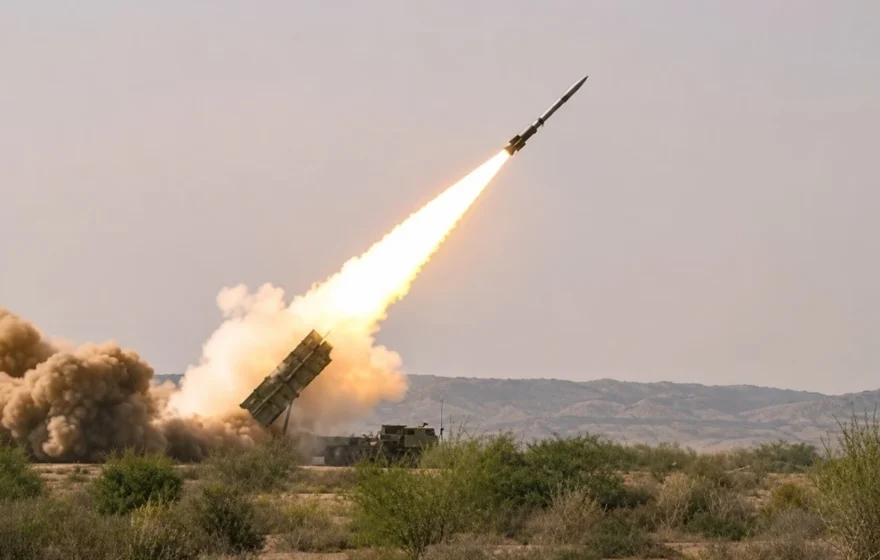
The Pakistan Army has successfully test-fired the Fatah-3 supersonic cruise missile, marking another milestone in the country’s defence capabilities and adding a new weapon to a missile programme that has expanded rapidly over the past two years. The military’s media wing, Inter-Services Public Relations, announced the successful launch on Wednesday, describing the missile as a system equipped with advanced navigation and propulsion technology that can strike targets at long range with high precision while travelling faster than the speed of sound.
According to the ISPR statement, the Fatah-3 is capable of engaging targets at long range with what the military called high precision and lethality at supersonic speed. The announcement did not disclose the missile’s maximum range, its exact speed, or the location of the test. What the military did make clear is the purpose the weapon is intended to serve: the Fatah-3 will significantly enhance the operational flexibility and strike reach of the Pakistan Army’s Rocket Force Command, further strengthening the country’s conventional deterrence and overall defence posture.
The launch was witnessed by the Commander of the Army Rocket Force Command, senior officers of the Pakistan Armed Forces, and the scientists and engineers involved in developing the weapon system. The successful test drew praise from the top of the state and the military, with President Asif Ali Zardari, Prime Minister Shehbaz Sharif, the Chief of Army Staff and Chief of Defence Forces, Field Marshal Asim Munir, and the services chiefs all commending the teams behind it.
The Fatah-3 is not a weapon that appeared out of nowhere. Defence analysts had already been tracking it since May this year, when the ISPR revealed the system in a video and described it as a ramjet-powered supersonic cruise missile, designed for both land-attack and anti-ship missions. Analysts who have studied the system estimate it can sustain speeds of roughly Mach 2.2 to Mach 3.5, several times faster than the subsonic cruise missiles Pakistan already operates, although those figures are estimates rather than officially confirmed specifications. A ramjet engine uses the missile’s own forward speed to compress incoming air, making sustained supersonic flight possible at the lower altitudes where a cruise missile is hardest to detect and intercept.
The Fatah-3 is the third member of a broader family of weapons that has become the backbone of Pakistan’s conventional strike capability. The original Fatah-1 is a guided rocket system, while the Fatah-2 is a manoeuvrable ballistic missile with a range of around 400 kilometres. The Fatah-4, a subsonic ground-launched cruise missile with a range of about 750 kilometres, added a longer reach, and the programme has continued to grow this autumn, with an extended-range Fatah-4 tested on 6 October and an extended-range Fatah-2 following a week later. Together, the family now spans short-range rockets, manoeuvrable ballistic missiles, and cruise missiles at both subsonic and supersonic speeds.
The test also has to be read against the events of this year. Pakistan’s Fatah-1 and Fatah-2 systems were reported to have been used during the four-day conflict with India in May, a confrontation that ended in a ceasefire but left both countries determined to sharpen their conventional arsenals. Since then, both sides have pressed ahead with missile development, and the Fatah-3 launch fits squarely into that pattern: Pakistan’s missile programme is not standing still, and the Rocket Force Command is steadily building a layered strike capability.
There is a reason supersonic cruise missiles attract so much attention from military planners. Speed compresses the time an enemy has to react, and a missile that flies low and fast gives air defences a much smaller window in which to detect, track and intercept it. The Fatah-3’s reported land-attack and anti-ship roles would give it added flexibility, although the military has not yet said how it intends to deploy it.
For all the significance of the announcement, much about the Fatah-3 remains unknown. The ISPR statement gave no range or speed figures, no details about the target used in the test, and no indication of when the missile will be formally inducted into service or produced in numbers. That silence is not unusual, since militaries routinely announce a successful test while keeping the precise performance of a new weapon classified. But it does mean the real test of the Fatah-3 lies ahead: a single successful launch shows the system works, yet it does not by itself prove the missile can be produced at scale and kept in a state of readiness.
What the test does demonstrate is the direction of Pakistan’s military thinking. The creation of the Army Rocket Force Command, and the steady expansion of the Fatah family within it, shows a deliberate effort to organise conventional firepower across different ranges and flight profiles rather than relying on a single missile type. In a region where the military balance is watched closely, that kind of capability is as much a signal as it is a weapon: a statement to a rival that Pakistan can reach further and faster than before, and a reassurance at home that the armed forces are continuing to modernise.
