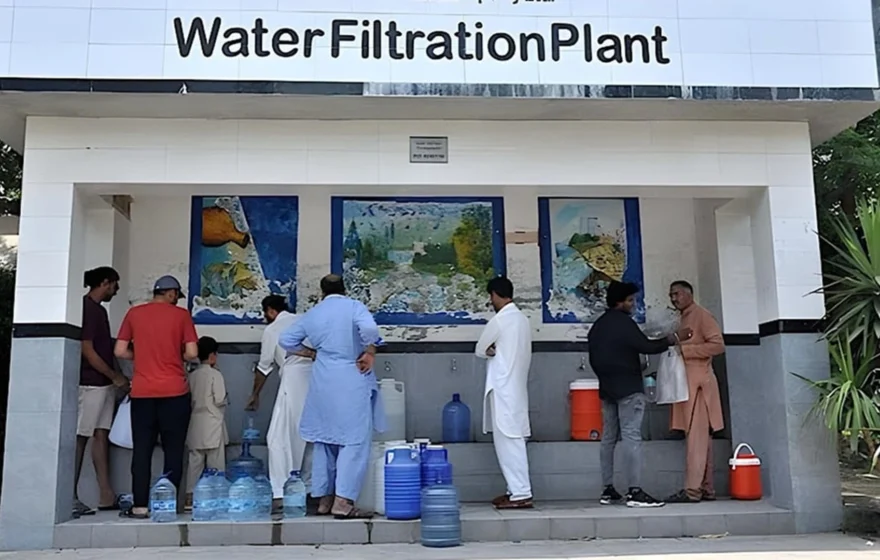
Punjab Chief Minister Maryam Nawaz Sharif has given the province until June 2027 to finish 5,734 water filtration plants, telling officials that the plants must not only be completed on time but kept working properly afterwards. The direction came as she chaired a meeting of the Punjab Saaf Pani Authority on Sunday, where the focus was squarely on whether people in streets and neighbourhoods across the province are actually getting clean drinking water.
To keep a closer eye on the work, the chief minister ordered assistant commissioners to supervise the filtration plants in their areas and to set up public committees that will watch how each plant performs. The idea is that local oversight will catch faults early, rather than leaving a plant to sit broken while residents go without safe water. Alongside that, mobile maintenance units staffed with plumbers and technical workers will be set up in every tehsil, so repairs can be carried out quickly when a plant breaks down.
The meeting also approved a Last-Mile Water Supply Project aimed at reaching areas that are still without clean drinking water in Chakwal, Rajanpur and Rawalpindi. Officials were told to give priority to supply schemes covering 256 kilometres in Chakwal and 1,780 kilometres in Rajanpur, a scale that shows how far the remaining work still stretches in those districts. The chief minister was also briefed on water bottling plants in Khushab, Dera Ghazi Khan, Rahim Yar Khan and Bahawalpur, which together turn out 10,000 bottles of 19 litres each every day.
According to that briefing, around 4.8 million people have already benefited from the Chief Minister’s Water Bottling Project, while more than 75,000 bottles of drinking water have been delivered directly to households. Those figures point to a programme that is already reaching a large number of families, even as the larger filtration network is still being completed. Maryam Nawaz told the meeting that access to clean drinking water is every citizen’s right, and she pledged to extend water supply schemes to other areas once the work in Chakwal, Rajanpur and Rawalpindi is done. The June 2027 deadline now gives officials a clear date to work towards, and the test will be whether the plants finished by then stay in working order long after the ribbon is cut.
