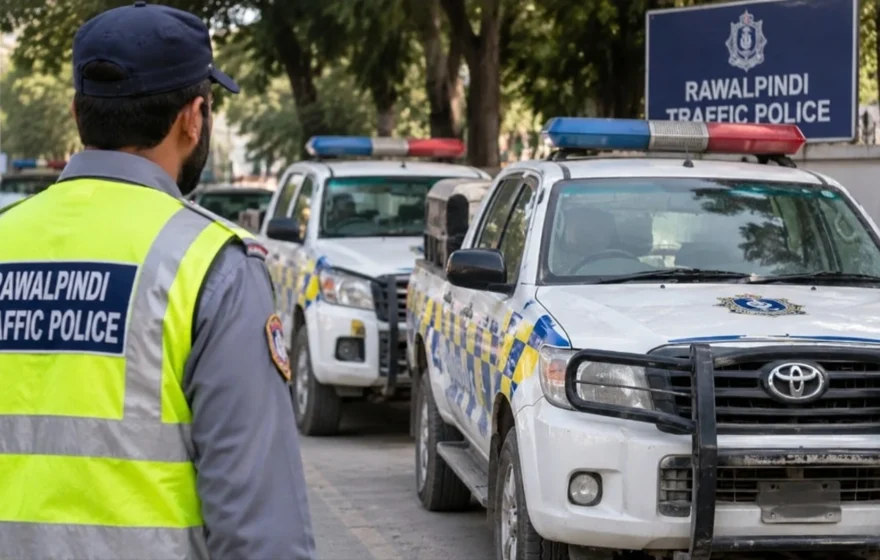
Rawalpindi Traffic Police has begun inspecting its own vehicles, and any unit found mechanically unfit will stay off the road until it is repaired. The move puts the department’s own fleet under the same fitness rules it enforces on the public, at a moment when Punjab is tightening its grip on smoke-emitting vehicles and the smog season is settling in.
Chief Traffic Officer Farhan Aslam said the inspection is being carried out in phases, and the first round took place on Friday. Officers examined fifteen vehicles at the Police Lines, and three of them, including two forklifts, were found in poor mechanical condition, pumping out visible smoke. All three were taken off field duty at once, and they will not return to service until the necessary repairs are complete.
The inspection was led by Deputy Superintendent of Police Traffic Headquarters Muhammad Kaleem Akhtar, who carried out a detailed review of each vehicle. His team checked the engine oil, the mechanical and electrical systems, and the overall condition of the official vehicles, the same checks wardens apply to ordinary motorists. He directed the Motor Transport Officer to arrange the repairs without delay and to keep maintenance regular from now on, while drivers found negligent in looking after government vehicles will face departmental action.
The scale of the task is considerable. Rawalpindi Traffic Police operates a fleet of forty-five vehicles, including forklifts, and around five hundred and fifty motorcycles, used for traffic management across the city and for VVIP security duties. The remaining vehicles will be inspected over the coming days. A department cannot credibly enforce fitness rules with vehicles that would fail its own checks.
The timing is no accident. The inspection began days after Minister of State for Interior Tallal Chaudhry chaired a meeting to review the smog situation, air quality and pollution control in Islamabad. In that meeting it was decided that vehicles without fitness and emission test certificates will not be allowed to enter the capital. The minister said fitness was already a legal requirement that had been overlooked for quite some time, and that strict enforcement had now begun in earnest, with unfit vehicles to be impounded and first information reports lodged on serious violations.
Rawalpindi has been moving in the same direction for weeks. In mid-October the traffic police launched a large-scale crackdown on smoke-emitting vehicles, on the directives of Punjab Chief Minister Maryam Nawaz and Chief Traffic Officer Aslam, with special squads posted at transport terminals and at the city’s entry and exit points. Vehicles found emitting smoke are impounded and their owners fined heavily, and they remain impounded until the owners obtain valid fitness certificates.
The action sits inside a much wider enforcement drive across Punjab. The provincial Transport Department inspected as many as five thousand vehicles during a week-long crackdown from the first to the seventh of November, issuing challans to six hundred and fifty-nine vehicles for lacking fitness certificates and emitting excessive smoke, and impounding four hundred and nine vehicles. Four hundred and forty-two overloaded goods vehicles were also fined a total of two point six million rupees. Provincial Minister for Transport Bilal Akbar Khan has said there will be zero concession for smoke-emitting vehicles or automobiles operating without fitness certificates.
Private motorists are being drawn into the same regime. Punjab vehicle owners have until the thirty-first of December to obtain the mandatory vehicle emissions fitness certificate where their cars fall under the testing requirement, with testing carried out through authorised Private Vehicle Inspection and Certification System centres, with Lahore first in the rollout. Cars are exempt for their first five, six or seven years depending on engine capacity, and the remaining owners pay between five hundred and two thousand rupees for testing. The Environment Protection Agency says it tested around three hundred thousand vehicles last year.
The urgency behind all of this was on display again on Friday, when heavy smog pushed air quality in several Punjab cities into the hazardous category. Lahore recorded an hourly air quality reading of four hundred and sixty-five on Friday morning, while Gujranwala and Multan registered readings of six hundred and sixty-one and six hundred and forty-one respectively. Lahore’s Deputy Commissioner ordered a crackdown, with officials saying they had impounded twenty-one smoke-emitting vehicles and issued challans to fifty-four vehicles, fined a total of two hundred and sixteen thousand rupees.
The significance of Rawalpindi’s move lies less in three grounded vehicles than in the signal it sends. Enforcement bodies that ask the public to meet a standard must be seen to meet it themselves, and a police vehicle trailing smoke undermines every challan its wardens issue. The real test will be in what follows: whether the remaining thirty vehicles and the five hundred and fifty motorcycles pass their checks, and whether the three grounded vehicles actually return repaired rather than quietly slipping back into service. If the department keeps the results visible, the exercise becomes a template for other government departments whose own vehicles are among the worst offenders on Punjab’s roads, and the fitness regime stops looking like a rule for the public alone.
