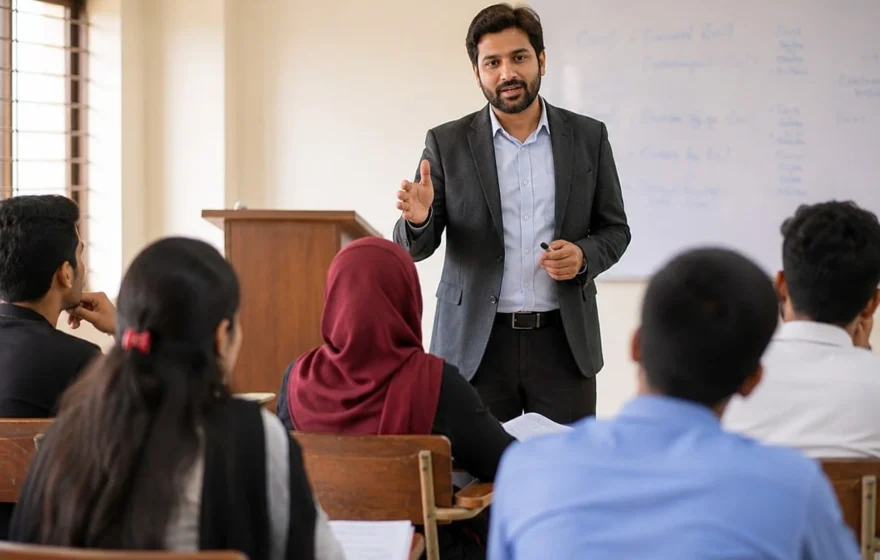
The Sindh government has made training mandatory for principals and administrative officers of government colleges, with no leave or exemptions allowed for nominated participants. The College Education Department has issued a schedule for the programme, which will begin on November 23, 2026, at the Training, Management and Research Wing, known as the TMR Wing, of the Services, General Administration and Coordination Department in Karachi.
The training will cover financial management, project management, civil service rules, procurement, leadership, and digital governance. Sessions will run from 8:45 in the morning until 6:30 in the evening, making for long and intensive days. All nominated officers have been directed to attend the sessions and to follow the requirements on attendance, punctuality and discipline strictly. Participants must also bring their laptops, so that the practical parts of the training, particularly those dealing with digital governance and financial systems, can be carried out properly.
Officers travelling from outside Karachi will have to arrange their own accommodation, and all participants will be required to submit a report to their respective departments when the training is complete. Formal instructions have been issued to make sure that every nominated officer takes part, and the message from the department is unambiguous: this is not a voluntary course that can be skipped, but a requirement of the job.
The programme is the latest step in an effort that began last year to prepare college teachers for the administrative side of running a college. In August 2025, for the first time in Sindh’s history, a structured training programme was launched for college teachers in administrative roles and responsibilities. The inaugural session was held at the TMR Wing in Karachi, where Education Minister Syed Sardar Ali Shah told participants that the process of learning should never stop, and that strengthening principals and administrative officers would improve the quality of colleges. College Education Secretary Shahab Qamar Ansari said at the time that 200 teachers from across Sindh would be trained in that phase, in batches of 30, covering services, procurement, financial management, human resources and the rules and regulations that govern their work. Those who completed the training, he added, would be given priority when appointments as principals and administrative officers were made in future.
That background matters, because the job of a college principal in Sindh involves far more than teaching. A principal is responsible for the college’s budget, purchasing, staff management, admissions and examinations, and for dealing with the education department itself, yet many of those asked to take on the role have spent their careers in the classroom with little or no training in management.
The subjects chosen for the new programme reflect that gap. Financial management and procurement are at the heart of running a public college, where every purchase must follow government rules and every rupee must be accounted for. Civil service rules govern appointments, leave, discipline and promotions, and a principal who does not understand them can easily make mistakes that cause problems for staff and for the college. Project management matters because colleges are frequently involved in building work, repairs and development schemes. Leadership and digital governance point to the direction the department wants to move in, with college administration increasingly expected to work through online systems rather than paper files.
The decision to make the training compulsory, with no leave or exemptions, is a sign of how seriously the department is taking it. In the past, training courses for government officers have often suffered from poor attendance, with nominated participants finding reasons to stay away. The requirement to bring a laptop and to submit a report afterwards reinforces the point: this is meant to be a working course, not a formality.
There is also a wider context. Teacher associations in Sindh have complained for some time that principal posts in more than half of the province’s colleges are vacant or filled by junior officers, and that political interference has affected appointments. In that environment, a systematic training programme that prepares a pool of qualified officers for senior roles is a practical step, even if it does not by itself resolve the disputes over who gets appointed. The department’s hope appears to be that, over time, a trained cadre of principals will make the colleges easier to run and harder to mismanage.
For the officers who will attend from November 23, the immediate reality will be long days at the TMR Wing, beginning before nine in the morning and ending after half past six in the evening, with laptops open and reports to write. It will not be an easy week, particularly for those travelling from other parts of Sindh who must find their own accommodation in Karachi. But if the programme delivers what it promises, those officers will return to their colleges with a clearer understanding of the rules they work under, the money they manage, and the responsibilities they carry. In a province where the quality of a college often depends on the person running it, that is a change worth making.
