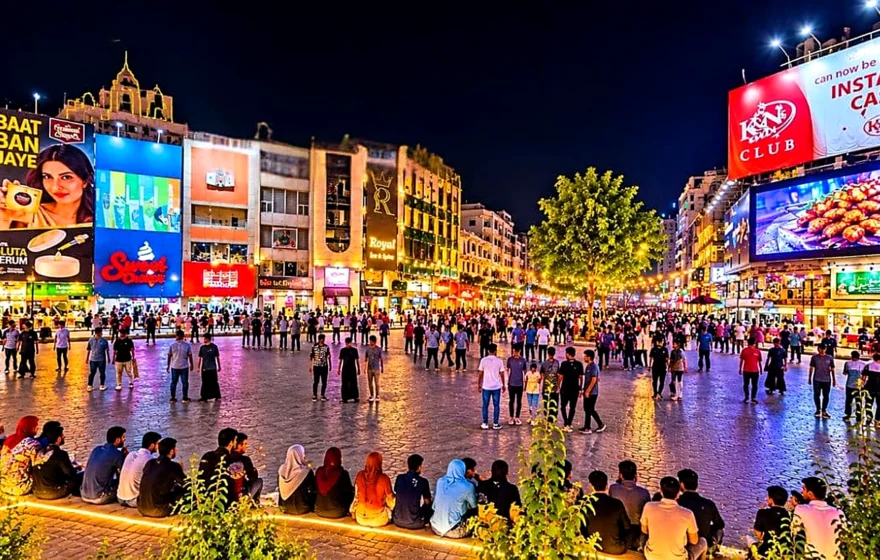
Karachi has a new address for an evening out. Sindh Chief Minister Syed Murad Ali Shah on Sunday evening formally opened the Sindhi Muslim Food Walk in Chanesar Town, a one-kilometre stretch near Tariq Road rebuilt at a cost of Rs250 million into a car-free, pedestrian-friendly dining destination. The project turns a traditional food street already popular with visitors from across the city into a properly organised public space, with new roads, lighting, drainage and parking, and a nightly window in which vehicles are kept out so families can stroll, sit and eat in comfort.
The inauguration itself set the tone the organisers want the place to keep. The chief minister unveiled the plaque, congratulated Chanesar Town Municipal Corporation Chairman Farhan Ghani, the municipal commissioner, engineers, contractors and workers who had carried the scheme through to completion, and then walked the length of the new food walk himself. He stopped at eateries along the way, spoke to restaurant owners, customers and passers-by, and posed for selfies with citizens who had gathered for the occasion, while musical performances and a fireworks display gave the opening a festive air.
Work on the scheme began on February 1 this year and was completed last month, with the town administration executing it from its own resources. The chief minister urged other town administrations across Karachi to attempt similar projects by improving their revenue collection and using their funds efficiently. The message was that a town which manages its own money well can deliver a visible improvement to daily life without waiting for a mega-project. He also promised to visit the food walk at least once a month himself, and assured residents that its maintenance and security would be looked after, a pledge that will matter as much as the opening ceremony in deciding whether the place thrives.
The physical transformation goes well beyond a fresh coat of paint. Sewerage lines along the stretch have been replaced, electrical cabling has been taken underground and overhead wires removed, and roads and footpaths have been rebuilt for pedestrians rather than for through traffic. Modern streetlights, bollard lights and decorative lighting now illuminate the walk after dark, roundabouts have been planted and landscaped, and parking facilities and diversion roads have been improved so that visitors arriving by car have somewhere sensible to leave their vehicles. The result, between Shahrah-e-Faisal and Shahrah-e-Quaideen, opposite Tariq Road, is a dining strip designed to be walked rather than driven through, and that distinction is central to its appeal.
That car-free character is enforced every evening. Regular vehicles are kept out of the food walk from 6pm to 2am, the hours when Karachi’s food streets traditionally come alive, so that families with children, elderly visitors and groups of friends can move freely between eateries without dodging traffic. The food on offer spans the range Karachi’s diners expect: traditional Pakistani dishes and barbecue sit alongside Chinese food, fast food, ice cream and shakes. For restaurant owners, the hope is that a cleaner, safer and better-lit setting will bring steadier evening trade, while for residents the gain is a neighbourhood asset they can use every day.
The new food walk joins a long and much-loved tradition. Karachi’s reputation as Pakistan’s great food city rests substantially on its street food, shaped by the communities that have settled here since Partition brought Mughlai and Awadhi cooking from Delhi, Lucknow and Hyderabad Deccan, alongside Pashtun grills and other regional flavours. Burns Road, in the old downtown near Empress Market, remains the benchmark for many food lovers, famous for its nihari, haleem, biryani and bun kebabs, while Boat Basin in Clifton draws late-night crowds for barbecue and rolls and Do Darya offers seafood beside the Arabian Sea. The Sindhi Muslim strip, long known as a food destination in its own right, now enters that company with a deliberate advantage: it has been planned as a single, coherent space rather than growing up piecemeal.
There is also a wider civic argument behind the project. The chief minister described the food walk not as a beautification exercise but as a comprehensive urban improvement initiative, intended to make the area more accessible, attractive and convenient for businesses, visitors and residents alike. Organised commercial spaces, he argued, can attract investment, generate employment and strengthen economic activity at neighbourhood level. If the Sindhi Muslim Food Walk sustains its early promise, it could become a template for other towns, each adapting the idea to its own streets and traders.
The real test, however, begins now that the speeches and fireworks are over. Food streets live or die on upkeep: drains that stay clear, lights that stay on, footpaths that stay walkable, and security that makes families comfortable returning week after week. The town administration’s promise of proper maintenance and security, and the chief minister’s pledge of monthly visits, give residents a clear standard to hold the project to. If those pieces hold together, the Rs250 million spent here will look like money well used. For now, the lights are on, the grills are lit, and the city’s newest food walk is open for business.
