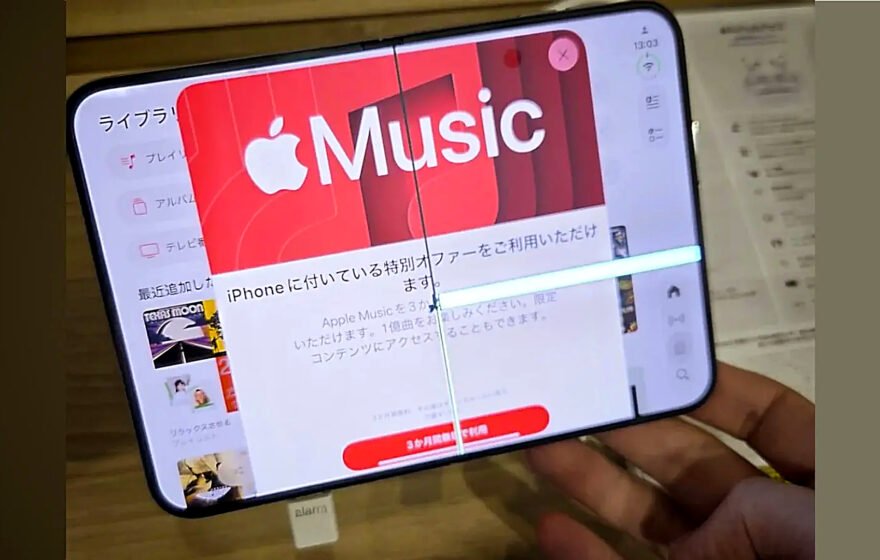
Apple’s first foldable phone has stumbled badly just a day after going on sale, after the iPhone Duo failed a widely watched iPhone Duo durability test that left its folding screen damaged and its hinge jammed with dust. The result is an awkward start for a device Apple has pitched as its most ambitious iPhone yet, and it lands at the worst possible moment, with early buyers already reporting cracked screens of their own.
The test was carried out by Zack Nelson, who runs the YouTube channel JerryRigEverything and has been putting folding phones through the same punishing routine since the first generation arrived. His verdict was blunt. Most folding phones survive his tests, he said, but the iPhone Duo did not, a conclusion that will be hard for Apple to shrug off given how much of the Duo’s appeal rests on its hinge and its folding display.
The trouble began with dust. Despite the phone’s IP68 rating for dust and water resistance, Nelson covered the handset in sand and dirt and watched the grit work its way into the hinge. Once it was in there, the magnets that are supposed to pull the two halves shut could no longer do their job, and the phone stayed slightly open for the rest of the test. For a device designed to fold flat and slip into a pocket, a hinge that cannot close properly is about as fundamental a problem as it gets.

Photo: Wikimedia Commons
The screens told a mixed story. The outer display, protected by Apple’s Ceramic Shield 2 glass, held up well and only picked up faint marks at level 7 on the Mohs hardness scale, which is roughly where a regular flagship phone sits. The flexible 7.6-inch inner screen was a different matter entirely, scratching at level 2, a point so soft that even a fingernail can leave a mark. Nelson did credit the screen’s matte nano-texture coating for hiding most of those scratches while the display is switched on, but the marks themselves are permanent, and he warned that replacing the inner screen costs around $1,000.
The bend test was worse still. Bending the open phone backwards left a permanent green line across the inner display, and a second attempt added more lines before the screen stopped responding to touch altogether. By the end of the test, the phone that had been sold as a triumph of engineering could no longer close properly or register touches on its main display.
Early owners appear to be running into problems of their own. Clips shared online show apps struggling with the new form factor, with one widely circulated video showing a video app shrinking into a small window instead of filling the larger screen when the phone is unfolded. Separate reports from buyers describe inner screens cracking along the hinge within hours of purchase, including one owner in Australia who said the display broke after fewer than 20 openings and roughly six hours of use, with no sign of any impact damage, and who reported that an Apple store replaced the device on the spot. Apple has not commented publicly on the test or on the early complaints.
Some perspective is worth keeping. Nelson’s tests are deliberately far harsher than anything a phone will face in a pocket or a bag, a single test unit says nothing reliable about failure rates, and he himself could not say whether the trapped dust or the flexing of the hinge was what finally killed the screen. Some reviewers have also run folding tests on early units without any trouble. Even so, the contrast with Samsung is uncomfortable for Apple, since the Galaxy Z Fold 8, now in its eighth generation of folding phones, came through the same tester’s bend test with its screen still working.
That is the real sting for Apple. The Duo went on sale on October 23 starting at $1,999, making it the most expensive iPhone the company has ever sold, and its precision-engineered hinge was meant to be the proof that Apple had solved the problems that have dogged folding phones for years. Instead, within a day of launch, buyers weighing that kind of money have been given a vivid reason to wait, whether for a response from Apple, for longer-term reports from owners, or for a second generation that irons out what the first could not. The Duo may yet prove itself in everyday use, but its opening weekend will now be remembered less for its design than for the test it failed.
