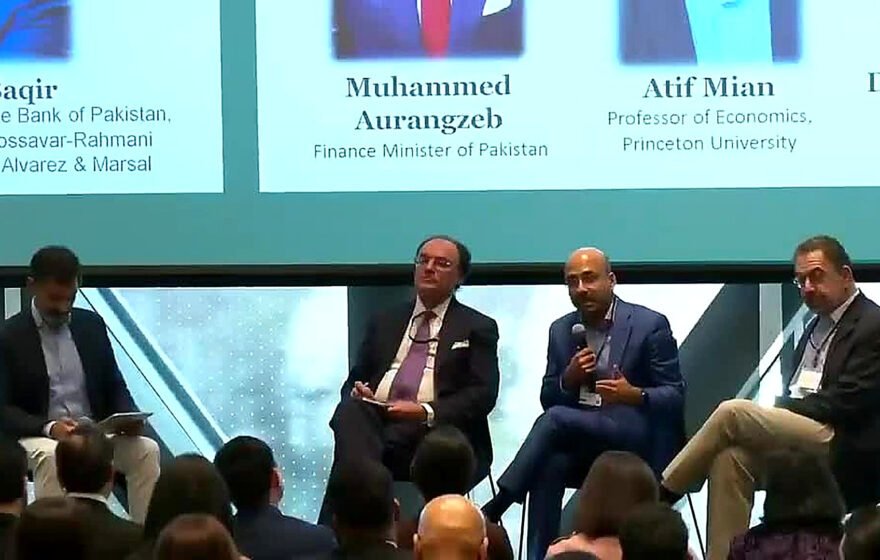
Renowned Princeton economist Atif Mian has set off a fierce debate about Pakistan’s economic model, arguing that the country effectively sends its workers abroad so that its wealthy elite can enjoy a more comfortable life in places like the Defence Housing Authority. His remarks, made during a panel discussion at the Pakistan Conference at Harvard University, have spread rapidly online after he shared a clip of the exchange on X, where it quickly went viral.
Mian shared the stage with Finance Minister Muhammad Aurangzeb, former State Bank of Pakistan governor Reza Baqir and Nobel laureate Daron Acemoglu, and his intervention cut straight to the heart of how Pakistan earns its foreign exchange. He said the policy of encouraging Pakistanis to work overseas is designed to bring their earnings home, and that those inflows then allow the elite to live more comfortably in upscale housing societies. That way of thinking, he insisted, has to change.
At the centre of his argument is Pakistan’s heavy dependence on remittances, which he described as particularly dangerous from a political economy perspective. He noted that the money sent home by overseas workers is now almost equal to the country’s export earnings, while remittances amount to close to ten per cent of gross domestic product. Rather than treating that as a warning sign, he said, Pakistan celebrates it, with policy papers openly setting the goal of pushing remittances even higher.

Photo: Wikimedia Commons
Mian turned that logic on its head, arguing that in a country growing the right way, remittances should shrink as a share of the economy rather than grow. When people can find decent work and a good life at home, he said, they stay instead of leaving, and the need to depend on money sent from abroad fades. The audience greeted that point with applause, a reaction that underlines how widely the frustration resonates.
He linked the remittance trap directly to Pakistan’s weak export performance and its exchange rate. Keeping the rupee overvalued, he argued, acts as a tax on exporters, because it makes Pakistani goods more expensive abroad. The arrangement suits the elite, he said, because their wealth comes largely from sectors that are not traded internationally, above all land. A strong rupee, meanwhile, increases their purchasing power for foreign travel and imported goods, so they have little reason to press for change.
The scale of the flows Mian is talking about is striking. According to State Bank of Pakistan data, overseas workers sent home a record 38.3 billion dollars in the 2024-25 fiscal year, up sharply from 30.3 billion dollars the year before. Mian himself has written that around ten million Pakistanis live abroad and that their remittances now run to roughly 38 billion dollars a year, about a tenth of the economy. He has warned before that when such inflows are left unmanaged they push up the currency in real terms and hollow out the export sector, a pattern economists call Dutch disease, and he has long argued that Pakistan needs sustained growth of around five per cent a year to repair decades of lost ground.
Mian is no stranger to blunt warnings about Pakistan’s economy. The Princeton professor co-authored the acclaimed book House of Debt and co-founded the Centre for Economic Research in Pakistan, and his work has repeatedly returned to the same theme: an economy organised around consumption and real estate rather than production will keep disappointing its people. His latest remarks fit that longer critique, framing remittances not as a triumph to be celebrated but as a symptom of an economy that has not created enough opportunity at home.
Whether policymakers take the message on board is another matter, because changing the incentives Mian describes would mean confronting the very groups that benefit from them today. As long as land and other non-tradable assets reward their owners more richly than factories and exporters, the system will keep pushing workers abroad and celebrating the money they send back. The viral reaction to his Harvard remarks suggests the public is ready for that conversation, even if the country’s economic elite is not.
