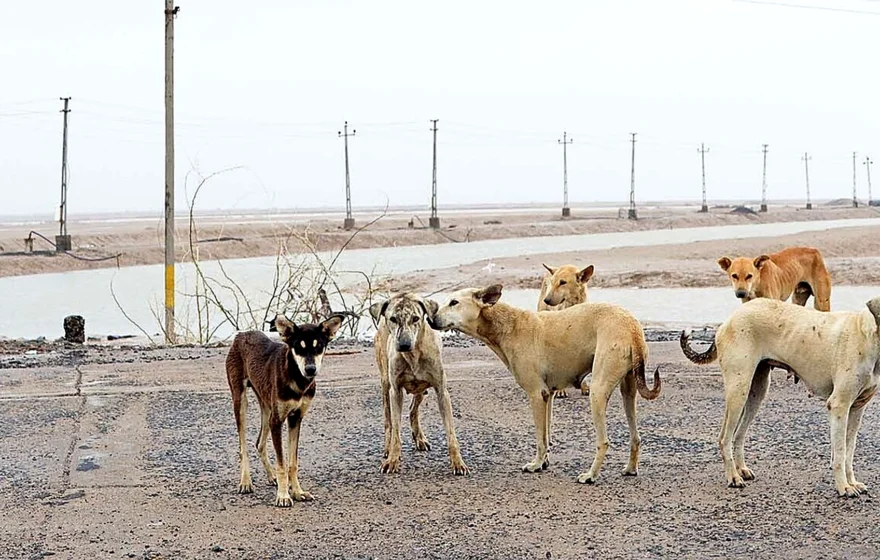
The Mardan Cantonment Board has begun a fresh drive against stray dogs in the cantonment area, saying it is responding to growing complaints from residents who feel unsafe in their own neighbourhoods. Dozens of stray dogs have already been culled in the operation, according to the board, and officials say the campaign will continue across the cantonment until people can move around without fear.
Residents told the board that stray dogs had become a regular presence in residential streets and around public buildings, making daily life harder, particularly for children walking to school, worshippers heading to mosques, and patients visiting hospitals. The board says the problem was worst in the morning and evening, when streets fill with schoolchildren and worshippers and the chance of an unwanted encounter rises sharply.
According to board officials, the campaign relies on poisoned bait, with a dedicated dog removal team carrying out targeted operations where complaints have been strongest. The team has concentrated its work around mosques, schools, hospitals and other public facilities, where large numbers of people gather daily and a frightened child or elderly person would have little room to get out of the way.
Dr Raza Shah, the Chief Executive Officer of the Cantonment Board, briefed journalists on the operation and explained how the board had organised its response. He said a special team had been deployed to remove stray dogs from different localities within the cantonment limits, giving priority to areas where dogs were disrupting daily routines and raising the risk of attacks.
Dr Raza said the steady stream of complaints had left the board with little choice but to act at once. He observed that stray dogs had become a source of worry for people of every age group, but especially for children and elderly residents, who are least able to defend themselves if an animal turns aggressive. For families, the issue is whether a child can walk to school without anxiety.
The chief executive made clear that the board does not see this campaign as a single, short exercise. He said such campaigns are run from time to time, whenever public complaints build up or a fresh need emerges, and he described the present operation as part of that continuing responsibility to give residents a safe and clean environment, particularly near mosques, schools, hospitals and homes.
Residents have welcomed the move and asked the authorities to keep the campaign going regularly rather than letting it fade after a few days. Their argument is straightforward: the people most at risk are also least able to protect themselves, including children, women, elderly residents and worshippers, and a campaign that stops too soon will leave the same problem waiting to return.
The Mardan operation sits within a wider, often heated debate in Pakistan about free-roaming dogs, in which public safety, animal welfare and public health pull in different directions. Dog bites are reported in very large numbers every year, and a report before the Lahore High Court recorded more than 500,000 stray dog bite cases in Punjab alone between 2024 and March 2026. Estimates of rabies deaths vary widely, showing how patchy official data remains, yet rabies, once symptoms appear, is almost always fatal and almost entirely preventable by vaccination.
That preventability lies at the centre of the case made by animal welfare groups and health specialists who oppose culling. They argue that killing stray dogs does not solve the problem, because dogs are territorial and a gap left by culled animals is quickly filled by new, often unvaccinated dogs from nearby areas. The World Health Organisation holds that dog-mediated rabies is eliminated by vaccinating dogs rather than killing them, and that mass vaccination combined with humane population control breaks transmission in a way culling does not.
The humane alternative most often proposed is TNVR, short for trap, neuter, vaccinate and release, under which dogs are caught, sterilised and vaccinated, then returned to their territory, where they hold ground against newcomers while no longer adding to the population. Punjab adopted an animal birth control policy on this model in 2021, and pilot work in Lahore was reported to have steadied dog numbers, yet implementation has been uneven and several areas have drifted back to culling when complaints rise.
For Mardan, the question is therefore not only whether this drive makes the cantonment feel safer in the short term, but whether it is paired with anything longer lasting. A campaign built entirely on removal must be repeated as new dogs arrive, while a programme that also vaccinates and sterilises would aim to shrink the problem at its source. Until that steadier work is in place, the Mardan drive remains a reminder of a problem Pakistan has faced for decades: a safety concern everyone agrees must be addressed, and a lasting solution still out of reach.
