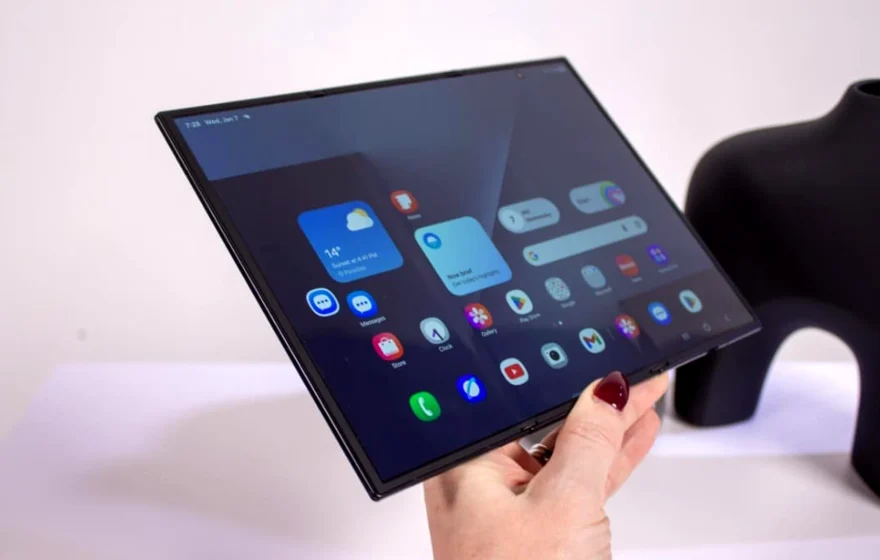
A fresh leak has put Samsung at the centre of one of the most ambitious foldable ideas yet: a tablet that folds down to a manageable size and then opens into a screen larger than most laptops. Samsung has not confirmed the project, and no official specification, price or release window has been shared.
The report comes from a tipster on X who uses the handle @kro_roe. That account had already suggested, in August 2026, that a very large foldable tablet was being developed, without naming the company behind it. In a newer post dated 29 October 2026, the same tipster said Samsung had begun work on the device.
Samsung’s Foldable Tablet Could Have a 17-Inch Screen
According to the leak, the device would offer a display of about 17 inches when fully opened, and a display of roughly 8 inches when folded shut. A 17-inch screen is larger than the display on most mainstream laptops, and it would give a tablet far more room for reading, drawing, watching video, or running two apps side by side.
An 8-inch folded size, by contrast, is close to a small tablet, and far easier to carry in a bag than a rigid 17-inch slab. The leak also suggests that several versions and test units are being tried out, which is normal at an early stage, when companies compare hinges, screen shapes, weight and durability before settling on one design.
The folding method itself, however, is still unclear. One option is an outward-folding screen, where part of the display stays visible on the outside when the device is closed. That makes it quick to glance at, but it leaves the flexible screen more exposed to scratches and knocks.
The other option is closer to Samsung’s Galaxy Z Fold phones, which hide a large folding screen inside and add a separate cover screen outside. That protects the main display, but it also means building and paying for two screens, which could push manufacturing costs higher.
Samsung Has Explored Large Foldable Displays Before
Even so, the idea is not coming out of nowhere. Samsung’s display division has spent years showing large folding panels at trade shows, long before any of them reached shops. At Display Week in 2021, it demonstrated a 17-inch folding screen, and at the Consumer Electronics Show in January 2022 it presented a concept called Flex Note, a 17.3-inch panel that folded down to roughly the size of a 13-inch laptop.
The same show also featured tri-fold concepts called Flex S and Flex G, in which a single display folded in two places to create three sections. The Flex S folded in an S shape, leaving one section visible when closed, while the Flex G folded inward in a G shape, protecting the screen inside. Those concepts never became consumer products in that form, but they showed that Samsung was already thinking beyond a single fold, and beyond phones, years before the latest tablet rumour.
There is also a longer history of rumours about a Samsung folding tablet. In 2023, reports linked the company to a device sometimes called the Galaxy Z Tab, but no such product was ever launched. That is a useful warning: a company can explore a category, build prototypes and brief suppliers without ever deciding that the finished product is good enough, affordable enough or reliable enough to sell.
Launch Date and Pricing
For now, there is no reliable information about when such a tablet could appear, if it appears at all. The tipster has not shared a processor, battery size, camera setup, operating system or storage options, and Samsung has said nothing official. Readers should therefore be cautious about any launch date or price circulating online without a named source.
Price is likely to be a major hurdle. A large folding OLED panel is far more complex to make than a conventional tablet screen, and a hinge strong enough to support a 17-inch display, while surviving repeated folding, adds further cost. Add a second outer screen, if Samsung chose that design, and the bill rises again. That is why folding laptops with 17-inch-class screens have carried premium prices, and why a Samsung folding tablet, if it ever launched, would probably sit well above ordinary tablets rather than competing with them on price.
The timing of the leak fits a broader pattern in the industry. Phone makers have spent several years refining folding handsets, and attention is now turning to larger screens, where the benefit of folding is more obvious: a big display is genuinely useful, but it is also genuinely awkward to carry. A tablet that folds could, in theory, solve that problem, offering a large canvas for work and entertainment without demanding a large bag.
Whether buyers would accept the weight, the crease, the battery demands and the price is a different question, and only a real product, tested in daily use, can answer it. Until then, the reported Samsung tablet remains a project said to be under development, with no confirmed design, no confirmed specifications and no guarantee of release. Readers should wait for Samsung itself to speak before treating it as a device they will be able to buy.
