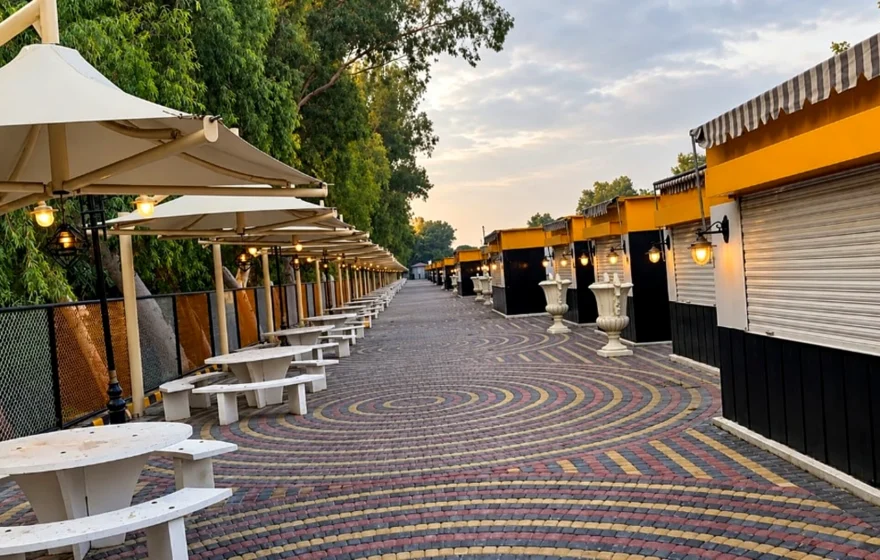
A familiar food street in Karachi’s Sindhi Muslim Cooperative Housing Society is about to get a formal new identity. The street, long known to local diners, has been turned into a modern food walk, and Sindh Chief Minister Syed Murad Ali Shah will formally open it on November 1. The project has been developed under the administration of Chanesar Town, and its organisers present it as more than a fresh coat of paint on an old eating-out spot: it is meant to be a place where people can eat well and stroll in the evening without competing with traffic.
The idea is simple, and one Karachi has tested before elsewhere. In the evening, when families most want to be out, the street belongs to people on foot. Regular vehicles will be kept out completely between 6pm and 2am, giving visitors a traffic-free stretch in which to wander, choose a restaurant, and sit down without the noise and exhaust of passing cars. For parents with young children, and older visitors who find busy roads daunting, that change may matter as much as any new seating.
What visitors will find there reflects the way Karachi eats. The food walk will offer traditional Pakistani cuisine alongside barbecue, Chinese dishes, fast food, ice cream and shakes, a mix designed to suit a family outing in which different members want very different things. One table may order kebabs and karahi, another may prefer noodles or a burger, and children may head straight for dessert. That breadth is part of the appeal of the city’s food streets generally: they are rarely about one dish or one restaurant, and more about the chance to graze, compare and return to a favourite.
According to the Chanesar Town administration, the aim is to turn the area into a safe, quality and family-friendly recreational destination, where residents can spend time with their families and friends rather than simply passing through for a quick meal. A food street only works as an evening destination if visitors trust the surroundings, feel comfortable lingering, and believe the food meets a decent standard. Organised surroundings and a predictable traffic-free window are part of building that confidence.
The opening has not come out of nowhere. Karachi’s mayor, Murtaza Wahab, visited the food walk in Sindhi Muslim Society on October 30, accompanied by Chanesar Town chairman Farhan Ghani, who briefed him on the facilities and arrangements for visitors. The mayor described the project as a place that would give citizens quality food in a pleasant, traffic-free environment where families could spend their leisure time comfortably, and he urged Karachi residents to visit and enjoy what it offers. That visit, a day before the formal inauguration was due, suggests the city administration sees the project as a showcase rather than a routine local upgrade.
It also sits within a wider effort to give Karachi’s food culture a more organised setting. During the same visit, the mayor noted that work was also under way to develop Burns Road as a food street. Burns Road, in Saddar, is the city’s most famous historic food street, whose food scene grew after Partition as migrants brought their cooking traditions with them, and in recent years it has been pedestrianised in the evenings. The new food walk follows a similar logic, adapted to a neighbourhood with its own established restaurants.
Sindhi Muslim Society itself is no stranger to diners. Its main roads are lined with restaurants offering Chinese, grilled, fast-food and cafe menus, and the area has long drawn visitors from beyond its own streets. What the food walk adds is organisation: a defined stretch, a clear evening window without regular traffic, and a stated ambition to be a recreational destination rather than a collection of separate eateries competing for kerb space. For local businesses, that organisation could bring steadier evening footfall, as visitors who come for a walk stay longer, try more than one outlet, and return with friends.
For residents, the test will come after the inauguration ceremony. A food walk is easy to launch and harder to sustain, and its success will depend on less visible details: whether the 6pm to 2am vehicle closure is enforced consistently, whether walkways stay clean and welcoming, whether food quality holds up when crowds grow, and whether families feel safe bringing children late into the evening. The stated goal of a safe, family-friendly destination will be judged on those nightly realities, not on the opening speeches.
If it works, the project could become a template for other neighbourhoods in a city where eating out is central to social life, but where traffic and a lack of safe public space often limit where families can go. Karachi has no shortage of good food or of people eager to eat out together. What it has often lacked is organised, pedestrian-friendly space in which to enjoy it. The food walk, opening on November 1, is an attempt to provide exactly that: a familiar street where the evening belongs to walkers, diners and families rather than to cars.
