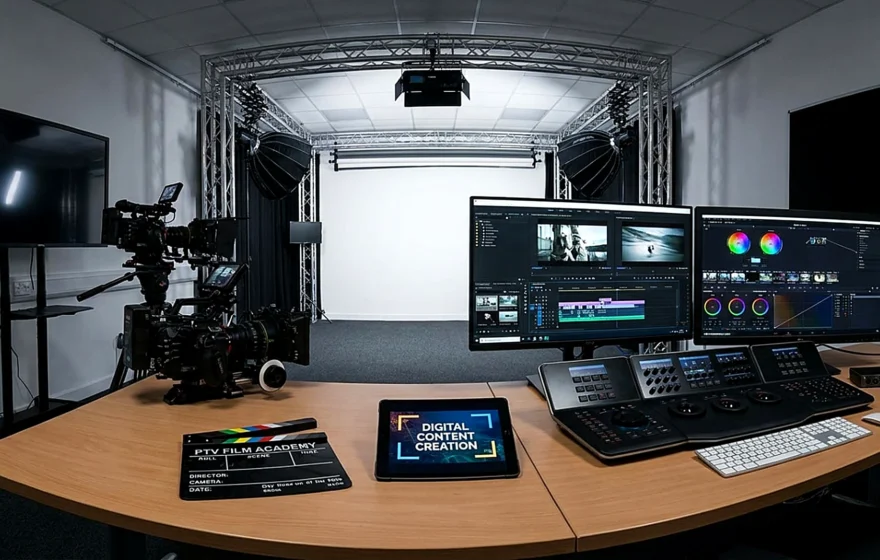
Federal Information Minister Attaullah Tarar has ordered a detailed plan to bring back the Pakistan Television Drama and Film Academy as a modern training centre, where young Pakistanis can learn the practical skills needed for filmmaking, television drama and digital content creation. The decision was taken at a high-level meeting in Islamabad on Monday, where officials reviewed how the academy could be rebuilt and how PTV Home could be refreshed alongside it.
The meeting, chaired by the minister, looked at proposals for specialised training programmes, better technical facilities and a style of teaching that gives students real, hands-on experience rather than classroom theory alone. Federal Secretary for Information Ashfaq Ahmed Khalil and other senior officials from the information ministry were present, and the discussion covered both the shape of the revived academy and the way it would be run in partnership with the private sector.
At the heart of the plan is a simple idea: Pakistan has no shortage of young people who want to work in film, television and online media, but many struggle to find structured, professional training at home. The academy is meant to close that gap, giving students real studio experience, professional editing equipment and portfolios of finished work they can show to employers.
One of the most striking parts of the discussion was colour grading, the craft of shaping the look and mood of a film or television programme after it has been shot. Tarar told the meeting that Pakistan would, for the first time, offer an advanced training programme in this field. Until now, he said, professionals who wanted to learn colour grading properly often had to travel abroad to find the training and the facilities. Bringing that expertise home would matter not only for students, but for the wider industry, because local productions could then be finished to a higher standard without sending work overseas or relying on a very small pool of specialists.
The wider training offer goes well beyond a single specialism. Students would be taught filmmaking, drama production, editing, colour grading and digital content creation, with modern classrooms, studio laboratories, workstations and trainers who understand current industry practice, all tied together by a comprehensive curriculum.
A pilot project is to be launched in partnership with the private sector, and the minister stressed that it should be transparent and practical. The point of involving private companies is to keep training closely aligned with what the industry actually needs, since production methods change quickly. Such partnerships could also create new sources of income for Pakistan Television, and officials said efforts would be made to keep the academy financially sustainable as it grows into a fully functioning professional centre.
The minister also made clear that the revived academy should not exist in isolation. Student work would be encouraged for PTV News, PTV Home and other Pakistan Television platforms, giving emerging talent a real audience and turning classroom work into something broadcasters and producers can see. It also gives PTV a stream of fresh, locally made content.
Why does this matter beyond one institution? Television drama has long been one of Pakistan’s most popular cultural forms, and audiences now move between television channels, streaming services and short-form video. Producers therefore need people who can work across all of those formats, and a centre teaching drama production alongside digital content creation responds to that shift. If it works, it could help produce camera operators, editors, colourists, directors and content creators comfortable in both traditional studios and online production.
There are, however, questions that will decide whether the plan succeeds. A strategy on paper is only the first step: the academy will need trainers with current industry experience, equipment that is maintained and updated, and a curriculum reviewed regularly. The pilot project will be an important test, and the minister’s emphasis on transparency and practicality suggests officials are aware of that risk.
The financial sustainability of the academy will also matter, because training in film and television is expensive, depending on studios, cameras, editing suites and software. A centre that earns income through partnerships and productions has a better chance of surviving and growing than one that depends entirely on government funding.
For young people considering a career in media, the announcement is welcome, but the real test will come when the strategy becomes timetables, admissions, classrooms and studios. If the academy opens with proper facilities, experienced trainers and a clear path from training to work, it could become an important route into Pakistan’s creative industries. If it does, the benefit would extend beyond PTV itself, strengthening the country’s film and drama industry by giving it a larger, better-trained workforce and by making modern production facilities available at home for the first time in fields such as colour grading. That is the ambition behind Monday’s meeting, and it is one that will now be judged on delivery rather than on promises.
