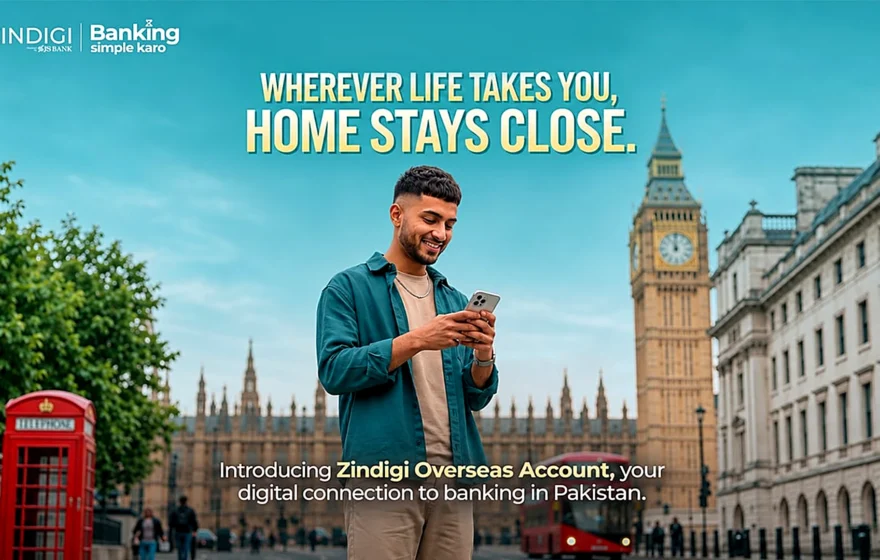
Pakistanis living outside the country can now open and run a bank account back home entirely from their phones, without holding a Pakistani mobile number and without walking into a branch. Zindigi, the digital banking brand powered by JS Bank, has launched its Zindigi Overseas Accounts, a product built around one simple idea: a person’s address may change, but their financial life in Pakistan should not have to stop.
For years, distance has been a quiet obstacle in everyday banking. An overseas Pakistani who wanted to support family, settle a utility bill, or keep household spending on track often had to rely on someone else, wait for a visit home, or juggle a local number they no longer used. The new account removes that friction at the very first step. Eligible customers can sign up with the international WhatsApp number they already use, complete the process digitally, and hold a proper bank account with an International Bank Account Number, rather than a wallet that only stores value.
That distinction matters. A wallet is useful for payments, but an account with an IBAN sits inside the formal banking system. It can receive and send money in the way a regular account does, and it gives the holder a recognised banking identity in Pakistan even while they live abroad. For families, that means support can move through proper channels. For the account holder, it means their financial commitments at home remain visible, manageable, and under their own control.
The account is designed around the practical needs of people who live in one country and support a household in another. Through the Zindigi app, customers can look after family support, pay utility bills, handle household expenses, and make local transfers in Pakistan. The point is not a single flashy feature but the combination: the ordinary money tasks that used to require presence, paperwork, or a favour from a relative can now be handled directly, from abroad, on the holder’s own terms.
Eligibility rests on the identity documents that already define overseas Pakistani status. The digital onboarding facility is open to eligible holders of a Pakistan Origin Card, a National Identity Card for Overseas Pakistanis, or a Computerised National Identity Card. Those documents have long been the gateway to formal services for Pakistanis abroad, and using them for a fully digital sign-up keeps the process familiar while removing the branch visit that used to go with it.
Customers will be able to choose between two account types, depending on their financial needs and the rules that apply to them. The first is the Non-Resident Account Repatriable, and the second is the Non-Resident Account Non-Repatriable. The names point to an important difference in how money held in the account may later be moved, and customers are expected to pick the option that fits their own circumstances. Not every expatriate has the same plans for their money, and a single account design rarely fits everyone.
Speaking about the launch, Noman Azhar, Co-Founder and Chief Officer at Zindigi by JS Bank, said the company’s vision is to make banking simpler, more accessible, and genuinely borderless for every Pakistani. He added that geographical boundaries should never limit access to financial services, and that by letting overseas Pakistanis open and manage accounts digitally using their international mobile numbers, Zindigi is bringing banking closer to millions of Pakistanis who call another country home but remain deeply connected to Pakistan.
That direction is visible in Zindigi’s recent work. Earlier in 2026, the platform partnered with the UK-based service nsave to make it faster, simpler, and more affordable for freelancers and individuals in Pakistan to receive international remittances, in line with the State Bank of Pakistan’s push to encourage inward remittances through formal channels. The overseas accounts launch extends the same logic from receiving money to holding and managing it: once funds reach Pakistan, the holder should be able to keep them in a proper account and use them for the purposes they were sent for.
The launch also sits within a larger shift in Pakistani banking. The State Bank’s Roshan Digital Account initiative, run with commercial banks including JS Bank, already allows non-resident Pakistanis to open accounts digitally, in rupees and in foreign currencies, using their CNIC, NICOP, or POC documents. Zindigi’s version packages that foundation for a mobile-first audience signing up through an app.
There are questions any new overseas account must still answer in practice: how quickly onboarding is completed, what limits apply, how repatriation works under each account type, and how support is handled across time zones. The real test will be the first customers who sign up from abroad and use the account for everyday tasks.
Even so, the direction of travel is clear. Banking for overseas Pakistanis is moving away from paperwork and presence and towards identity, apps, and instant access. If the product delivers on its promise, a Pakistani living abroad will be able to look after money matters at home as routinely as someone living next door, and distance will stop deciding who gets to bank properly.
