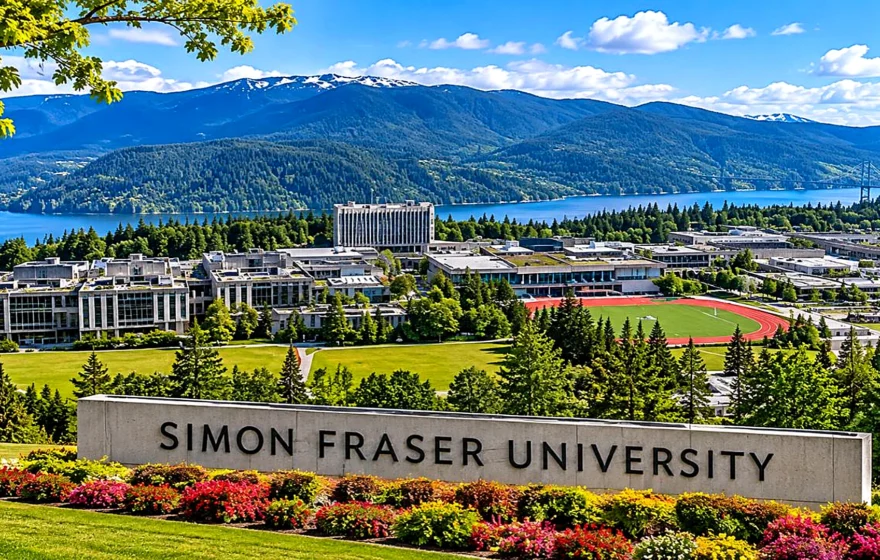
Simon Fraser University in Canada has opened funded research places for graduate students, offering Pakistani applicants a route into advanced study in satellite radar, remote sensing and artificial intelligence. The places are based in the university’s SARLab in British Columbia and are structured as graduate research assistantships, so successful candidates will work with researchers while completing a master’s or doctoral degree.
Satellite radar research is increasingly important for monitoring remote environments that cannot easily be observed from the ground. Students joining this laboratory can gain experience with real satellite data, advanced computing and industry collaboration, while building a research record that can support a longer academic or professional career.
Simon Fraser University Graduate Research Assistantship Details
The assistantships are offered through SARLab, which specialises in satellite radar and remote sensing, environmental monitoring and the use of artificial intelligence to interpret complex radar signals. Students will be expected to develop scientific understanding alongside practical skills in data analysis and programming, and to work across disciplines that include engineering, computer science, physics and earth science.
Scholarship Benefits and Financial Support
The laboratory guarantees a stipend of at least 28,000 Canadian dollars a year for master’s students and at least 32,000 Canadian dollars a year for doctoral students, for two years and four years respectively. Students may also receive at least 15,000 Canadian dollars a year through graduate fellowships or teaching assistantships. The combined support is intended to cover tuition, mandatory fees and living expenses, although applicants should confirm their individual package before accepting an offer. They will also have access to specialised facilities, satellite datasets and advanced computing resources.
Available Master’s and PhD Research Positions
Three doctoral positions are available under a project funded by the Natural Sciences and Engineering Research Council of Canada in partnership with MDA. The project aims to improve satellite radar methods so they can produce mapping applications shaped by the needs of communities in Canada’s North.
Arctic Marine Monitoring Using SAR and AI
This position focuses on Arctic marine environments, where small vessels can be difficult to detect in coastal conditions affected by sea ice, icebergs and complex ocean surfaces. The researcher will use satellite and airborne synthetic aperture radar, combined with artificial intelligence, to improve detection and monitoring. Applicants need a master’s degree in electrical engineering, computer science, remote sensing, physics, geomatics or a related field, and experience in signal processing or computer vision would help.
Arctic Land Monitoring Using InSAR, Geophysical Modelling and AI
This position examines changes across Arctic landscapes, including permafrost degradation, ground deformation, hydrology, coastal erosion and infrastructure stability. The work will use interferometric synthetic aperture radar, geophysical modelling and artificial intelligence. Applicants need a master’s degree in geophysics, remote sensing, earth science, engineering, computer science, physics or a related discipline, and experience with geospatial analysis, machine learning or interferometric radar would be an advantage.
Compact Polarimetric SAR for Maritime Surveillance
This position examines how radar signals interact with ocean surfaces under different wind conditions, to improve vessel detection and ocean wind measurement for future satellite missions. Applicants need a master’s degree in electrical engineering, remote sensing, physics, geomatics, computer science or a related field, and experience with radar signal processing, electromagnetic modelling, synthetic aperture radar, Python or MATLAB would be valued. Candidates may also be considered for other positions in the laboratory.
Eligibility Criteria for Master’s and PhD Applicants
Applicants need a relevant background and a strong interest in research, with the laboratory welcoming students from remote sensing, engineering, computer science, physics, geophysics, geomatics and related areas. Strong programming skills in C++ and Python are valued, as is the ability to write clearly about scientific work. Research in this field often involves incomplete or noisy data, so independence, curiosity and teamwork are also important qualities.
English Language Requirements
Applicants must meet the university’s English standards. The International English Language Testing System requirement is an overall academic score of at least 7.0, with no section below 6.5. The laboratory lists a Test of English as a Foreign Language internet-based score of 93, with at least 20 in each section, under the previous scoring system, and applicants taking the revised test should confirm the applicable equivalent, following changes introduced in January 2026. The university does not require the Graduate Record Examination for engineering science graduate admission.
Documents Required for Application
Applicants should prepare an updated curriculum vitae, an academic transcript and a cover letter explaining their background, research interests and programming skills, and stating whether they seek a master’s or doctoral place and which research area interests them. For formal admission they will also need a statement of interest, an unofficial transcript and contact details for three referees.
How to Apply for Simon Fraser University Research Assistantship
Applicants should first contact Professor Bernhard Rabus at brabus@sfu.ca with the required documents, so the laboratory can assess whether their interests match an available position. Shortlisted candidates will then complete formal graduate admission through the School of Engineering Science. For Pakistani students, the opportunity combines funded study with skills in radar, artificial intelligence and environmental monitoring that are also relevant to flood monitoring, agriculture, coastal management and disaster response.
