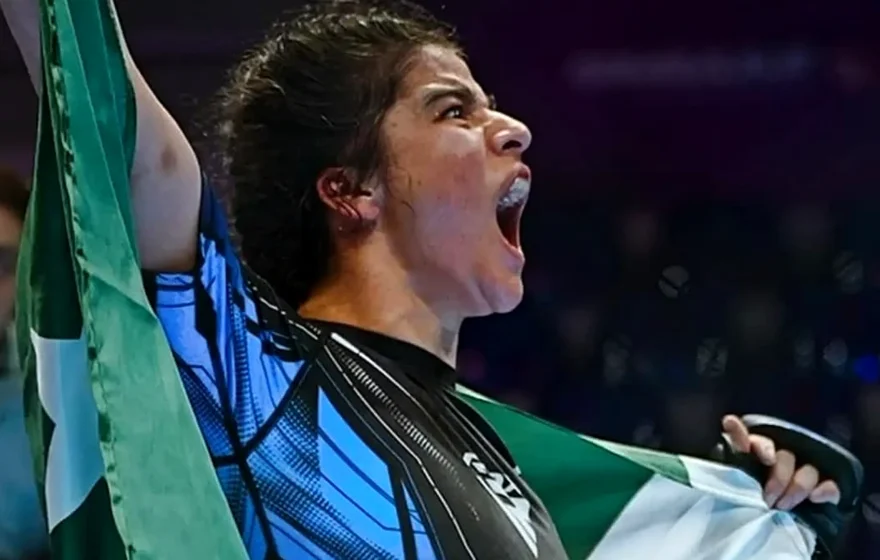
Pakistan’s Maliha Ali has pulled off one of the biggest wins of her career at the IMMAF World Championships in Tbilisi, Georgia, defeating Russia’s two-time European champion Veronika Drozdova by split decision. The 24-year-old from Hunza in Gilgit-Baltistan won in the featherweight division, contested at 65.8 kilograms, to advance to the quarter-finals of the tournament.
The scale of the achievement becomes clear when the two camps are compared. Drozdova arrived with a Russian team of more than 60 athletes, backed by government support and one of the best-funded mixed martial arts programmes in the sport. Maliha, by contrast, fights for a federation that describes itself as among the most underfunded at the event. That she beat a two-time European champion under those circumstances says as much about preparation and temperament as it does about talent.
Maliha is no stranger to big stages. She is also a wushu champion and a national kickboxing gold medallist, and she came into the tournament in Tbilisi after winning a silver medal at the IMMAF World Cup in Angola earlier this year. That breadth of striking experience, across wushu, kickboxing and now mixed martial arts, has shaped a fighter who is comfortable in more than one discipline, and it showed against Drozdova.
The fight itself followed a pattern familiar to anyone who has watched a well-prepared underdog. Maliha started cautiously in a southpaw stance, feeling out her 19-year-old opponent, before gaining control in the opening round. She pushed Drozdova against the cage and landed several clean strikes, although the Russian responded with a couple of overhand left punches that served as a warning.
Maliha strengthened her position in the second round, securing a takedown and moving into full mount, where she landed several powerful strikes from the top position. It was the kind of dominant round that wins fights, and it gave her a cushion that would prove vital. In the final round she appeared to tire, allowing Drozdova to secure a takedown and control the action on the ground, and she lost the third round. But the work of the first two rounds had already been done, and the judges awarded her the split decision.
What followed was a scene that captured the emotion of the moment. Maliha celebrated with her corner, embraced her opponent, and performed a prostration of gratitude with the Pakistani flag draped over her shoulders. Pakistan MMA Federation President Omar Ahmed celebrated the victory from her corner, having watched the plan come together exactly as intended.
Maliha credited her coaches and the team’s preparation for the result. “We worked on our opponent’s game plan, how she fights, and executed our strategy. And thankfully it worked,” she said. It was a modest summary of a disciplined performance, and it reflected a camp that had done its homework on a champion opponent rather than simply hoping for the best.
Omar revealed that the federation had organised a six-week training camp and brought in an international jiu-jitsu and grappling coach to address weaknesses identified during Maliha’s previous performance in Angola. That detail explains the second round in particular: the takedown, the control from mount, and the composure on the ground were not accidents but the product of targeted work on exactly the areas that had needed improvement.
Highlighting the funding gap between the two countries, Omar said Pakistan was competing with significantly fewer resources than Russia. “Compared to them, we are the most underfunded and probably the least-resourced federation competing in this event because of the sports policy in Pakistan. But still, we manage to eke out victories against such formidable opponents,” he said. He added that the determination of Pakistani fighters continued to produce results despite limited financial support.
That funding gap is not new. Pakistan’s participation in last year’s championships in Tbilisi was reportedly financed entirely through private sponsorship, without government funding. When athletes must rely on private backers to reach a world championship at all, every win carries extra weight.
The story does not end with this victory. Maliha will now face Mexico’s Andrea Gabriela Guzman Salazar in Wednesday’s quarter-finals, a step closer to a world title. Her twin sister Manesha Ali, who won gold at the IMMAF World Cup in Luanda earlier this year, will compete against Poland’s Martyna Caruk on the same day. Both fighters are aiming to secure world titles for Pakistan, and a successful day for the sisters would be a landmark for the country’s growing MMA scene.
For Pakistani sport, the wider significance is hard to miss. The country’s international reputation has long rested on cricket and hockey, but athletes like Maliha are building a different story, one of young women from places like Hunza competing with the world’s best in sports that receive little attention or funding at home. Wins like this one show the next generation that the path exists, even when the system makes it harder than it should be.
