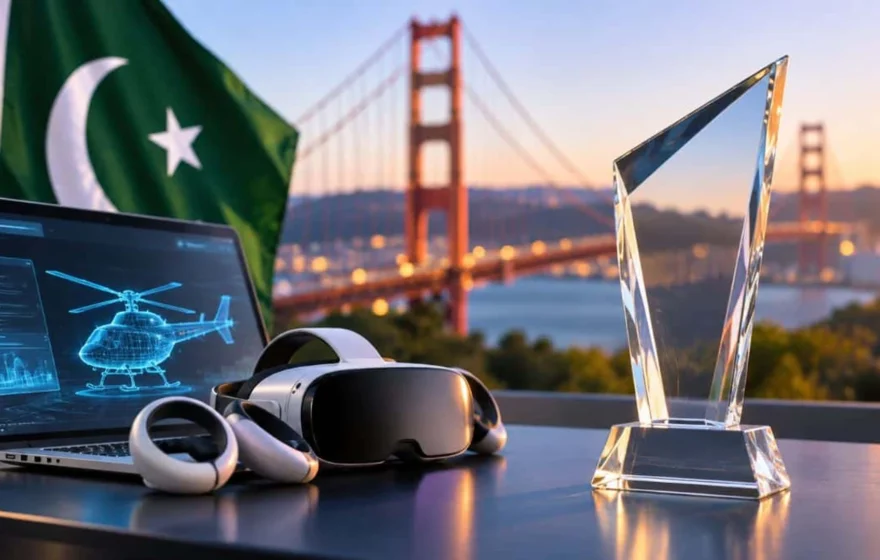
A Pakistani technology startup has won international recognition at one of the world’s most watched gatherings for young companies, taking home the GOAL Startup Award at the Silicon Valley November Summit in California. RLabs, a company building extended-reality simulation and artificial intelligence training tools, was picked from a field of startups from around the world, and the win has put a spotlight on Pakistan’s growing technology scene.
The summit ran from November 2 to 5, 2026, and was organised by Plug and Play, the global innovation platform and venture capital firm behind one of the world’s best-known accelerator programmes. RLabs was among just 18 startups from different countries chosen to pitch under Plug and Play’s Global Overseas Acceleration and Learning programme, known as GOAL. The company’s founder presented its technology before more than 3,000 people, including startup founders, venture capital investors, corporate executives, innovation leaders and government representatives, and came away with the programme’s top award.
RLabs is led by Harris Ahmed, a 2018 graduate of the National University of Sciences and Technology in Islamabad, and the company was incubated at the National Incubation Centre for Aerospace Technologies, or NICAT. It is a familiar path in Pakistan’s technology sector: a university-trained engineer, supported by a specialist incubator, building a product aimed at a global market rather than only a local one.
What RLabs Actually Builds
RLabs develops technology built around extended-reality simulators, synthetic data and machine training. In plain terms, the company creates realistic virtual environments in which people can learn to operate complex machinery without the cost, risk or downtime of training on the real thing. Ahmed has said the team spent years using extended-reality technology to train people for demanding, hands-on work, and it is now applying the same experience to a different problem: training artificial intelligence systems and machines.
According to NICAT, RLabs is also developing a proprietary large language model to power a modular simulation engine that can work across different platforms. The incubator claims the technology can cut simulation development time by as much as 75 percent, a figure that has not been independently verified and should be treated as the incubator’s own claim rather than a proven result. Even so, the direction of travel is clear. Simulation is becoming a core part of how artificial intelligence is trained, because models that must operate in the physical world need vast amounts of practice data, and realistic simulated environments are one of the few ways to produce it at scale.
A Win That Opens the American Market
Following the recognition in Silicon Valley, Ahmed has said RLabs is preparing to launch in the United States. The move would give the Pakistani startup access to a far larger market for simulation, artificial intelligence and machine-training technologies, and to the investors and corporate customers who cluster around it. It is worth being precise about what the award does and does not mean: it is a mark of recognition, and available reports do not confirm any investment of a specific value attached to it. The real prize is visibility, credibility and access, and those are things a young company from Pakistan often finds hardest to win.
The timing is also favourable. Plug and Play selected 140 startups from 20 countries across 13 programmes for its Silicon Valley fall batches of 2026, and Pakistani companies have featured more than once. Five startups from the National Incubation Centre in Lahore secured places in the same fall accelerator, and another Pakistani artificial intelligence startup, Blainy, earned a spot in a Plug and Play programme earlier in May 2026.
Government Hails the Achievement
Federal Minister for Information Technology and Telecommunication Shaza Fatima Khawaja congratulated the startup, describing the award as a proud moment for Pakistan. She said the recognition reflected the potential of Pakistani technology talent and the country’s growing startup ecosystem. The state has spent years building incubation centres such as NICAT and the wider National Incubation Centre network, and an international award is the kind of return that justifies that investment.
The question now is what RLabs does with the momentum. An award opens doors, but it does not pay salaries, win customers or build a product. A launch in the United States will test the company in the most competitive market in the world, where simulation and artificial intelligence training are crowded fields and where buyers will judge the technology on results rather than on the story behind it. The 75 percent time-saving claim will be tested in the same way, by customers rather than by judges.
Even with those tests ahead, the win matters beyond one company. It gives Pakistan’s startup ecosystem a concrete example to point to, it gives young engineers a reason to believe that work done in Islamabad can be recognised in California, and it gives investors a reason to look more closely at what is coming out of the country’s incubators. For a sector that has often promised more than it delivered, a trophy from Silicon Valley is a useful piece of evidence that the promise is starting to be kept.
