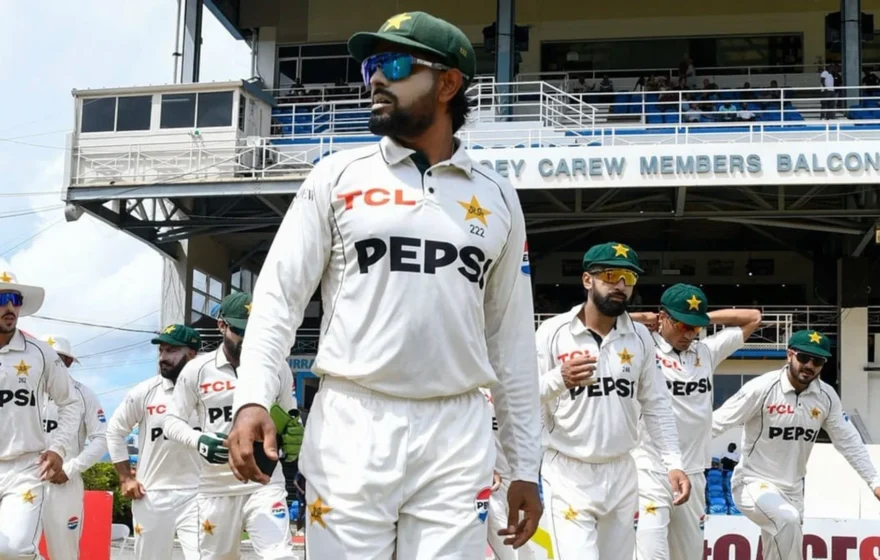
Babar Azam has finished the year at the top of one of Test cricket's most revealing lists, holding the highest batting average of any player in the world in 2026, even as his long wait for a Test century stretches towards four years.
The Pakistan captain leads the ranking of Test batting averages in 2026 among players with at least ten innings, with an average of 50.55. He is, by this measure, the most consistent Test batter on the planet this year, yet he has not reached three figures in the format since December 2022. Both things are true at once, and the tension between them is what makes his story so compelling.
England's Harry Brook sits second on the list, having scored 558 runs in twelve innings at an average of 46.50. Bangladesh's Mushfiqur Rahim is third with an average of 44.16, while Australia's Travis Head and England's Joe Root complete the top five with averages of 42.09 and 41.75 respectively. To sit above all of them across a calendar year is a reminder that Babar's class has never really gone away.
Highest Test Batting Averages in 2026
The numbers behind the headline are worth a closer look. Babar's average of 50.55 puts him more than four runs per innings clear of Brook, a significant gap over a full year of Test cricket. Mushfiqur's 44.16 in third place reflects a fine year for a veteran who has carried Bangladesh's batting for more than a decade, while Head's 42.09 and Root's 41.75 underline how hard it has been for even the best batters to dominate in a year of testing pitches and strong bowling attacks. Averages in the low forties have been enough to make the top five, which makes Babar's position at the summit all the more impressive.
His latest contribution to that record came on the opening day of the first Test against Sri Lanka at Rawalpindi Cricket Stadium, where he scored 50 from 58 balls, striking seven boundaries in an innings that moved briskly along before it was cut short. He shared a 69-run partnership with debutant Mohammad Taha, a stand that steadied Pakistan after early wickets, before he was caught by wicketkeeper Kusal Mendis off Dilshan Madushanka. It was the sort of innings that has become familiar from Babar in recent times: fluent, assured, full of the timing that once made him look like the finest batter in the world, and then over just when it seemed to be building towards something bigger.
The fifty was his fifth Test half-century of the year, and it kept his 2026 average above fifty. Yet it also extended the other statistic that follows him everywhere, the one that his critics quote and his supporters wince at. Babar has now gone 41 consecutive Test innings without a hundred, having last reached the milestone against New Zealand in December 2022. In the same match at Rawalpindi, he crossed the 7,000-run mark in first-class cricket, a landmark that speaks to the sheer volume of runs he has scored across his career, but the century drought remains the story that defines him in the longest format.
That drought has become one of the longest-running narratives in modern cricket. His last Test hundred was a match-saving 161 against New Zealand in Karachi in December 2022, an innings that capped a remarkable year in which he scored 1,184 Test runs including four centuries. Since then the wait has passed 1,300 days. From 2016 to 2022 he scored 3,645 Test runs at an average of 49.25 with nine centuries, but since the start of 2023 his average has fallen to around 30, and his highest score in that period has been 88, made in Pakistan's win over the West Indies. He even turned to domestic cricket earlier this year, asking the Pakistan Cricket Board to arrange a place for him with OGDCL in the President's Trophy so he could work on his game in first-class cricket, a step that showed how seriously he takes the problem.
Babar's numbers describe a batter who keeps getting starts and keeps getting out. Five half-centuries in a year is the record of a man who is regularly reaching fifty, and the absence of a hundred is the record of a man who is regularly failing to go on. Four of his recent half-centuries have come in his last five Tests, which suggests the form is returning, and the only thing missing is the conversion that once came so naturally to him.
For Pakistan, the stakes go beyond one man's statistics. Babar remains the captain, the senior batter and the player around whom the side's batting is built, and his return to big hundreds would transform the team's prospects in a series that continues with a second Test scheduled for Lahore. A captain who leads the world's averages is already making a statement. A captain who also scores centuries is a different force altogether.
