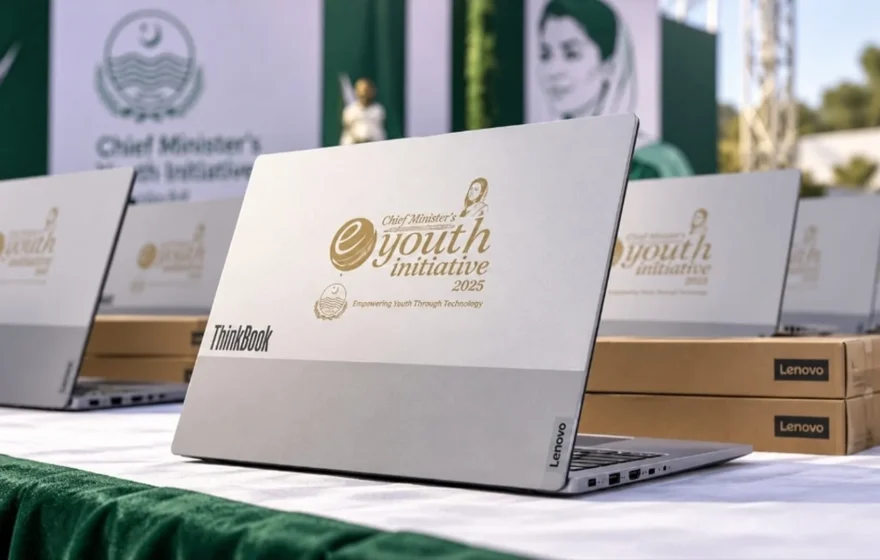
Punjab Chief Minister Maryam Nawaz handed laptops to students in Jhelum on Tuesday and awarded Honhaar scholarships worth about Rs2.5 million to 109 students, in the latest stop of a province-wide distribution drive. Speaking at Government Comprehensive High School in Jhelum, she told the audience that laptops and scholarships were students' rights rather than government favours, and that no talented young person should be held back by poverty. The ceremony, held on 10 November, carried a wider message about merit, public schools and the future of education in Punjab.
Maryam congratulated the students who received laptops and scholarships, and praised their parents for the sacrifices they had made to support their children's education. She has struck the same personal note at similar ceremonies across the province. For many families in the audience, the cost of a laptop or a semester's fees can decide whether a child continues studying, and the chief minister returned to that point more than once during her address.
She stressed that opportunities in education and employment should go to students on the basis of ability, not political connections or recommendations. The point matters in a province where access to government jobs and favours has long been shaped by who a family knows, and Maryam has made merit a recurring theme of her public appearances. At the Jhelum ceremony she framed the laptop and scholarship schemes as proof that the system could work differently, rewarding hard work rather than influence.
The chief minister also spoke about the state of public schools, saying her government was working to improve them and to give students modern facilities. She pointed to plans for nearly 300 Nawaz Sharif Schools of Eminence across Punjab, equipped with computer laboratories, artificial intelligence laboratories and science laboratories. Work on the Jhelum campus is due to begin on 15 December, and she has described the schools as offering facilities comparable to expensive private institutions.
She urged young people to focus on their education, develop their skills and contribute to the country's development. The appeal fits a broader argument her government has been making: that Punjab's future depends less on roads and buildings than on whether its young population gains the skills to find work. A laptop, in that argument, is a tool rather than a gift, and the scholarship is an investment students will repay through their work.
The Jhelum ceremony is part of a much larger programme. The CM Laptop Scheme aims to distribute around 110,000 laptops to high-achieving students in public universities, colleges and technical and medical institutions, with 13th-generation Core i7 machines reported. Allocations include 20,000 laptops for university students, 14,000 for college students, 4,000 for technical and agricultural students and 2,000 for medical and dental students. About 32 per cent of the laptops are reserved for students from South Punjab, and 2,000 are set aside for minority students.
The Honhaar Scholarship Programme runs alongside it and has grown into one of the province's largest financial aid schemes. The chief minister has said it has so far supported 160,000 students across 70 disciplines, with 108,000 scholarships awarded in its first three phases, and the scheme covers full tuition fees. Applications for the next phase opened in October, with the deadline extended to 19 November 2026, and eligibility depends on a Punjab domicile, enrolment in a selected discipline and family income below set limits.
The scale of the drive is visible in the ceremonies held across Punjab in recent weeks. At a similar event in Attock on 3 November, 6,161 laptops were distributed to students across the Rawalpindi division, alongside 2,590 Honhaar scholarships worth Rs196.97 million. The chief minister told that gathering she had raised the laptop allocation from 40,000 to 112,000 as the programme expanded since its relaunch. Students from Swabi in Khyber Pakhtunkhwa also received support there, some saying it had helped them pay semester fees of nearly Rs200,000.
The Schools of Eminence project, which Maryam highlighted in Jhelum, is the longer-term half of the same policy. Around 300 schools are planned across the province, with about 80 campuses in the first phase already holding regular classes, and two schools planned in every tehsil, one for boys and one for girls. Admission is open to families with monthly incomes below Rs200,000, entry is through a standardised merit assessment, and the schools are run through the Punjab Education Foundation with air-conditioned classrooms and qualified teachers.
Whether the programme succeeds will not be decided at ceremonies like the one in Jhelum. Laptops and scholarships remove two immediate barriers for poor students, the cost of a device and the cost of fees, but they do not by themselves guarantee learning or employment. The test will come in the years ahead: whether recipients complete their degrees, whether the new schools keep their promised standards, and whether merit genuinely replaces connections in the decisions that shape young lives. On that measure, the Jhelum ceremony was a promise as much as a distribution, and its value will be judged by what follows.
