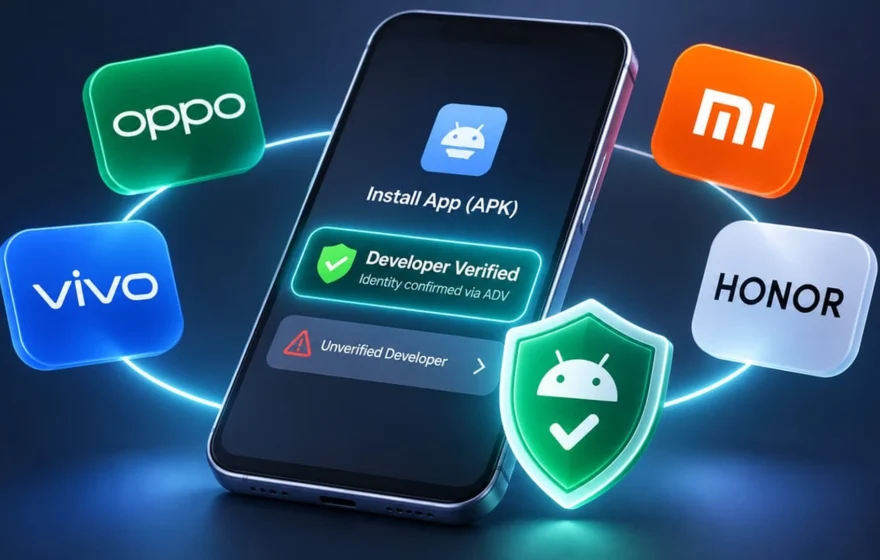
Four of China’s biggest phone makers have begun asking a simple question of anyone who wants their app on your phone: who exactly are you? Oppo, Vivo, Xiaomi and Honor have introduced a shared system called Android Developer Verification, or ADV, for apps installed outside their official stores in mainland China.
The scheme was announced by the Mobile Intelligent Terminal Ecosystem Alliance, a group the four manufacturers belong to. Until now, China has had no single real-name system for apps installed from outside an official store, which means that when a harmful app appeared on someone’s phone, it was often hard to say who had made it. ADV is meant to close that gap by tying every app to a named, verified developer.
The four companies have also agreed to recognise each other’s results. A developer verified by one need not repeat the process with the other three. The alliance has admitted the checks could slow distribution down at first.
How the New Verification System Works
The heart of the system is identity. Under ADV, a developer’s verified identity is linked directly to their applications. Apps already listed in the four manufacturers’ own stores will be verified automatically, and their developers will not need to file anything new. The extra step only appears when someone installs an APK file from elsewhere, whether that is a developer’s website, a third-party store or a file shared by a friend.
In that case, the phone checks whether the developer has been verified. If not, it shows an “unverified” warning, and the user must confirm the installation by hand before it can go ahead. The warning does not block the install outright, but it makes the risk visible in a way a quiet download never did.
ADV is a system for identifying developers, not for detecting malware: a verified app can still contain harmful code, and an unverified app is not automatically dangerous. The companies will keep running separate virus and malware checks, and ADV sits alongside them. The point is accountability: if an app turns out to be a scam, someone will know who made it.
How Xiaomi Is Running Its Own Checks
Xiaomi has moved first. It opened ADV submissions on October 21 and began checking sideloaded app installations on October 31, so the warning system may already be live on its phones. Its process looks at three things: the app’s package name, its signing key and the developer’s verification status. Change the package name or the signing key, and the developer must be verified all over again.
Developers distributing outside Xiaomi’s store must register through its HyperOS developer platform, complete real-name verification as an individual or a company, and upload a signed empty APK linked to their package name. Xiaomi says identity checks take one to three working days, and app verification is automated and immediate.
Oppo, Vivo and Honor have also published developer documentation, although their exact rollout dates and procedures have not been independently confirmed. All four intend to share verification results, so a developer verified on one platform counts as verified on the others.
Google Is Moving in the Same Direction
The Chinese initiative is not happening in isolation. Google announced a similar developer verification policy in 2025, and it began enforcing the new rules on September 30, 2026, in Brazil, Indonesia, Singapore and Thailand. The first phase covers installations through seven app stores, including Honor App Market, Oppo App Market, V-Appstore and Xiaomi GetApps, and Google plans to extend the requirement to all certified Android devices in 2027.
Google’s version asks developers to verify their identity with a government-issued ID and pay a one-time fee of 25 dollars, and it has drawn criticism from open-source developers, including F-Droid, whose apps are often built by volunteers. Google’s answer is an advanced process that still lets determined users install apps from unregistered developers after a 24-hour wait, a delay meant to stop scammers who talk people through installing a malicious app over the phone.
The Chinese alliance has not mentioned any similar option, which leaves open how much choice users in China will have when installing an app from an unverified developer. For now, the warning and manual confirmation appear to be the only route.
Will More Brands Sign Up?
Whether other Chinese phone makers join is still open. The four are among the largest names in the Chinese market, and if their system works smoothly, smaller brands will find it hard to stay outside it.
The move fits a wider pattern in China, where app stores already have to file details of their apps with the regulator. ADV extends that logic beyond the stores. For users, it should mean fewer anonymous apps and a clearer warning when something looks risky. For developers, it is one more step before their software reaches a phone. And for the industry, it is another sign that the open, install-anything era of Android is giving way to a world where somebody always knows who made the app on your screen.
