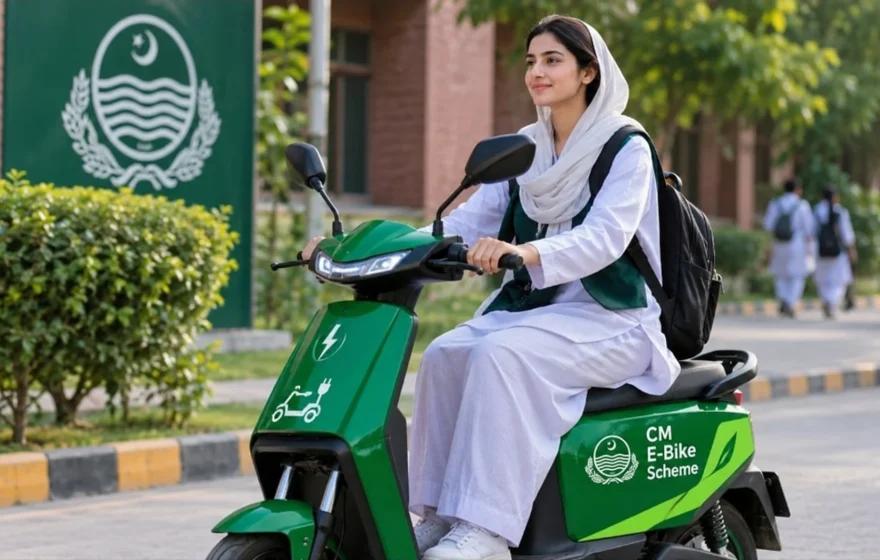
Punjab Chief Minister Maryam Nawaz Sharif has pushed back the first round of electric bike deliveries under her government's student scheme, telling students in Jhelum on Tuesday that the bikes will now start reaching them in December rather than on November 5 as originally planned.
The announcement came at a ceremony in Jhelum where the chief minister was handing out laptops and Honhaar Scholarships. Addressing a hall full of young people, many of whom had applied for a bike, Maryam said the new date had been fixed because of the sheer number of machines that have to be built before they can be handed over.
She explained that the government had worked towards November 5 as the starting point for the first phase of distribution, but the scale of manufacturing meant the timetable had to move. With thousands of electric bikes being built for students across the province, she said, it was better to wait a few more weeks than to start handing out bikes before enough of them were ready.
The chief minister also used the occasion to speak directly to the students waiting for their bikes. She urged every applicant to complete proper riding training before taking a bike onto the road, and to wear a helmet on every journey. Road safety, she said, mattered just as much as the convenience the scheme was meant to provide, and she advised young riders to follow traffic rules and ride responsibly at all times.
The scheme is designed to make daily travel easier for students, particularly those who struggle to reach their colleges and universities. For many young people in Punjab, the journey to class means long waits for crowded buses, expensive rickshaw rides or depending on a family member for a lift. A bike of their own, the government argues, gives them independence and removes one of the quiet obstacles that can stand between a student and regular attendance.
The scheme was launched in April 2024 as one of the first student welfare programmes of Maryam Nawaz's government, run jointly by the Punjab Transport Department and the Bank of Punjab with a subsidy of around Rs2.6 billion. In its first phase, 27,179 bikes were offered, including 19,000 petrol bikes and 8,179 electric bikes. Most of the electric bikes, 7,479 of them, were reserved for female students, aimed at giving young women a safe and independent way to travel. Applications were taken online through the portal bikes.punjab.gov.pk, with the bikes offered on easy, interest-free monthly instalments.
To qualify, an applicant must be a Punjab resident, at least 18 years old, enrolled as a regular student at a college or university recognised by the Higher Education Commission, and hold a valid motorcycle learner's permit or driving licence. The government says the bikes are allocated through a transparent balloting process, with the aim of reaching students in smaller towns as well as in Lahore.
The second phase of the scheme was launched in September 2026, opening the programme to a fresh group of applicants. Distribution under that round had been expected to begin on November 5, a date the chief minister herself had mentioned at a ceremony in Mandi Bahauddin in late October. Tuesday's announcement in Jhelum moves that date to December, a delay of roughly a month.
The Jhelum event was part of a wider round of student ceremonies the chief minister has been holding across Punjab in recent weeks. At similar gatherings in Attock on November 3 and at the University of Rasul on October 27, she distributed laptops and Honhaar Scholarships, telling students that merit, not personal connections, would decide who benefits. Under the Honhaar Scholarship Programme, 108,000 students have received support in its first three phases, while the laptop allocation has been raised from 40,000 to 112,000 devices, with more than 48,000 handed out so far.
For students waiting on their bikes, the delay is a disappointment, but a short one, and the government will hope the extra weeks buy it a smoother rollout. Handing out thousands of electric bikes is a logistical exercise as much as a political one: the machines must be manufactured, checked, registered and delivered, and a rushed start risks faulty bikes and long queues. A December start, if it holds, would still put the bikes in students' hands well before the new academic term gathers pace.
The bigger test will come after the bikes are delivered. Electric bikes need charging points, servicing and spare parts, and young riders need training and helmet rules that are actually enforced. The chief minister's emphasis on training and helmets suggests the government is aware of that risk. If the December distribution goes ahead as now promised, and the bikes reach the students who applied for them, the scheme will have passed its first real test of delivery. Students, meanwhile, would be wise to use the extra weeks well: finish the riding training, sort out a learner's permit or licence, and be ready when the call comes.
