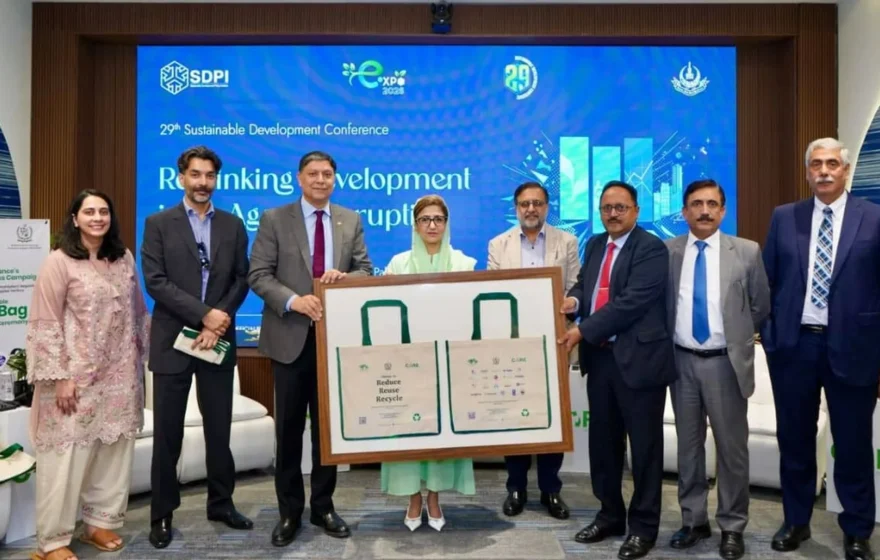
Pakistan’s packaging industry has called on the government to bring in a phased, nationwide law making producers responsible for the plastic packaging they put on the market. The demand was made at a policy session in Islamabad, where the Collect and Recycle Alliance, known as CoRe Alliance, also handed over 5,000 reusable tote bags to the Pakistan Environmental Protection Agency as a practical step away from single-use plastic.
The session, titled From Policy to Practice: Strengthening Extended Producer Responsibility for Better Systems in Pakistan, was held on 5 November 2026 during the 29th Sustainable Development Conference, organised by the Sustainable Development Policy Institute with CoRe Alliance at Allama Iqbal Open University.
Extended producer responsibility, usually shortened to EPR, means the companies that make or sell packaged goods also carry responsibility for that packaging once the customer has finished with it. Instead of collection and recycling costs falling entirely on city governments and taxpayers, producers contribute by funding collection schemes or meeting targets set by the regulator. The model pushes manufacturers towards packaging that is easier to recycle.
For Pakistan, the need is hard to overstate. The United Nations Development Programme puts the country’s annual plastic waste at more than 3.3 million tonnes, while WWF-Pakistan puts it at nearly two million tonnes and warns that 86 per cent is not managed properly. More than 1.7 million tonnes ends up in landfills, dumps, drains and waterways each year, placing Pakistan among the ten worst plastic-polluting countries. A 2023 study by the Pakistan Environmental Protection Agency found less than a tenth of the country’s plastic waste is recycled, and the World Bank has estimated that Pakistanis use between 55 and 112 billion plastic bags every year.
Opening the session, Dr Shezra Mansab Ali Khan Kharal, the Minister of State for Climate Change and Environmental Coordination, said Pakistan’s shift towards a circular economy would only work if government and industry acted together. She argued that a well-designed system could strengthen waste collection and recycling and give the country the organised systems it has so far lacked.
Sheikh Waqar Ahmad, the chief executive of CoRe Alliance, told the gathering that a circular economy needs both good policy and practical action on the ground. He pressed for greater industry participation, tax incentives and easier access to finance, so private investors would fund recycling plants and collection networks. The distribution of 5,000 reusable bags, he added, was meant to show the alliance pairing its policy demands with action of its own.
Amir Mohyuddin, the Additional Secretary at the Ministry of Climate Change and Environmental Coordination, said a harmonised approach, introduced in stages with clear responsibilities for each side, was essential. The point matters because waste management is split between federal and provincial authorities, and a scheme designed in Islamabad will fail if it does not fit how provinces actually work. The panel discussion brought together Zainab Naeem of the Sustainable Development Policy Institute, Babar Aziz Bhatti of Green Earth Recycling, and Zia Hyder of the SPEL Group.
Much of the session drew on a White Paper that CoRe Alliance had already submitted to the Federal Minister for Climate Change and Environmental Coordination in May 2026. Namwar Yusuf Rahman, the alliance’s project manager, summarised the paper, setting out how its recommendations could keep rules consistent across the country while leaving room for local differences. Bhatti told the session that recyclers already had the capacity to process large volumes of material, but only if waste was separated properly at the start, since mixed waste costs more to process and produces lower-quality recycled material.
The discussion covered the practical questions that will decide whether any framework succeeds, including phased targets, shared responsibility along the value chain, industry-led producer responsibility organisations under regulatory oversight, green financing, digital systems to trace material from collection to reuse. Speakers also raised the position of informal waste workers, who already collect and sort recyclables by hand, and argued that any new system should bring them into the formal chain rather than pushing them aside.
Alongside the policy debate, the alliance handed over 5,000 co-branded reusable tote bags to Pak-EPA, presenting them to Dr Shezra Mansab Ali Khan Kharal during the conference. A separate ceremony had taken place a day earlier at the Pak-EPA office in Islamabad, attended by directors Dr Mohsina Zubair and Dr Zaigham Abbas. The initiative supports the Single-Use Plastics (Prohibition) Regulations of 2023, which apply to the Islamabad Capital Territory.
The real test now lies beyond the conference hall. A White Paper and a well-attended session are useful, but Pakistan has seen environmental policies announced before, only for enforcement to fade once the headlines moved on. For the framework to make a difference, it will need legal force, a regulator willing to enforce targets, financing that reaches recyclers and collectors, and cooperation from provincial governments. If the government turns the alliance’s recommendations into law, the session may be remembered as the moment the conversation moved from policy papers to practice. If it does not, the bags will still be useful, but the plastic will keep piling up.
