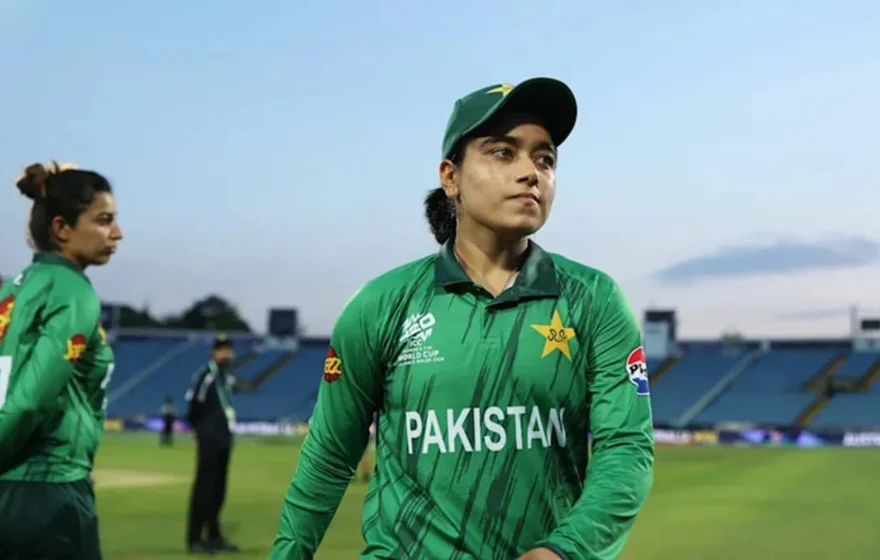
Pakistan women’s cricket captain Fatima Sana has called for her team to be treated the same as the men’s side, urging fans to show up for the women’s game in the numbers they already bring to men’s matches. The twenty-five-year-old said she dreams of a time when the women’s team receives the same recognition and support as the men, and she asked supporters to fill the stands for women’s fixtures just as they do for the men. It was a simple request, and it carried the weight of a player who has seen from the inside how wide the gap still is.
Sana was speaking to CricBlog TV after the Perth Scorchers’ six-wicket victory over the Melbourne Stars on Sunday, a match that underlined how far she has come as a cricketer and how far the women’s game has travelled with her. Cricket is growing around the world, she said, and she hopes women’s cricket in Pakistan will grow with it. The appeal was not about money or contracts alone. It was about being seen: about crowds turning up, matches being watched, and young girls in Pakistan seeing women cricketers treated as stars in their own right rather than as a footnote to the men’s game.
Her own career gives the argument its force. Sana, who has captained Pakistan since 2024, is playing for the Perth Scorchers in Australia’s Women’s Big Bash League, one of the leading women’s competitions in the world. She is only the second Pakistani player to appear in the WBBL, following former captain Nida Dar, who represented the Sydney Thunder in 2019. Since making her debut on the thirty-first of October, Sana has taken five wickets in five matches at an economy rate of 7.62 runs per over, figures that place her joint tenth among the tournament’s leading wicket-takers. She plays alongside former New Zealand captain Sophie Devine and Australian batter Beth Mooney, and has spoken warmly about the support of her teammates in Perth.
This is Sana’s second appearance in an overseas league, having previously represented the Birmingham Phoenix in England’s The Hundred competition. She has said she is grateful for the chance to play in Australia, and she hopes more Pakistani women cricketers will get the same opportunity, so they can gain experience in top competitions and bring it home. The point matters because exposure of that kind is still rare for Pakistani women players, and each player who breaks through makes the path a little easier for the next one.
Sana’s record backs up every word. She holds the world record for the fastest half-century in women’s Twenty20 internationals, reaching fifty in just fifteen balls against Zimbabwe in Karachi on the fifteenth of May, finishing unbeaten on sixty-two from nineteen deliveries as Pakistan completed a three-nil series whitewash. The previous mark of eighteen balls had been shared by Sophie Devine, Phoebe Litchfield and Richa Ghosh. Earlier in the year she smashed ninety from forty-one balls against South Africa, rescuing Pakistan from sixty-four for six to one hundred and eighty for nine. She also led Pakistan to a bronze medal at the 2026 Asian Games in Aichi-Nagoya, Japan.
The next chance is the biggest one yet. Pakistan will host the ICC Women’s T20 World Cup in 2028, with twelve teams taking part from the seventh of September to the first of October. It will be the country’s first ICC women’s tournament, a landmark for a nation that has previously hosted two men’s one-day World Cups and the ICC Men’s Champions Trophy in 2025. India’s matches will be played at a neutral venue under the hybrid arrangement the two countries now follow, but the rest of the tournament will be played on Pakistani soil. Sana has welcomed the decision, saying it could encourage more girls to take up cricket and persuade parents to give their daughters more opportunities to play.
That is the heart of her appeal. A World Cup at home will only change things if people turn up to watch it, and if the girls who watch it can see a future in the game. Sana’s own story shows what is possible: a right-arm medium-fast bowler who became captain at twenty-two, broke a world record, won an Asian Games medal, and now holds her own in one of the toughest franchise leagues in the world. But she is still, in many ways, an exception, and she knows it. The structures around her, from domestic cricket to coaching to crowds, have not kept pace with the talent.
Equal treatment is not a slogan. It means full stadiums for women’s matches, the same coverage and the same respect, and a pathway that lets the next Fatima Sana come through without having to fight for every inch of it. The 2028 World Cup gives Pakistan a stage to show the world what its women’s cricket can be. Sana’s message is that the country should start treating its women’s team as though it belongs on that stage already, because the players have earned it.
