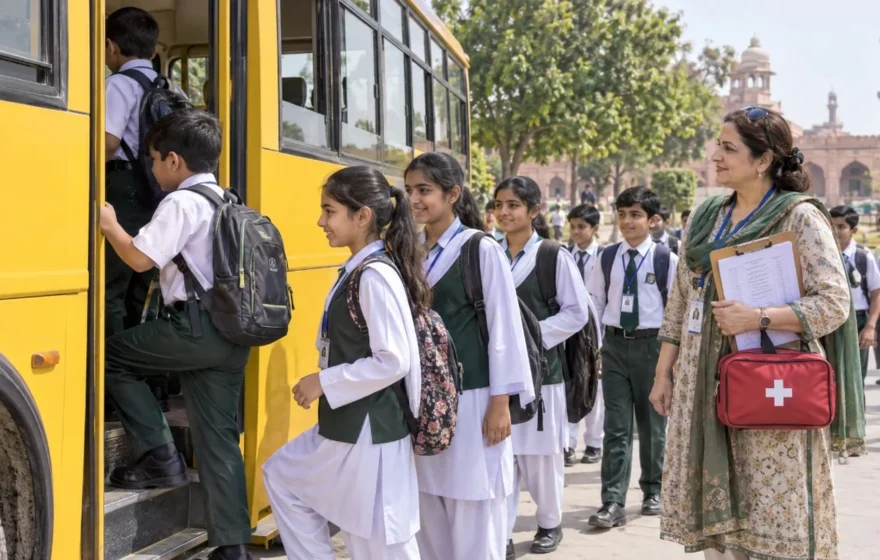
The Punjab School Education Department has issued new guidelines for outdoor trips and recreational tours run by public and private schools across the province. The rules cover almost every part of a school journey, from the choice of vehicle and the hour of travel to supervision and what children must produce when they return. The message is plain: trips should continue, but only with proper planning, the right permissions and the safety of every child put first.
The sharpest change concerns when and how children may travel. Schools will no longer be allowed to take students on highways or through hilly areas at night when the weather is bad, a restriction aimed at the riskiest journeys a school group can make. Before any tour takes place, the school must also obtain prior approval from the relevant District Education Authority. With the request, the school must hand over the tour schedule, transport details and a list of every student travelling, so the authority knows who is going, where and how.
Parents are brought into the process before the bus ever leaves the school gate. Schools must obtain written consent from parents, together with emergency contact numbers, before any child joins a trip. The requirement gives families a proper say in whether their child travels and makes sure the school can reach a parent quickly if something goes wrong.
The new guidelines do not arrive out of nowhere. Punjab has regulated school trips for years, usually tightening the rules after something went wrong. An earlier set of instructions followed a school bus accident near Kallar Kahar in 2011, in which students were killed, and those rules already demanded permission from district officers, fitness certificates for buses and identity cards for children. In December 2014, recreational and study trips were suspended altogether after the attack on the Army Public School in Peshawar. More recently, in October this year, traffic police in Murree made fire extinguishers compulsory in school vehicles and limited how many children each vehicle may carry. The latest guidelines sit in that same tradition.
Supervision and Safety Rules
At the heart of the new framework are supervision requirements that apply from the moment a group sets off until it returns. A senior teacher, or a designated group in-charge, must accompany every tour, so one adult is clearly responsible for the party. Where girls are part of the group, a senior female teacher must travel with them as well. The department has also fixed a ratio of one teacher for every fifteen students, stricter than the one teacher for every twenty students in the 2011 rules, so each teacher watches a smaller group.
Transport is another area where the rules leave little room for cutting corners. Only vehicles with valid fitness certificates and commercial permits may be used, so schools cannot hire an untested bus simply because it is cheap or free at short notice. Every student must carry a school identity card showing emergency contact numbers and blood group, so help can be summoned quickly if an accident occurs. Staff must also carry a first aid kit and keep a record of students’ medical information.
The guidelines also set out how students must behave while away. Children may not visit places that have not been approved in advance, and they may not separate from the group, two rules that prevent the confusion and risk that arise when a party scatters across an unfamiliar site. Tobacco, weapons and other dangerous items are banned completely.
Report Required After Every Trip
The rules do not end when the bus returns to school. Once a tour is over, students must submit a report, a project or a presentation about what they saw and learned, turning the journey into schoolwork rather than a day out with nothing to show for it. The requirement is a reminder that an educational tour is meant to teach, whether the destination is a historical site, a museum or a factory, and that a trip’s value lies in what children take away from it.
The department has directed that all of the instructions must be implemented strictly in both public and private schools, so no school can treat the framework as optional. That matters because many of Punjab’s schoolchildren study in private schools, and a rule covering only one sector would leave them unprotected. Enforcement will now depend on the District Education Authorities, which must check the schedules and student lists schools submit, and on head teachers, who must make sure the paperwork matches what actually happens on the road.
Taken together, the guidelines strike a careful balance. They do not ban school trips, and they should not, since a well-run visit can give children experiences no classroom can provide, from seeing history where it happened to understanding the world beyond their neighbourhood. What they do is close the gaps that have caused trouble before: travel at dangerous hours in bad weather, unchecked vehicles, groups too large for their teachers to supervise, and tours organised without anyone outside the school knowing. If schools, parents and district authorities all play their part, children can keep exploring and their families can trust they will come home safe.
