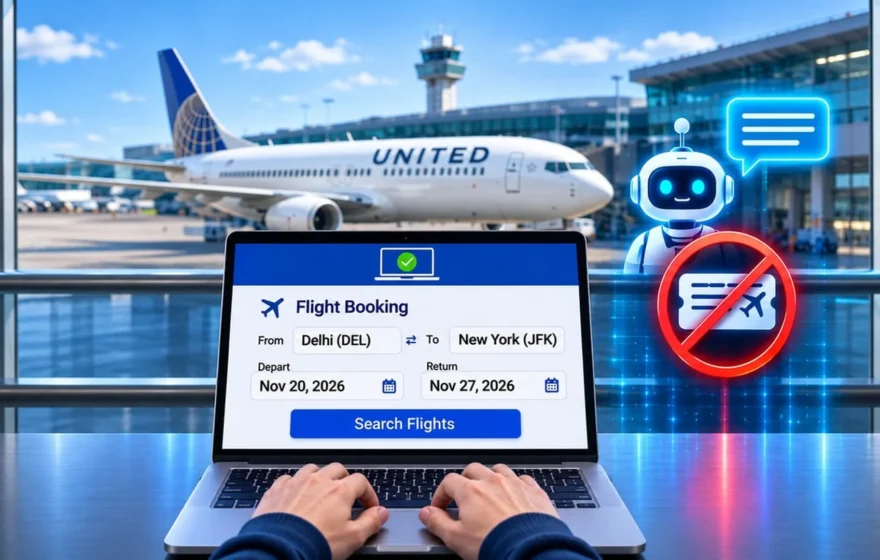
United Airlines has told third-party artificial intelligence assistants that they can no longer book flights, check passengers in, or manage customer accounts, becoming the first major American carrier to write such a ban into its rulebook. The Chicago-based airline announced the restrictions on Wednesday, November 11, and has written them into its Contract of Carriage, the document that sets out the terms every passenger agrees to when buying a ticket. From now on, an AI agent that books, changes, or services a United ticket without the airline’s permission is breaking those terms, and United can cancel the reservation without notice.
Why United Airlines Is Blocking AI Agents
United says the decision is, above all, about protecting its customers. An AI assistant that books a flight or manages a trip needs the keys to a passenger’s account: login details, payment cards, and access to a MileagePlus loyalty balance. Handing that information to a tool the airline has not checked or approved creates obvious dangers. A booking could be made by mistake, a reservation could be changed without the traveller realising, or miles could be spent on something the customer never asked for. Travellers can still use AI tools to research a journey and compare options, provided those tools do not reach into United’s website or app. What they cannot do is let an assistant log in, buy, or change anything in their name. United’s position is that an AI agent needs the airline’s authorisation as well as the traveller’s, and for now it has authorised none of them.
AI Check-In Could Violate Aviation Regulations
There is also a legal worry behind the ban, and it centres on check-in. Under American aviation security rules, a passenger checking in for a flight must personally confirm that their checked luggage contains no prohibited items, including explosives and other dangerous goods. United argues that an AI agent completing check-in automatically could skip that step altogether, leaving the airline unable to show that the passenger ever made the required acknowledgement. The carrier pointed to rules enforced by the Federal Aviation Administration and the Department of Transportation as a further reason for acting now rather than waiting for a problem to appear.
Restrictions Extend to Travel Agencies
The new policy reaches further than United’s own website and mobile app. The airline is updating its booking, ticketing, and distribution rules so that the restrictions also apply indirectly, through travel agencies and flight booking platforms. Any agency that wants to use an AI agent to service United flights will need the airline’s express written consent first, and an agency that ignores that requirement risks losing its authority to sell United tickets at all. That does not mean travellers will lose access to United flights through the services they already use. Aviation analyst Henry Harteveldt of Atmosphere Research Group told CBS News that passengers will still be able to find and book United fares through established platforms such as Google Flights, Kayak, and Hopper. The airline has also made clear that bookings made by AI agents before November 11 will not be cancelled simply because an agent made them.
Airlines Could Also Face Higher Costs From AI Searches
There may be a commercial calculation behind the ban as well as a safety one. Harteveldt told CBS News that United’s decision could partly reflect the cost of letting AI assistants loose on its systems. Every flight search an airline answers has to be priced in real time, and an AI agent does not search once and stop. Given a vague instruction such as finding the best way to spend a week away, an assistant can sweep through date ranges, airports, connections, and fare classes, generating thousands of queries for a single trip that may never be booked. The strain is not hypothetical. In June 2026, a coding agent pointed at Etihad Airways’ website returned more than 881,000 fare combinations for one trip, a workload that would take a human traveller years to repeat and that cost the airline real money to answer.
United Will Review AI Restrictions as Technology Develops
United says the ban is not the last word. The airline plans to update its Digital Trust Center to explain the new restrictions and tell passengers how to protect their accounts. It also says it wants to build standardised, secure integrations with third-party AI assistants in time, but that no such partnership exists yet. The wider industry is not speaking with one voice. JetBlue president Marty St. George told the Skift Commerce Summit in New York that airlines should adapt if travellers prefer booking through AI tools. Southwest, meanwhile, introduced a ChatGPT plugin in October that lets travellers discover destinations and shop for flights through the AI platform. Travellers themselves remain cautious. An Expedia Group survey of more than 5,700 adults published in April 2026 found that only 8 percent were willing to let AI complete a booking, while 68 percent still preferred established travel brands. United is betting that, for now, most of its customers would rather keep the final click in their own hands.
