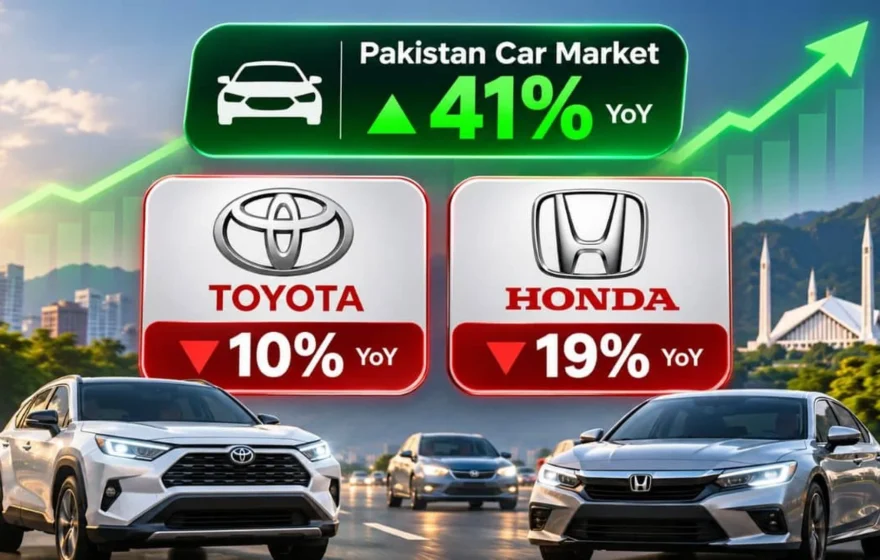
Pakistan’s car market delivered one of its strongest months of the current fiscal year in October 2026, yet the headline growth hid a sharp split between the country’s three big Japanese assemblers. Overall sales jumped 41% on the same month last year, but while Suzuki’s showrooms were busier than they have been in months, Toyota and Honda both sold fewer cars than a year ago.
According to the latest data from the Pakistan Automotive Manufacturers Association (PAMA), reported by Topline Securities, total car sales reached 24,418 units in October, up 41% year on year and 62% higher than September. AHL Research put cumulative four-month sales at 74,900 units, up 37%. Passenger cars alone accounted for 21,635 of October’s sales, against 13,513 in October 2025, a rise of about 60%.
Toyota Sales Fall 10%
Indus Motor Company, which assembles Toyota vehicles in Pakistan, sold 4,078 units during October, down 10% on a year ago and 2% lower than September. Combined sales of the Toyota Corolla, Yaris and Corolla Cross fell 7% year on year to 3,496 units, while Fortuner and IMV sales declined 27% to 577 units. The fall is striking because Toyota had been the one bright spot only a month earlier, when Indus Motor was the only assembler to record growth, with sales up 31% year on year to 4,142 units. October has reversed that position entirely.
Honda Records Bigger Decline
Honda Atlas Cars recorded an even sharper fall, selling 2,101 units in October, down 19% year on year and 1% lower than September. Sales of the Honda City and Civic stood at 1,933 units, down 14% on a year ago and 4% on the month. The smaller end of Honda’s range fared worst of all, with combined BR-V and HR-V sales collapsing by 53% year on year to just 168 units. September sales of 2,128 units were already down 8% year on year.
Buyers are clearly returning to showrooms, but they are not, for the moment, choosing Honda in the numbers they once did. The collapse in BR-V and HR-V volumes suggests buyers in the crossover space are looking elsewhere. Honda will need a response if it is not to lose further ground.
Suzuki Powers the Rebound
Almost all of October’s growth came from one company. Pak Suzuki Motor Company sold 15,921 vehicles during the month, up 115% year on year and nearly three and a third times its September figure. The Alto led the surge with record monthly sales of 11,363 units, up about 130% on the 4,931 sold in October 2025, while the Swift sold 3,214 units, up nearly 175% on the 1,170 sold a year earlier. Between them, the two small cars accounted for more than half of all the cars sold in the country during October.
The scale of Suzuki’s turnaround is best understood against September, when the company had its worst month of the quarter, selling only 4,862 vehicles, down 46% year on year, with Alto sales falling 37% to 3,354 units. October’s rebound therefore looks less like a sudden boom and more like demand that had been held back finally coming through, with Alto sales setting a monthly record.
A Market Recovering in Fits and Starts
The wider picture remains one of recovery, but an uneven one. Passenger car sales for the first quarter of the fiscal year, from July to September, reached 41,872 units, up 42.8% on the same quarter last year, and Business Recorder reported that car sales for the first four months of the fiscal year rose 48% to 63,418 units. September alone, however, had been a poor month, with passenger car sales falling to 10,939 units, down 9.8% year on year, as uncertainty over the new auto policy and the tax treatment of hybrid vehicles kept buyers waiting. That uncertainty may now be easing: last week the Prime Minister approved the final draft of the Auto Policy for 2026 to 2031, and the related industry policy is now set to go before the Federal Cabinet.
One caution is that PAMA’s figures cover only its reporting members. Several significant brands, including Kia, Changan, BYD and MG, do not report their sales to the association, and market estimates suggest those players sold roughly 20,000 vehicles in the first quarter alone, so the real size of the market is larger than the official tally shows. PAMA has linked the improvement in demand to easing inflation, and analysts expect the new policy and lower financing rates to support further growth.
October’s figures leave the industry with a clear story and an open question. Demand is plainly returning, the policy fog that held back September’s sales appears to be lifting, and the small, affordable end of the market is booming. But the recovery is being carried almost entirely by Suzuki, while Toyota and Honda, the two other pillars of the industry, are going backwards. If the new auto policy brings the stability manufacturers have been waiting for, the next few months will show whether Toyota and Honda can win back buyers or whether Suzuki’s dominance becomes the settled shape of Pakistan’s car market.
