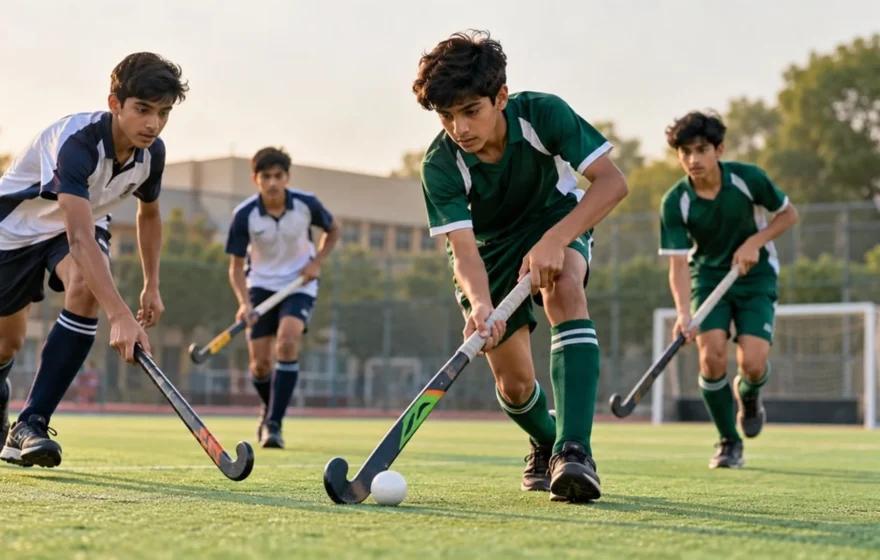
Pakistan has launched a Schools Hockey League, an attempt to rebuild the country’s national game from the classroom upwards and find the players who might one day restore its place among the world’s best. It was inaugurated with an exhibition match at the Naseer Bunda Hockey Stadium in Islamabad, where Islamabad Model College for Girls, Tarlai, beat Islamabad Model College for Girls, G-6/1-4, by two goals to nil.
Pakistan Hockey Federation president Mohyuddin Wani, who also serves as secretary of Inter-Provincial Coordination, attended alongside Dr Ehtasham Anwar and Herman Kruis, the head coach of the national team. Their presence underlined the point: this is not a one-off school tournament but the start of a pathway into the national setup.
The league is being launched simultaneously in Islamabad, all four provinces, Azad Jammu and Kashmir and Gilgit-Baltistan, with competitions for both boys and girls. That spread matters, because for years Pakistan’s hockey talent has come from a narrow base. The game’s own authorities have put the senior player pool at only around thirty to thirty-five players, a strikingly small number for a country of more than 240 million people.
Competitions at tehsil, district and divisional level will begin on November 15, followed by the provincial rounds in January 2027 and the national round in February 2027. The tiered structure is designed to give players from small towns the same route to the top as those from the big cities.
Members of the top three teams in both the boys’ and girls’ categories will receive monthly stipends for a full year. Players from the first-place teams will receive Rs. 10,000 a month, while those finishing second and third will receive Rs. 7,500 and Rs. 5,000 respectively. The overall winning team will also be rewarded with a foreign tour.
The federation will also select one hundred boys and one hundred girls each year for summer training camps offering professional coaching, fitness training and academic support, and will recognise principals and sports teachers who contribute to the league’s success with special awards.
The programme aims to identify young talent for the national teams while encouraging fitness, discipline, teamwork and healthy lifestyles among students. School sport in Pakistan has thinned out over the years as academic pressure, a shortage of grounds and the pull of cricket have squeezed hockey out of the daily routine of most children.
Pakistan remains the most successful country in the history of the Hockey World Cup, with four titles won in 1971, 1978, 1982 and 1994, and has won three Olympic gold medals, in 1960, 1968 and 1984. But the fourth World Cup title, won more than three decades ago, remains the last. Pakistan failed to qualify for the World Cup in 2014, the first time it had ever missed the tournament, and again in 2023. The national team last appeared at the Olympic Games in London in 2012, finishing seventh, and has failed to qualify for the three Games since.
Pakistan did return to the World Cup this year after an eight-year absence, but the campaign ended in the group stage, with a defeat against England, a draw with Wales and a 5-3 loss to India. The players have been frank that the realistic first target is a return to the world’s top eight.
Pakistan learnt its hockey on grass, where individual skill, close control and dribbling made it the most feared team in the world. As the international game moved to artificial turf and became faster and more physical, Pakistan was left behind, and coaching, funding and the domestic structure never caught up. At times the federation’s financial crises became so severe that officials warned the national team might not be able to keep playing internationally at all.
Recent months have brought signs of a more organised response. The federation has begun distributing hockey sticks to schools, and in October it formally launched the Pakistan Hockey League, a professional competition developed with a private marketing partner to bring in sponsors and give local players elite exposure. Sufyan Khan, the penalty-corner specialist named the International Hockey Federation’s Rising Star in 2024, has said the goal now is to qualify for the Los Angeles Olympics in 2028.
The Schools Hockey League is the foundation layer of that plan. A professional league can showcase talent, but it cannot create it, and a national team cannot be rebuilt from a pool of thirty-odd players. The stipends, camps and foreign tour are designed to make hockey a serious option for a schoolchild, rather than a hobby that ends when examinations begin.
Whether it works will depend on follow-through: whether the tehsil rounds actually happen in November, whether the stipends are paid on time, and whether the players picked for the summer camps are the best the competition finds. The inclusion of girls on equal terms is a real step forward for a sport whose women’s wing has long been under-resourced. If the structure holds and the money follows the promises, Pakistan may finally have a way of finding its next generation of hockey players before the game fades further from the country’s schools.
