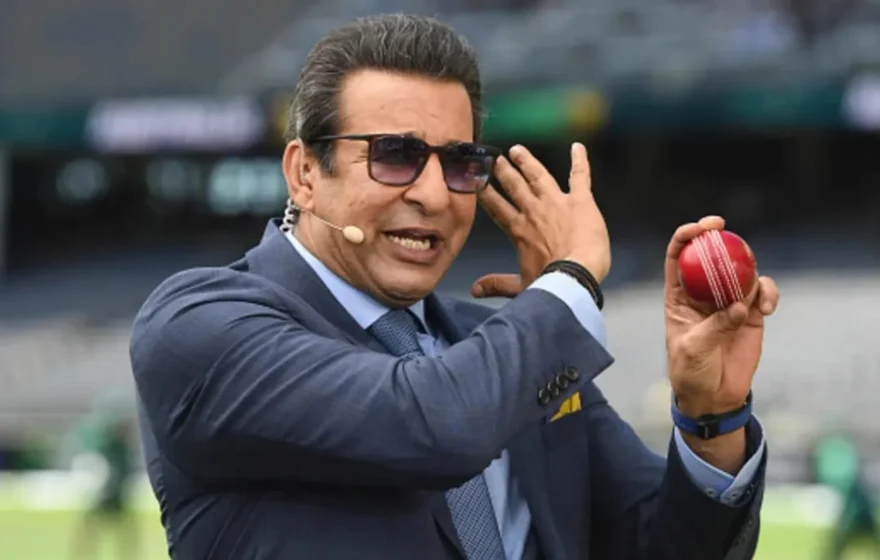
Nearly eight years after Australian cricket was shaken by its ball-tampering scandal, the controversy has returned to the centre of the game, and this time one of Pakistan’s greatest fast bowlers has joined the debate. Wasim Akram has shared his views on the 2018 episode after Usman Khawaja claimed that the whole Australian team knew sandpaper was being used during the Cape Town Test against South Africa.
The row flared up again last Saturday, when Khawaja, who retired from international cricket earlier this year after playing 88 Tests, made the claim in an interview with The Sydney Morning Herald ahead of the release of his autobiography, Sabr, next week. His words reopened a wound that Australian cricket has spent years trying to close. “It was all of us. Not the batters, not the bowlers, not the staff. All of us,” Khawaja said, adding that his book also includes a chapter on the scandal.
The remarks set off a fresh debate across Australian cricket, and the response from the current leadership was swift and firm. Pat Cummins, Australia’s Test captain, rejected the allegation during an hour-long press conference on Friday, describing Khawaja’s claims as “100 per cent wrong” and “complete and utter nonsense”. Cummins insisted that he had no knowledge of the ball-tampering plan. “When he says we all knew, if by that he means that we knew sandpaper was going out on the field, he’s 100 per cent wrong. I’ve said that consistently for the last eight years. I did not know that was happening,” he said.
It was against that heated background that Akram spoke. Reacting to the controversy in a video message on Saturday, the former Pakistan captain suggested that the Australian players might not have been aware of the plan at the time it was carried out. Akram, who described Cummins as a close friend, a great cricketer and one of the best leaders in world cricket, said he respected the Australian captain’s leadership.
“So probably the team didn’t know at the time what was happening, in my opinion. It’s my opinion. It can be right or wrong,” Akram said, offering his view with the caution of a man who knows that he was not in that dressing room and cannot settle the question for anyone else. He posted the video on social media with the caption “My two cents on the sandpaper issue”, a modest billing for an opinion that carried the weight of one of the finest fast bowlers the game has known.
Akram did, however, draw a line that only a bowler of his experience could draw. He pointed out that the marks left by sandpaper on a cricket ball are noticeably different from those caused by normal ball maintenance. Players regularly shine one side of the ball through an innings, and a one-bounce throw on a dry surface can leave scratches of its own, but the sandpaper scratch is another thing entirely. “But the sandpaper scratch is totally different from the one-bounce scratch,” he explained, adding that fans could see the difference by rubbing sandpaper against a relatively new cricket ball. He was careful to say that he was not taking sides, praising Australian cricketers for their straightforward nature, toughness and honesty, while noting that the renewed debate had once again put Australia under pressure nearly eight years after the original scandal.
The reason the story refuses to fade lies in what happened at Newlands in March 2018. On the third day of the third Test against South Africa, television cameras caught Australia’s Cameron Bancroft using sandpaper to rough up one side of the ball. The fallout was swift and severe. Captain Steve Smith and vice-captain David Warner were banned from cricket for twelve months, Bancroft was suspended for nine months, and head coach Darren Lehmann resigned. The episode became a byword for the line between gamesmanship and cheating.
That history is why Khawaja’s claim has landed so heavily. If the whole team knew, as he says, then the scandal was not the work of a small group but a shared secret, and the punishments handed out in 2018 would look incomplete. If Cummins is right, and only a few players knew, then the original account stands. There is no easy way to settle which version is true eight years on, and that is exactly why the debate has flared again.
Akram’s contribution sits between those two positions. He has not claimed to know what happened in the Australian dressing room, and he has backed Cummins as a leader and a friend. What he has done is explain, from a bowler’s knowledge, why the act itself was so serious: sandpaper does not leave the kind of mark that ordinary play leaves, and those who handle a ball for a living can tell the difference. His view does not resolve the argument, but it reminds everyone why it matters, and why a scandal from 2018 can still divide a dressing room in 2026.
